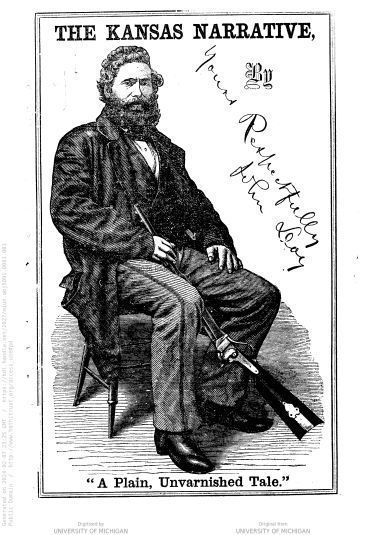
Description
"The Kansas Narrative of John Doy of Lawrence, Kansas - A Plain, Unvarnished Tale" - - (Researcher's note: Due to the numerous references to Platte County, only selected excerpts have been indexed.)
Chapter XVII An Attempt to Break Jail – A Hard Case, p. 101-103 - - About noon on the 4th of July, a tall, fine-looking, dark-colored man was brought into the lock-up. After the doors were closed, the signal was given by a punch with the broom-handle, and I went to the hole in the floor. The new arrival looked up and said that he knew me, having seen me when we were brought in to Weston, and so brutally treated—he was there with his master—and again at the hotel.
I asked why he was put into jail, and he told me that having the day - 4th of July - to himself, as customary, he had engaged to cook for the trip on a steamboat that was to carry an excursion party to Belmont, a town in Kansas, about six miles up the river.
He was busy at his stove, when Wright, the trader, came on board and ordered him to put on his coat, which having done, he was handcuffed and brought to the jail, but could not learn why. He said, moreover, that he had a wife and three children; that he hired his time of his master, and by working hard, had saved nearly $1100 dollars, which his master held for him, as well as a valuable watch; that he hoped by and by to get his freedom.
About 5 o’clock in the afternoon, Wright came in and told the poor man he had bought him, at the same time ordering him to strip, which he did, when Wright made the usual examination, and took note of all his marks, etc. The poor fellow asked Wright to let him see his wife and children, and to give him a chance to find a friend to buy him, both of which the trader promised should be attended to on the morrow, and then left.
After Wright had gone, the poor fellow, full of faith in his promises, became rather elated at the prospect of the future. He felt sure that he could find a friend who, with something more than his own $1100 dollars, could buy him, while he could easily work out the balance, and when he was once free and had all his earnings to himself, he would soon free his wife and children, and they would live so happily together. He was quite joyous while telling his fellow-prisoners how nicely he should manage.
Night came on, and we all went to bed. About 1 o’clock I was waked up by the creaking of the ponderous door beneath, and the clanking of chains. I jumped out of bed and put my ear to the opening to hear what was the matter.
Wright was there, and I heard him tell the poor fellow who had indulged in such pleasing anticipations and hopes, to “hush up” and put out his wrists. Never did I hear more agonized tones, or more piteous pleadings. When he found that there was no chance of being allowed to buy himself, he only asked to be permitted to see his wife and children just once more.
“Oh, master Wright! You promised me! You promised me!” But the poor man was cursed and told to “Hush up,” and marched in chains to the steamboat bound South.
I was afterwards informed that this matter had been arranged between Wright and the master, who had sold his slave rather under price on condition that he should be taken South without delay, whereby he could pocket the poor man’s earnings, which he had in his hands; and that this was by no means an uncommon case.
(Researcher's note: In January 1859 abolitionist John Doy agreed to take a group of 13 African American Kansans north to Iowa on one leg of the Underground Railroad. Dr. Doy and his group were then captured 12 miles north of Lawrence by a group of Missouri slave hunters which included Weston Mayor Benjamin Wood. Doy and his 21 year old son, Charles, were transported back to Weston, Missouri and placed in jail. He was later transferred to the Platte City jail and then to the St. Joseph, Missouri, jail. Along the way they were displayed in the streets and hounded, beaten and nearly hanged. He was charged with a federal offense of "slave stealing” and awaited a sentence of hard labor or death. In jail after a second trial that found him guilty, ten men went from Lawrence to St. Joseph in July 1859 and broke Doy out of jail. He returned to Kansas and later wrote a 137-page narrative describing in detail his experiences in Platte County, Missouri.)Date(s) of Creation
1/1/1860