Description
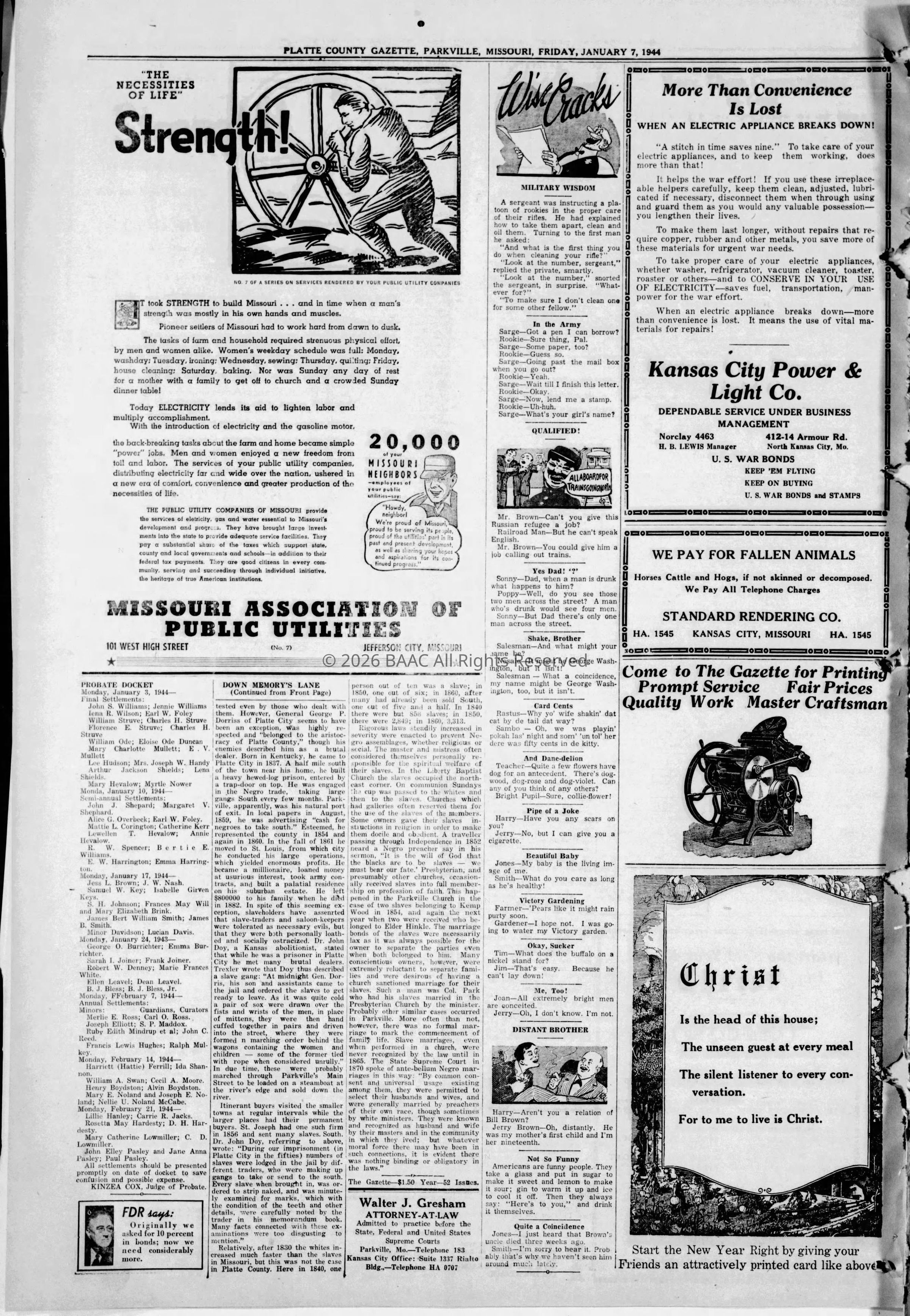
Down Memory's Lane by Dr. Donald D. Parker - - (excerpted from longer article) - - "Slavery Days in Parkville and Vicinity” - - Rigorous laws steadily increased in severity were enacted to prevent Negro assemblages, whether religious or social. The master and mistress often considered themselves personally responsible for the spiritual welfare of their slaves. In the Liberty Baptist Church, the slaves occupied the northeast corner. On communion Sundays the cup was passed to the whites and then to the slaves. Churches which had galleries often reserved them for the use of the slaves of the members. Some owners gave their slaves instructions in religion in order to make them docile and obedient. A traveler passing through Independence in 1852 heard a Negro preacher say in his sermon, “It is the will of God that the blacks are to be slaves - we must bear our fate.” Presbyterian, and presumably other churches, occasionally received slaves into full membership on profession of faith. This happened in the Parkville Church in the case of two slaves belonging to Kemp Wood in 1854, and again the next year when two were received who belonged to Elder (Levi) Hinkle. The marriage bonds of the slaves were necessarily lax as it was always possible for the owner to separate the parties even when both belonged to him. Many conscientious owners, however, were extremely reluctant to separate families and were desirous of having a church sanctioned marriage for their slaves. Such a man was Col. Park who had his slaves married in the Presbyterian Church by the minister. Probably other similar cases occurred in Parkville. More often than not, however, there was no formal marriage to mark the commencement of family life. Slave marriages, even when performed in a church, were never recognized by the law until in 1865. The State Supreme Court in 1870 spoke of ante-bellum Negro marriages in this way: “By common consent and universal usage existing among them, they were permitted to select their husbands and wives, and were generally married by preachers of their own race, though sometimes by white ministers. They were known and recognized as husband and wife by their masters and in the community in which they lived; but whatever moral force there may have been in such connections, it is evident there was nothing binding or obligatory in the laws.”Date(s) of Creation
1/7/1944