Description
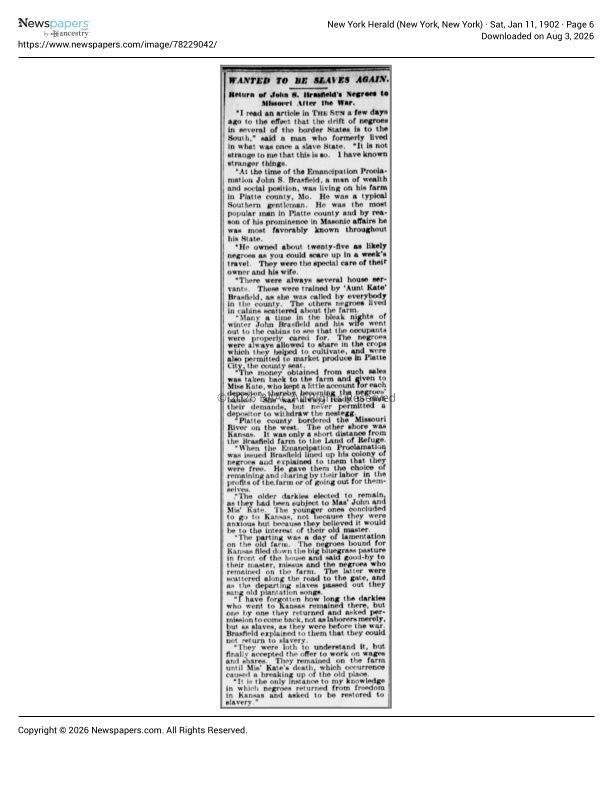
Wanted to Be Slaves Again - Return of John S. Brasfield's Negroes to Missouri After the War. - - “‘I read an article in the Sun a few days ago to the effect that the drift of negroes in several of the border States is to the South,” said a man who formerly lived in what was once a slave State. “It is not strange to me that this is so. I have known stranger things.
At the time of the Emancipation Proclamation John S. Brasfield, a man of wealth and social position, was living on his farm in Platte County, Missouri. He was a typical Southern gentleman. He was the most popular man in Platte County and by reason of his prominence in Masonic affairs he was most favorably known throughout his State.
He owned about 25 as likely negroes as you could scare up in a week’s travel. They were the special care of their owner and his wife.
There were always several house servants. These were trained by Aunt Kate Brasfield, as she was called by everybody in the county. The other negroes lived in cabins scattered about the farm.
Many a time in the bleak nights of winter John Brasfield and his wife went out to the cabins to see that the occupants were properly cared for. The negroes were always allowed to share in the crops which they helped to cultivate and were also permitted to market produce in Platte City, the county seat.
The money obtained from such sales was taken back to the farm and given to Miss Kate, who kept a little account for each depositor, thereby becoming the negroes’ banker. She was always ready to cash their demands, but never permitted a depositor to withdraw the nest egg.
Platte County bordered the Missouri river on the west. The other shore was Kansas. It was only a short distance from the Brasfield farm to the Land of Refuge.
When the Emancipation Proclamation was issued Brasfield lined up his colony of negroes and explained to them that they were free. He gave them the choice of remaining and sharing by their labor in the profits of the farm or of going out for themselves.
The older darkles elected to remain, as they had been, subject to Mas’ John and Mis’ Kate. The younger ones concluded to go to Kansas, not because they were anxious, but because they believed it would be to the interest of their old master.
The parting was a day of lamentation on the old farm. The negroes bound for Kansas filed down the big bluegrass pasture in front of the house and said good-bye to their master, missus and the negroes who remained on the farm. The latter were scattered along the road to the gate, and as the departing slaves passed out, they sang old plantation songs.
I have forgotten how long the darkies who went to Kansas remained there, but one by one they returned and asked permission to come back, not as laborers merely, but as slaves, as they were before the war. Brasfield explained to them that they could not return to slavery.
They were loath to understand it but finally accepted the offer to work on wages and shares. They remained on the farm until Mis’ Kate’s death, which occurrence caused a breaking up of the old place.
It is the only instance to my knowledge in which negroes returned from freedom in Kansas and asked to be restored to slavery."
(Researcher's note: On December 11, 1851, John S. Brasfield married his relative, Kate Brasfield. She was born in Woodford Co., Kentucky, October 15, 1826, and died March 30, 1890.)Date(s) of Creation
1/19/1902