Description
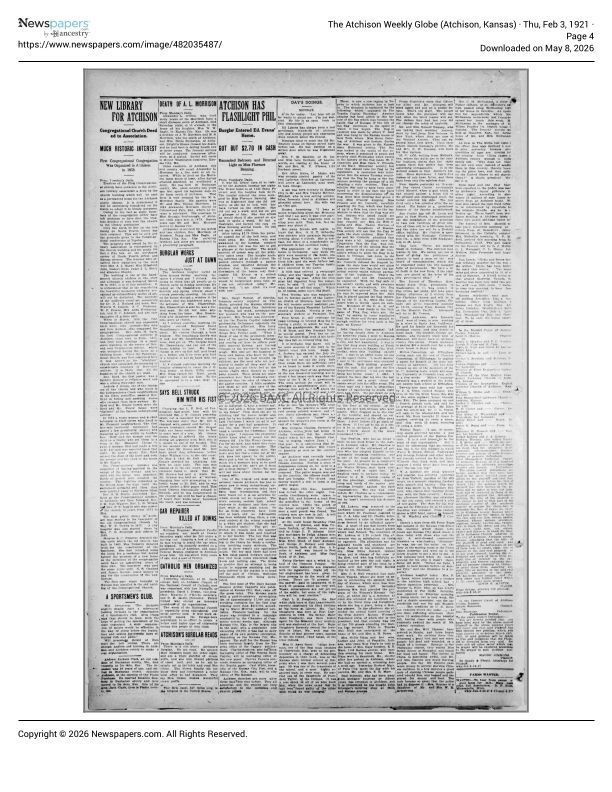
When in March, 1858, the first Congregational church was organized there were 9 persons – 5 men and 4 women—who composed the congregation. Rev. John H. Byrd, the first Congregational minister in Atchison, came here in June, 1857, and first held meetings in a small stone building on the corner of Second and Commercial Streets, which was occupied during the week as a banking house. When the Congregational church was first organized here it was known as the “abolition” church and signalized the Incoming of considerable numbers of Free-State settlers. It is likely that all the founders of the church are dead. Rev. Byrd, the first pastor, was a faithful pioneer in religious work and was a strong Free-State man. Andrew J. Evans, one of the founders of the church and who lived in the Independence Creek neighborhood at the Eden post office, assisted Rev. Byrd in hiding and assisting slaves who escaped from their owners. Mr. Byrd and Mr. Evans’ homes were the “stations” of the famous Underground Railway. In 1860 a negro woman and a child belonged to Duff Green who lived in Mt. Pleasant neighborhood. The first free-state territorial legislature had passed a law prohibiting slavery and declaring all slaves within its borders free. Duff sold the woman and the child to a trader who put them in a room in the Massasoit House to await a steamer that had made a trip to St. Joe (St. Joseph) and was expected back that night. By some means Rev. Byrd opened the door of the hotel and took the woman and her child to the home of Mr. Evans. The Congregational minister was suspected of having assisted in the escape of the slave woman and her child and his house was searched. Bands of armed men scoured the country. The fugitives remained at the Evans home for days until the excitement subsided and then they were spirited away to Northern Ohio.Date(s) of Creation
2/3/1921