Description
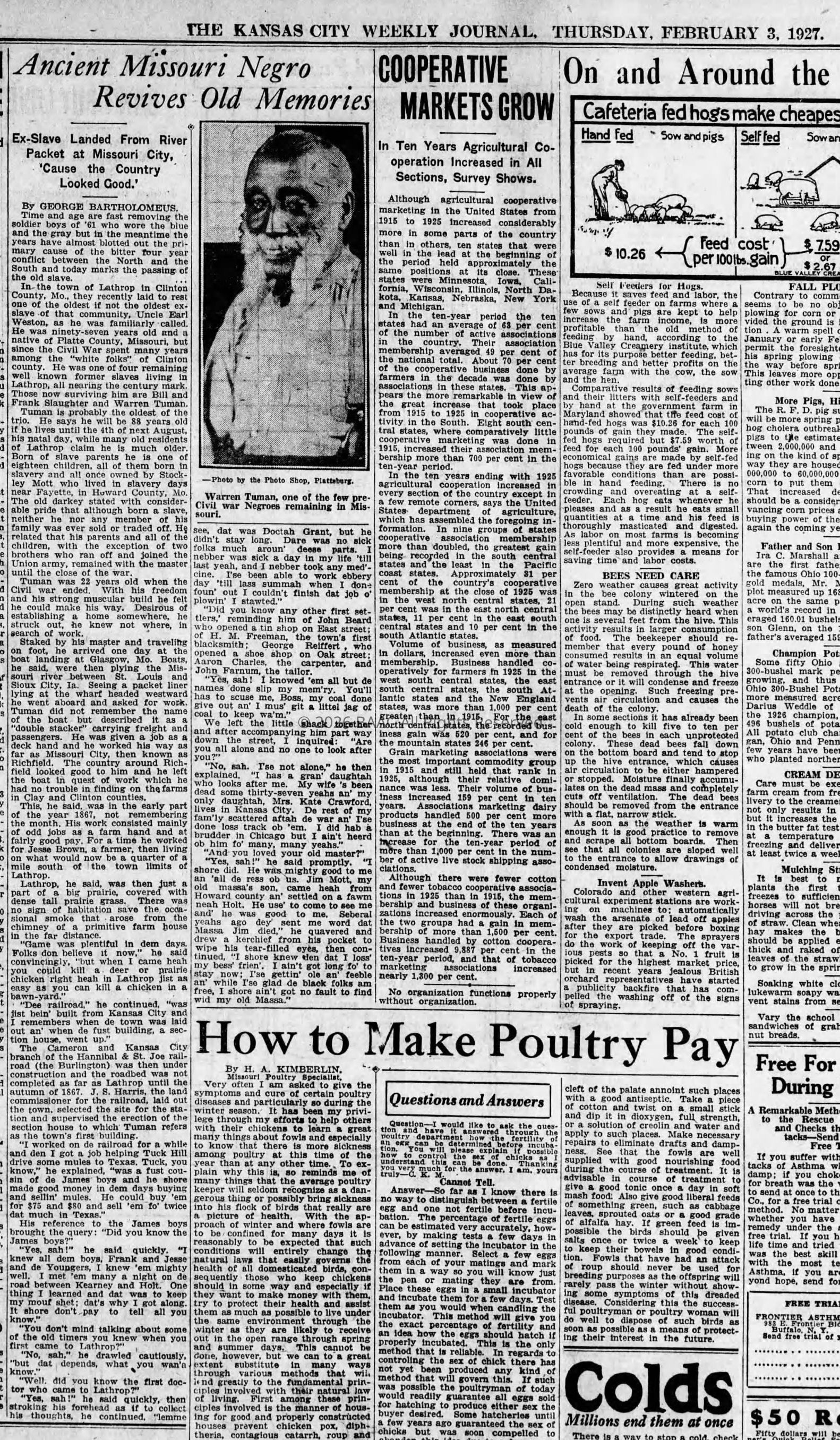
“Ancient Missouri Negro Revives Old Memories – Ex-Slave Landed from River Packet at Missouri City, ‘Cause the County Looked Good’ – by George Bartholomeus - - Time and age are fast removing the soldier boys of '61 who wore the blue and the gray but in the meantime the years have almost blotted out the primary cause of the bitter 4 year conflict between the North and the South and today marks the passing of the old slave. In the town of Lathrop in Clinton County, Mo., they recently laid to rest one of the oldest if not the oldest ex-slave of that community, Uncle Earl Weston, as he was familiarly called. He was 97 years old (born ~1830) and a native of Platte County, Missouri, but since the Civil War spent many years among the “white folks" of Clinton County. He was one of four remaining well known former slaves living In Lathrop, all nearing the century mark. Those now surviving him are Bill Slaughter, Frank Slaughter and Warren Tuman. Tuman is probably the oldest of the trio. He says he will be 88 years old if he lives until the 4th of next August, his natal day, while many old residents of Lathrop claim he is much older. Born of slave parents he is one of 18 children, all of them born in slavery and all once owned by Stockley Mott who lived in slavery days near Fayette in Howard County, Missouri. The old darkey stated with considerable pride that although born a slave, neither he nor any member of his family was ever sold or traded off. He related that his parents and all of the children, with the exception of two brothers who ran off and joined the Union army, remained with the master until the close of the war. Tuman was 22 years old when the Civil War ended. With his freedom and his strong muscular build he felt he could make his way. Desirous of establishing a home somewhere, he struck out, he knew not where, in search of work. Staked by his master and traveling on foot, he arrived one day at the boat landing at Glasgow, Missouri. Boats, he said, were then plying the Missouri river between St. Louis and Sioux City, Iowa. Seeing a packet liner lying at the wharf headed westward he went aboard and asked for work. Tuman did not remember the name of the boat but described it as a "double stacker" carrying freight and passengers. He was given a job as a deck hand and he worked his way as far as Missouri City, then known as Richfield. The country around Richfield looked good to him and he left the boat in quest of work which he had no trouble in finding on the farms in Clay and Clinton counties. This, he said, was in the early part of the year 1867, not remembering the month. His work consisted mainly of odd jobs as a farm hand and at fairly good pay. For a time he worked for Jesse Brown, a farmer, then living on what would now be a quarter of a mile south of the town limits of Lathrop. Lathrop, he said, was then just a part of a big prairie, covered with dense tall prairie grass. There was no sign of habitation save the occasional smoke that arose from the chimney of a primitive farm house in the far distance. "Game was plentiful in dem days. Folks don believe it now," he said convincingly, "but when I came heah you could kill a deer or prairie chicken right heah in Lathrop jist as easy as you can kill a chicken in a bawn-yard." “Dee railroad," he continued, "was jist bein' built from Kansas City and I remembers when de town was laid out an' when de fust building, a section house, went up." The Cameron and Kansas City branch of the Hannibal & St. Joe rail road (the Burlington) was then under construction and the roadbed was not completed as far as Lathrop until the autumn of 1867. J. S. Harris, the land commissioner for the railroad, laid out the town, selected the site for the station and supervised the erection of the section house to which Tuman refers as the town's first building. "I worked on de railroad for a while and den I got a job helping Tuck Hill drive some mules to Texas. Tuck, you know," he explained, “was a fust cousin of de James boys and he shore made good money in dem days buying and sellin’ mules. He could buy 'em for $75 and $80 and sell 'em fo' twice dat much in Texas." His reference to the James boys brought the query: "Did you know the James boys?" "Yes, sah!" he said quickly. “I knew all dem boys, Frank and Jesse and de Youngers, I knew 'em mighty well. I met 'em many a night on de road between Kearney and Holt. One thing I learned and dat was to keep my mouf shet; dat's why I got along. It shore don’t pay to tell all you know." "You don't mind talking about some of the old timers you knew when you first came to Lathrop?" "No, sah," he drawled cautiously, "but dat depends, what you wan’a know.” "Well, did you know the first doctor who came to Lathrop?" “Yes, sah!" he said quickly, then stroking his forehead as if to collect his thoughts, he continued, "lemme see, dat was Doctah Grant, but he didn't stay long. Dare was no sick folks much aroun' deese parts. I nebber was sick a day in my life ’till last yeah, and I nebber took any medicine. I'se been able to work ebbery day ’till lass summah when I don foun’ out I couldn’t finish dat job o’ plowin' I stawted." "Did you know any other first settlers,’ reminding him of John Beard who opened a tin shop on East Street; of H. M. Freeman, the town’s first blacksmith; George Reilffert, who opened a shoe shop on Oak Street; Aaron Charles, the carpenter, and John Farnum, the tailor. "Yes, sah! I knowed ’em all but de names done slip my mem’ry. You'll has to scuse me. Boss, my coal done give out an' I mus’ git a littel jag of coal to keep wa’m.” We left the little shack together and after accompanying him part way down the street, I Inquired: "Are you all alone and no one to look after you?” "No, sah. I’se not alone," he then explained. "I has a gran' daughtah who looks after me. My wife's been dead some 37 yeahs an' my only daughtah, Mrs. Kate Crawford, lives In Kansas City. De rest of my fam'ly scattered aftah de war an' I’se done loss track ob ’em. I did hab a brudder in Chicago but I ain't heerd ob him fo' many, many yeahs.” "And you loved your old master?" "Yes, sah I" he said promptly. "I shore did. He was mighty to me an 'all de ress ob us. Jim Mott, my old massa's son, came heah from Howard County an' settled on a fawm neah Holt. He use’ to come to see me and' he was good to me. Seberal yeahs ago dey sent me word dat Massa Jim died," he quavered and drew a kerchief from his pocket to wipe his tear-filled eyes, then continued. "I shore knew den dat I loss' my bess’ frien.’ I ain't got long fo' to stay now; I'se gettin' ole an' feeble; an' while I’se glad de black folks am । free, I shore ain’t got no fault to find wid my old Massa.”Date(s) of Creation
2/3/1927