Description
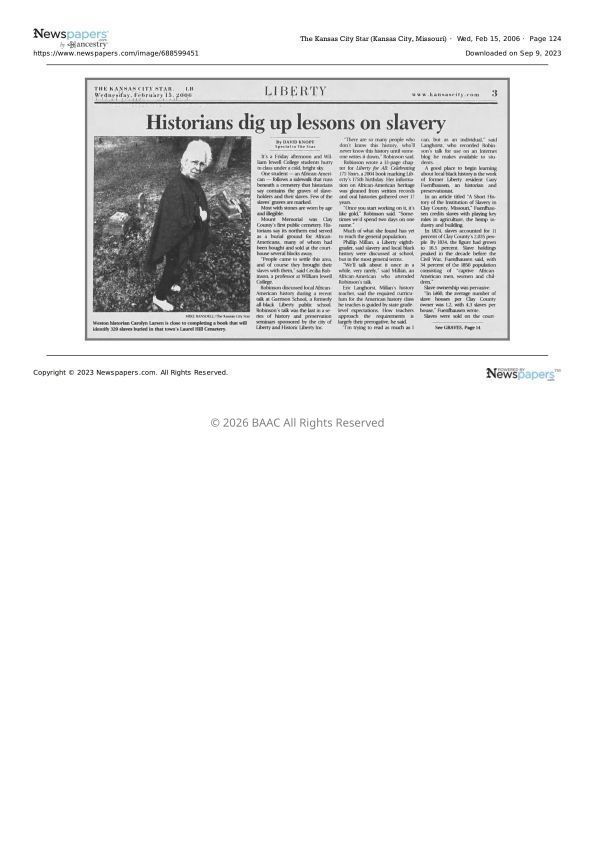
"Historians dig up lessons on slavery" - - (excerpt from longer article) - - Weston historian Carolyn Larsen is close to completing a book that will identify 320 slaves buried in that town's Laurel Hill Cemetery. Although some graves are marked, most are not, Larsen said. Her research of court records and other documents will help identify who's buried there.
“Before the Civil War, roughly a third to a half of Weston was black," said Larsen, who estimates that as many as 700 slaves were employed in hemp production, agriculture, or the river trade.
“That (labor) was very intensive here and they needed all the slaves they could get," she said.
Not all African-Americans buried in Laurel Hill were local. Larsen found a number were transported to Weston from elsewhere in Platte County.
Platte County Historical Society researcher Laverne Taulbee said Carroll Township's 1850 population of 2,777 people included 384 slaves. Carroll Township included Platte City, the county seat.
Platte County volunteers are gathering African Americans history, but little is organized - and almost nothing written.
Searching documents, Taulbee found a story attributed to Bill Dresser, a Leavenworth Times employee who went door-to-door selling newspaper subscriptions in the 1940s and 1950s.
Dresser told customers - including Taulbee's family - about a tavern whose basement once served as a “half way house” between Platte City and Weston. Slave owners, Dresser said, would chain slaves, either newly purchased or about to be sold, in a basement area called “the cave." The idea was to keep them from escaping.
The story - and others passed on verbally - await more thorough historical study. Taulbee, Larsen and Robinson agree that time is of the essence.
“I think it would be wonderful if our children could learn the history we're discussing, both the African-American children and white children," Robinson said.Date(s) of Creation
2/15/2006