Description
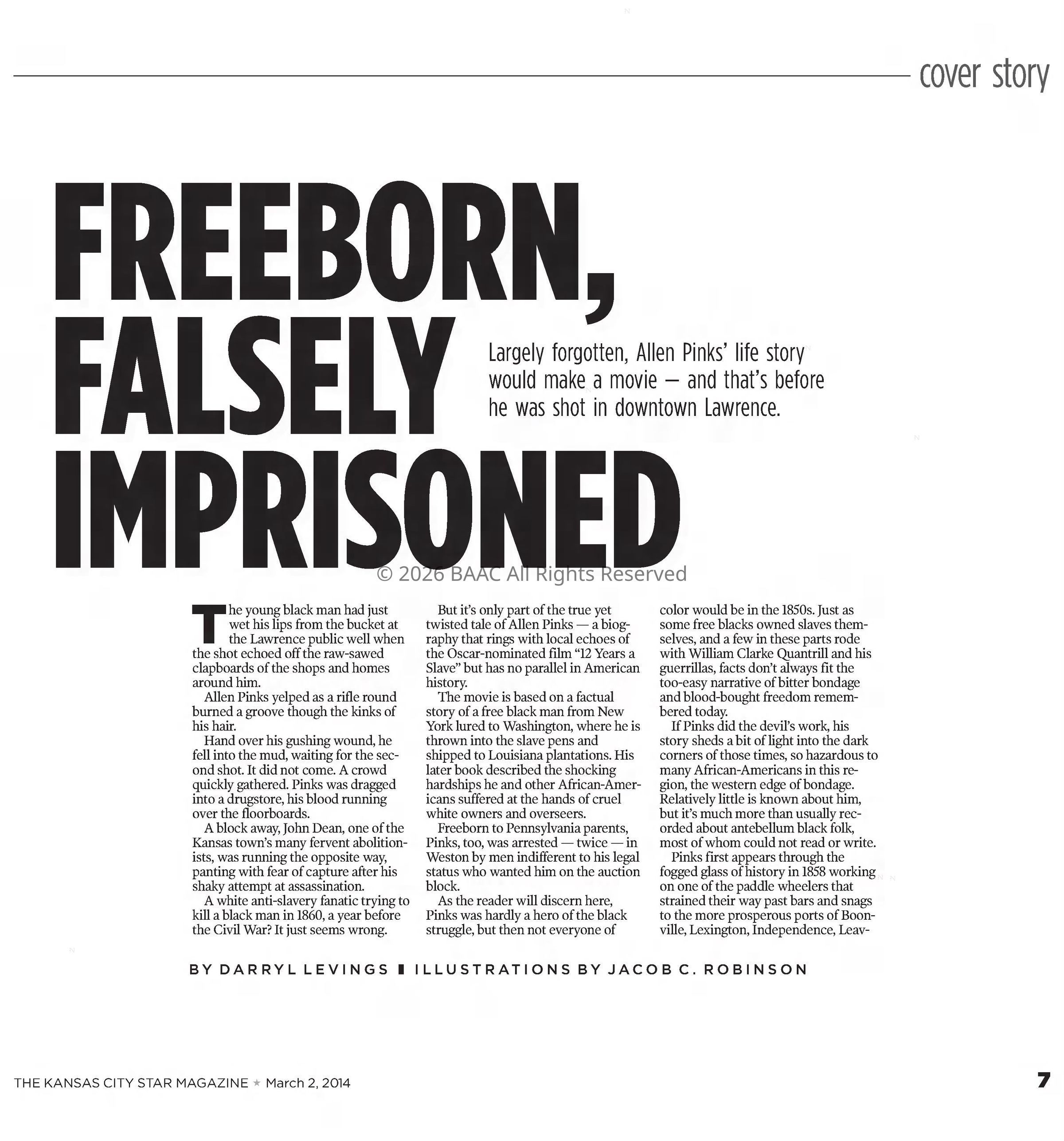
"Freeborn, Falsely Imprisoned - Largely forgotten, Allen Pink's life story would make a movie - and that's before he was shot in downtown Lawrence" by Darryl Levings (excerpted from longer article, see also 09/09/1858 Circuit Court Docket entry titled "09/09/1858: State of Missouri vs. Allen Pinks (Allen Pinks)")
"Freeborn to Pennsylvania parents, Pinks, too, was arrested - twice - in Weston by men indifferent to his legal status who wanted him on the auction block."
"The reason was a loose gang of thugs known as “border ruffians.” Some were from Missouri, but most appear to have been emigrants from northern states. Not picky, the ruffians would capture runaway slaves and take them home to their masters for the posted $200 bounty or more. Some, however, they “sold down the river,” that is sent to Alabama, Mississippi or Louisiana, where conditions for slaves generally were more harsh."
"The most notorious of the ruffians, except for one, was Jake Herd (or Jake Hurd), here described by William Connelly a Kansas historian prominent early last century: “He was known in every town on the border as being ‘sound on the goose,’ a holy terror, violent, quick and deadly with the revolver, fearless and daring, and a man who would risk his life to capture a negro, either free or runaway.”
"The story goes that Pinks’ freeman papers were tattered, and he left them in Independence with “a free colored wag-on-builder.” Landing at St. Joseph, he collected his pay and left his boat, deciding to go to Leavenworth, walking back south on the Missouri side."
"Upon reaching the Rialto ferry, he could not prove he was free so was seized as a likely runaway. He asked that someone in Weston go to Independence and fetch his papers or write the Jackson County clerk’s office, where he was registered. No one did. Perhaps no one was particularly interested in seeing him freed. On the slave block in Platte City, Pinks was worth about $1,300, with some going to the county officials for Pinks’ jail expenses and some to his captors."
"As an imprisoned Kansan, (John) Doy had every reason for his jaundiced view of Missourians. He recalled George Dorris, whom he depicted as one of several brutal slave dealers in Platte County as well as one of the local aristocracy. Dorris had his own slave pen south of town, a windowless heavy log structure with only a trapdoor for egress.
“At midnight Gen. Dorris, his son and assistant came to the jail and ordered the slaves to get ready to leave. As it was quite cold a pair of sox were drawn over the fists and wrists of the men, in place of mitten, they were then hand cuffed together in pairs and driven into the street, where they were formed in marching order behind the wagons containing the women and the children — some of the former tied with rope when considered unruly.” “Oh, may God preserve me from ever again witnessing such a scene of suffering and anguish as always attend the departure of a slave coffle for the South!”
"It’s not clear why Pinks spent so many months in the Platte County lockup; perhaps the authorities hoped to amass a larger sum for reimbursement for his keep when he was finally sold. Doy who was held there more than two months himself, said Pinks had bided his time and won the trust of the jailer, who also enjoyed his humor. He was given the task of bringing wood and buckets of water to the jail. The jailer had remarked that Pinks was too lazy to run away. This was aptly disproved one night when the prisoner did not return from the spring. Sticking to the woods, Pinks made his way to the St. Joseph riverfront, he told Doy later. There the fugitive was hired by the captain of the Minnehaha, bound for St. Louis. One can imagine his dismay when this vessel had business with Weston. The scene played out again. Despite the protests of captain and crew, he was dragged away to the iron box by the triumphant jailer."
"Months later, Pinks once again escaped. This time he was outside emptying his waste bucket, in which he had secreted an iron bar broken from his bed. He clobbered his shotgun-totting guard with it, ensuring the legally prescribed “well laid on” 39 stripes at the whipping post if he were captured. But this time he did not mess with boats. He made it to the wide river and swam. Doy wrote about Pinks’ arrival at his front door early one morning in Lawrence. “He was nearly naked, having nothing on but shirt and trousers, and those almost torn to pieces.... He had traveled a bee line from Platte City, and having been in somewhat of a hurry, had not paid sufficient respect to the thorns and briars he met with.”
"Fresh free papers were sent for, but when they arrived in September of 1859, Pinks had become cynical. “What good will they do me?” he reportedly told Doy. “Haven’t we seen plenty of free papers torn up and burnt in Platte County jail?” As Doy concluded: “And Pinks was right. A colored man’s free papers are not worth one red cent to him in the border towns of Missouri.”
"In Lawrence, Pinks worked at the Johnson House and set up a barber shop. It was about this time that Pinks got his scar at the town well in 1860. Connelly said this was John Dean’s second attempt on Pinks’ life. Supposedly, the fanatical wagonmaker from Iowa hired Charley Hart and another fellow to murder the black barber. The Kansas historian surmised, though, that Hart probably intended instead to capture and sell Pinks. Why waste one perfectly sound black man? In any event, Pinks allegedly saw them coming and escaped out a window. About that Charley Hart. Those familiar with those troubled times will recognize the name as the Lawrence alias for William Clarke Quantrill."
"At this point, according to the long-closed Lawrence Tribune, the Ohio-born Quantrill was “playing a dangerous double game, that of Abolitionist and Slave Liberator in Kansas, and that of an extreme Pro-Slavery man in Missouri, professing to slave-holders there that he was acting the part of a spy, detective and slave catcher in Kansas.”
"Truth is, Pinks was a Judas goat to his people. Wearing the sheepskin of the Kansas abolitionist and waving the promise of escape, the black man had been luring unsuspecting slaves away from their Missouri owners’ farms, shops or homes into the waiting arms of ruffian allies. Pinks was arrested with two white codefendants identified as Thomas McGee and Henry McLothlin (or McLaughlin). Both were associates of (Jake) Herd (Hurd). McGee, in fact, was in the gang that had stopped Doy and taken those free blacks into Missouri the year before."
"Then, on the 29th of that month (April 1869), according to the (Leavenworth Daily) Commercial, Pinks was being walked, manacled to a lawman, back to the jail from the courtroom. No doubt the junction of Fifth and Delaware was filled with wagons and buggies, with women in long skirts doing their shopping. At least three black gunmen materialized from the crowd and opened fire in broad daylight. Imagine the terror of Ed Montana, the constable attached to Pinks, who would have been jerking, grunting as the bullets smacked into him. The vigilantes were efficient enough; the lawman was unscathed. Pinks was hustled bleeding to his cell, and three physicians were summoned. His wounds included another in the head, but the fatal one was probably the slug that went over the sixth rib. “The poor wretch was in great pain, groaning and writhing terribly, his suffering tormenting him past expression,” the paper reported. Pinks never admitted the shooting of Bruce before bleeding out."Date(s) of Creation
3/2/2014