Description
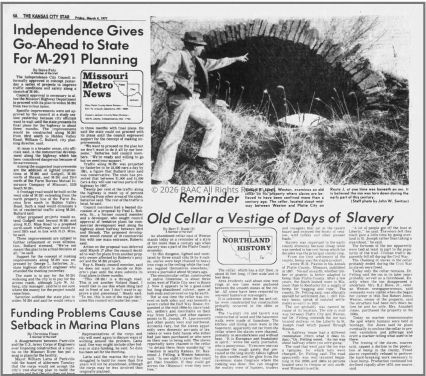
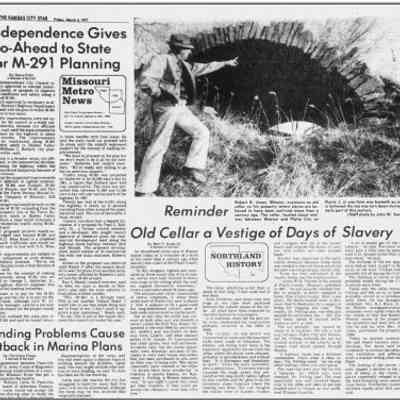
"Old Cellar a Vestige of Days of Slavery" - - An abandoned cellar east of Weston stands today as a reminder of a style of life more than a century ago when slavery was a part of the Platte County economy.
In this dungeon, lighted and ventilated by three small slits 24 by 9 inches, slaves were kept chained to heavy iron rings in the celling while the traders regaled themselves elsewhere,' wrote a journalist about 50 years ago.
The semicircular cellar, constructed of native limestone, is about 3 miles west of Platte City next to Route J. Now it appears to be a good-sized but long abandoned culvert, open at both ends and covered on top by earth.
But at one time the cellar was covered on both sides and was beneath a tavern called the Half Way House frequented in the mid 1800s by slave traders, settlers, and merchants on their way from Liberty and other eastern points to St. Joseph, Ft. Leavenworth, and other points west and northwest.
Accounts vary, but the slaves apparently were domestic servants of travelers or were field hands who either had just been purchased or who were on their way to being sold. The slaves reportedly were chained in the cellar "to detain them from wandering'' to freedom in nearby Kansas. Dr. Raymond J. Felling, a Weston historian, said. "In one night's travel they could get their freedom. If they could get across the (Missouri) river they were free."
The cellar, which has a dirt floor, is about 25 feet long, 17 feet wide, and 10 feet deep. Area residents said about 9 iron rings at one time were anchored between the smooth stones of the cellar. All since have been removed by souvenir hunters or scavengers. It is unknown when the inn and cellar were constructed but construction probably occurred in the 1830s or 1840s.
The 1 ½ story inn and tavern was constructed of wood and the basement walls were made of limestone. The kitchen and dining room were in the basement, apparently not far from the cellar where the slaves were chained, probably in semidarkness and without heat. “It is European and feudalistic in spirit," wrote the early journalist, who is anonymous. "Even now one can visualize the rough gaiety that prevailed at the long sturdy tables lighted by dim candles and the glow from the cavernous stone fireplace where the cooking was done. One can Imagine the motley crew of hunters, traders and voyagers that sat at the tavern board and enjoyed the feasts of venison, wild turkey, and other pioneer foods.”
Slavery was important to the early county economy because cheap labor was needed to harvest hemp which for decades was the principal county crop.
"From the first settlement of the county, hemp was the staple product,” wrote W. M.. Paxton in his Annals of Platte County. Missouri, published in 1897. “No soil on earth, whether timber or prairie, is better adapted to hemp than Platte County. After a few years, the South looked more to Missouri than to Kentucky for a supply of hemp tor bagging and rope.
The county, Dr Felling said, was officially opened for settlement January 1, 1837. History books speak of isolated settlements as early as 1820.
The inn probably was named because of its location. The site is mid way between Platte City and Weston, but Dr. Felling contends the inn was located midway on the Liberty to St. Joseph road which passed through Weston.
"A halfway house had a different connotation (from what it does today”, 'Dr. Felling noted. An inn was about halfway where you were going. '
The road that went past the inn was a turnpike for which tolls were charged, Dr. Felling said. The road apparently was well traveled beginning in the 1830s and 1840s as persons headed west to Oregon or into northwest Missouri to settle.
“A lot of people got off the boat at Liberty," he said. Travelers felt they could gain a little time by going over land to St Joseph rather than taking a steamboat," he said.
The fortunes of the inn apparently were tied at least in part to the popularity of the trail. Civilian traffic apparently fell off during the Civil War as slaves were freed.
The chaining of slaves in the cellar probably ended during the Civil War as slaves were freed.
Today only the cellar remains. Dr. Felling said the inn in its later years probably served as a farmhouse. Exactly when the inn disappeared is uncertain. Mrs. B. J. Bless, Jr., veteran Weston newspaperwoman, said remnants were visible when she began her career in 1912. But Robert Jones, Weston, owner of the property, said the structure had been torn down before he and his wife, Mrs. Annabell Jones, purchased the property in the 1930s.
Today no marker commemorates the spot where humans were held in bondage. But Jones said he plans eventually to enclose the cellar to prevent vandalism and pilferage and erect a marker telling what used to be there.
The freeing of the slaves, sources said, caused a decline in the production of hemp in the county. Freed slaves reportedly refused to perform the back-breaking work necessary to clean hemp. Production continued but declined rapidly alter 1870, one source said.Date(s) of Creation
3/4/1977