Description
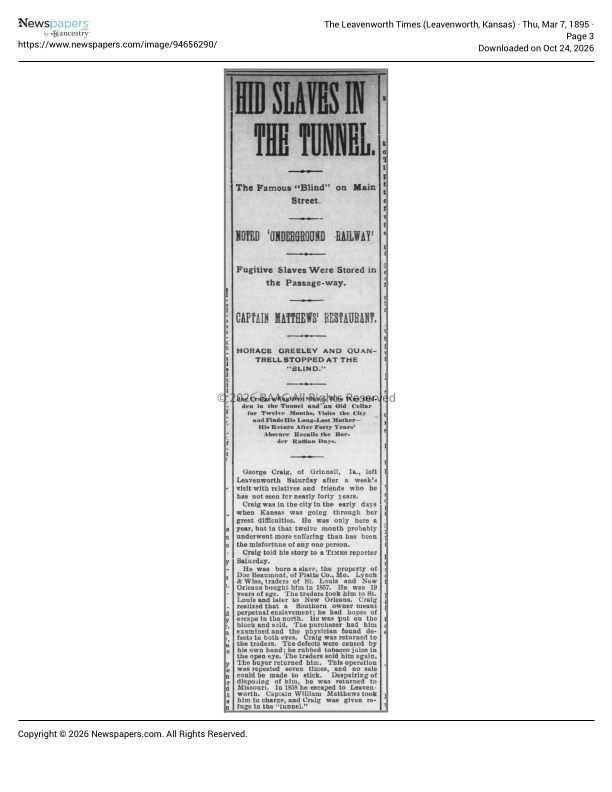
Hid Slaves In The Tunnel - The Famous "Blind" on Main Street - Noted Underground Railway - Fugitive Slaves Were Stored in the Passage-way - Joe Craig, a Fugitive Slave, Who Was Hiding in the Tunnel and an Old Cellar for 12 Months, Visits the City and Finds His Long-Lost Mother - His Return after 40 Years Absence Recalls the Border Ruffian Days.
George Craig, of Grinnell, Iowa, left Leavenworth Saturday after a week’s visit with relatives and friends who he has not seen for nearly 40 years. Craig was in the city in the early days when Kansas was going through her great difficulties. He was only here a year, but in those 12 months probably underwent more suffering than has been the misfortune of any one person. Craig told his story to a Times reporter Saturday.
He was born a slave (~1838), the property of Doc Beaumont, of Platte County, Missouri. Lynch & Wise, traders of St. Louis and New Orleans bought him in 1857. He was 19 years of age. The traders took him to St. Louis and later to New Orleans. Craig realized that a Southern owner meant perpetual enslavement; he had hopes of escape in the North.
He was put on the block and sold. The purchaser had him examined and the physician found defects in both eyes. Craig was returned to the traders. The defects were caused by his own hand; he rubbed tobacco juice in the open eye. The traders sold him again. The buyer returned him. This operation was repeated 7 times, and no sale could be made to stick. Despairing of disposing of him, he was returned to Missouri.
In 1858 he escaped to Leavenworth. Captain William Matthews took him in charge, and Craig was given refuge in the “tunnel.”
THE TUNNEL.
Opposite the new “Leavenworth” hotel, then the “Planters”, was a high-toned boarding house operated by Captain Matthews. An old ruin of the foundation now remains there. A. W. Whitney of Adrian, Mich., and H. C. Johnson then of Leavenworth, owned the property. Matthews paid them $75 a month for rent.
The boarding house was a “blind.” In the rear, concealed by a secret door, was “The Tunnel.” It had been dug at the expense of Colonel Anthony and other abolitionists, and extended about 50 feet to the West.
Underground quarters were provided for half a hundred people. As many as 60 slaves had been in hiding there at one time. It was called the “underground railway,” fugitive slaves being kept there until the coast was clear to Lawrence, when they would be smuggled over there by night, thence north to Iowa Point and east through Iowa and other northern States. Wherever an Abolitionist could be found who needed help a slave was left. The little bands would thus proceed Eastward gradually growing smaller until all were provided with homes. The leaders would then return to Lawrence.
CRAIG’S FLIGHT.
In the Spring of ’58 Craig escaped to Leavenworth. He was considered valuable. Eighteen hundred dollars ($1,800) was offered in reward for him, but he could not be found. The reward was increased to $2,000 to anyone who would tell when Craig was to be started for Lawrence or the north. But he could not be had.
About this time several slaves belonging at Fort Leavenworth were given refuge in the “underground railway.” The Dragoons then stationed there were ordered out and Matthews’ place searched. Colonel Anthony, however, had gotten wind of the proposed search and had Craig removed to the cellar of the building now occupied by J. W. Crancer & Co., Senator Baker and others at the corner of Third and Delaware streets. The Times was also published there.
Craig was stowed away in the cellar. The Dragoons searched in vain, but persisted and at irregular intervals the tunnel was inspected. Craig was kept in that cellar for 3 weeks and off and on for a whole year. (He, in company with friends, visited the cellar Friday.)
The slave men maintained such a diligent search for Craig, and so closely patrolled the road to Lawrence, that it was the spring of ’59 before he could be smuggled out. He was taken over there in April with some 20-odd others and started East in charge of John Brown. Craig was dropped off near where Grinnell, Iowa, now stands. John Brown went on east to Boston; thence to Canada, and a few months later made his famous assault at Harper’s Ferry.
It was only a short time ago that Craig learned of his relatives in Leavenworth. He came Monday and found his mother, Mrs. Jamima Craig, who lives with her grandson, Policeman Craig, in West Leavenworth.
At the Union station yesterday morning Craig bid his friends good-bye. He insisted on telling his colored brethren of the city and state that Colonel Anthony was the negroes’ true friend, and that, although Captain Matthews had aided him and others, he knew it was the money of Colonel Anthony and other abolitionists which backed up the captain.
This is a bit of Leavenworth’s early history. The old ruins of Captain Matthews’ boarding house, which was patronized by Horace Greeley, can be seen by any passerby just opposite the new “Leavenworth” hotel.Date(s) of Creation
3/7/1895