Description
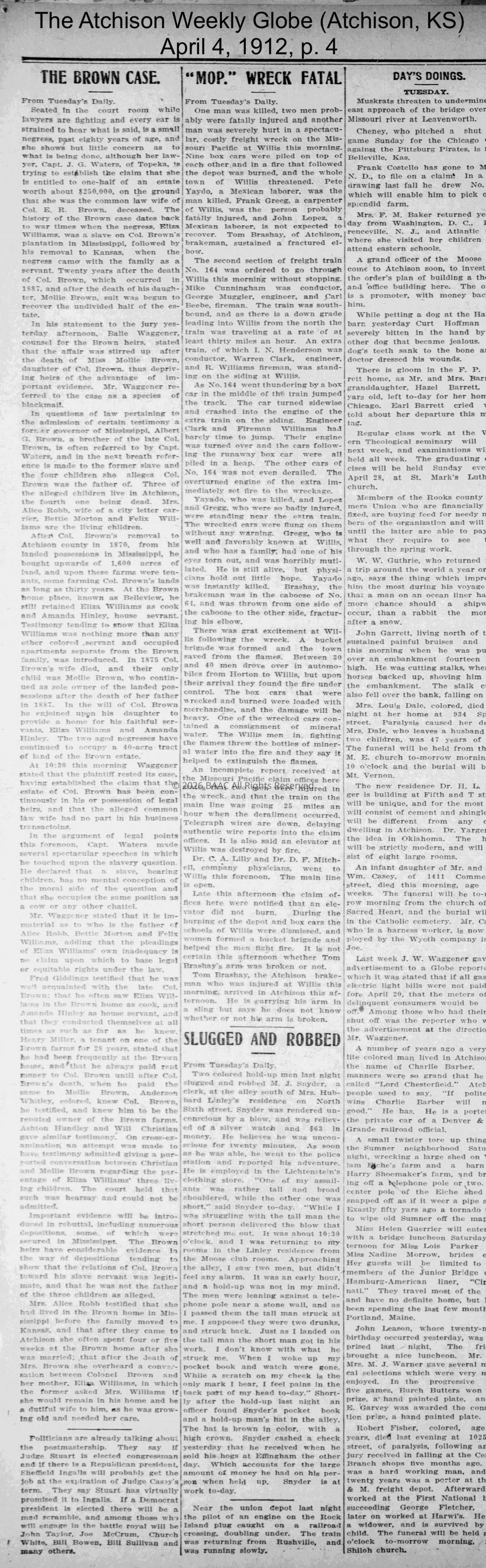
“THE BROWN CASE” - - From Tuesday’s Daily. (excerpted from longer article) - - Seated in the court room while lawyers are fighting and every ear is strained to hear what is said, is a small negress, past 80 years of age (born ~1832), and she shows but little concern as to what is being done, although her lawyer, Capt. J. G. Waters, of Topeka, is trying to establish the claim that she is entitled to ½ of an estate worth about $250,000 on the ground that she was the common law wife of Col. E. R. Brown, deceased. The history of the Brown case dates back to war times when the negress, Eliza Williams, was a slave on Col. Brown’s plantation in Mississippi, followed by his removal to Kansas, when the negress came with the family as a servant. Twenty years after the death of Col. Brown, which occurred in 1887, and after the death of his daughter, Mollie Brown, suit was begun to recover the undivided half of the estate. - - After Col. Brown's removal to Atchison County in 1870, from his landed possessions in Mississippi, he bought upwards of 1,800 acres of land and upon these farms were tenants, some farming Col. Brown's lands as long as 30 years. At the Brown home place, known as Belleview, he still retained Eliza Williams as cook and Amanda Henley, house servant. Testimony tending to show that Eliza Williams was nothing more than any other colored servant and occupied apartments separate from the Brown family, was introduced. In 1875 Col. Brown’s wife died, and their only child was Mollie Brown, who continued as sole owner of the landed possessions after the death of her father in 1887. In the will of Col. Brown he enjoined upon his daughter to provide a home for his faithful servants, Eliza Williams and Amanda Henley. The two negresses have continued to occupy a 40-acre tract of land of the Brown estate. - - In the argument of legal points this forenoon, Capt. Waters made several spectacular speeches in which he touched upon the slavery question. He declared that a slave, bearing children, has no mental conception of the moral side of the question and that she occupies the same position as a cow or any other chattel. Mr. Waggener stated that it is immaterial as to who is the father of Alice Robb, Betty Morton, and Felix Williams, adding that the pleadings of Eliza Williams’ own inadequacy is no claim upon which to base legal or equitable rights under the law. - - Mrs. Alice Robb testified that she had lived in the Brown home in Mississippi before the family moved to Kansas, and that after they came to Atchison she often spent 4 or 5 weeks at the Brown home after she was married; that after the death of Mrs. Brown she overheard a conversation between Colonel Brown and her mother, Eliza Williams, in which the former asked Mrs. Williams if she would remain in his home and be a dutiful wife to him, as he was growing old and needed her care.Date(s) of Creation
4/25/1912