Description
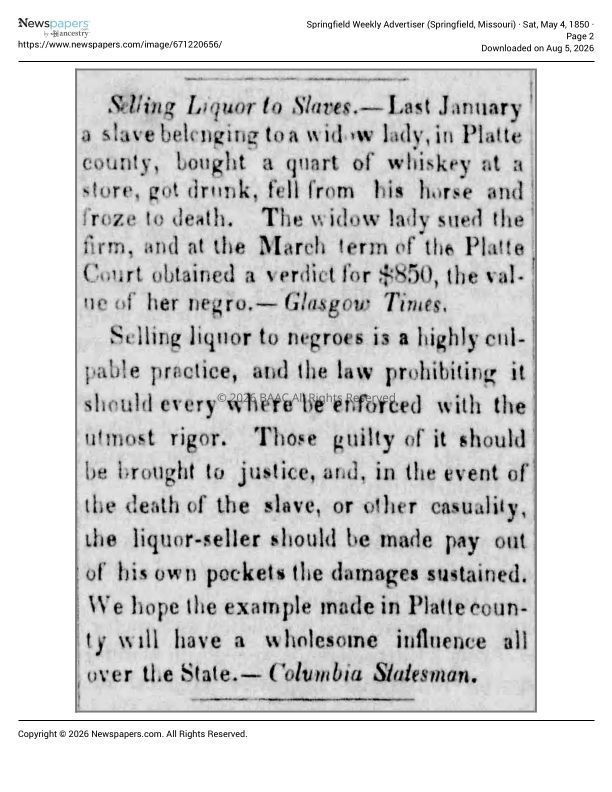
Selling Liquor to Slaves. - - Last January a slave belonging to a widow lady, in Platte County, bought a quart of whisky at a store, got drunk, fell from his horse and froze to death.
The widow lady sued the firm and at the March term of the Platte court obtained a verdict for $850, the value of her negro. - Glasgow Times
Selling liquor to negroes is a highly culpable practice, and the law prohibiting it should every where be enforced with the utmost rigor. Those guilty of it should be brought to justice, and, in the event of the death of the slave, or other casualty, the liquor-seller should be made to pay out of his own pockets the damages sustained.
We hope the example made in Platte County will have a wholesome influence all over the State. - Columbia Statesman.
(Researcher's note: See Circuit Court Docket entry dated 03/22/1850: Margaret Hughes vs. Phinehas Skinner & Ely Shepherd & Benjamin F. Baker (Willis) ""We the Jury find for the Plaintiff against Phinehas Skinner and Ely Shepherd and assess the Plaintiff's damages to the sum of $850.00 and we find the Defendant Baker not guilty."" Missouri Supreme Court Opinion affirming judgment 13 Mo. 440 (1850): This was an action on the case by Mrs. Hughes against Skinner, Shepherd and Baker for an injury to her slave that occasioned his death, and was tried at the March term 1850 of the Platte Circuit Court. Upon the trial, it appeared that the plaintiff was the owner of a slave, Willis, worth $900.00 and the defendants, Shepherd and Skinner, were the owners of a store in which they sold intoxicating liquors not less than a quart, and a mill, and Baker was their clerk, In January 1849 the boy came to the mill with grain to be ground and while there went to the store with a bottle, bought a quart of whisky, carried it to the mill and there got drunk, started home about sundown and was found early next morning lying on his face in the road not far from the mill speechless, his jaws locked and frozen nearly to death. He was taken to the mill immediately, received immediate medical attendance, lived 8 or 9 days and died. The whisky was sold to the boy without any permit from his owner, and neither Skinner nor Shepherd were present at the time. The clerk (Baker) was in the habit of selling whisky to the slaves without the permission of the owners and Shepherd was frequently present when this was done and made no objection.” The jury found a verdict for $900, for which the plaintiff had judgment, after motions for new trial and in arrest were overruled.)Date(s) of Creation
5/4/1850