Description
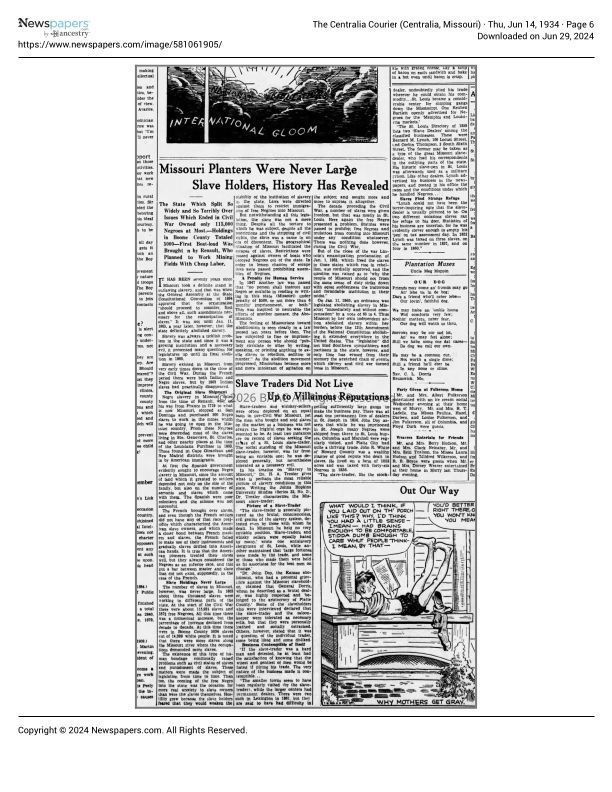
Missouri Planters Were Never Large Slave Holders, History Has Revealed. - The State Which Split So Widely and So Terribly Over Issues Which Ended in Civil War Owned Only 115,000 Negroes at Most. – Holdings in Boone County Totaled 5,000 – First Boat-load was Brought in by Renault, Who Planned to Work Mining Fields with Cheap Labor. - - It has been 70 years since Missouri took a definite stand in outlawing slavery, and that was when the General Assembly at the State Constitutional Convention of 1864 approved that the organization “should proceed to consider, first and above all, such amendments necessary for the emancipation of slaves." It was not until January 11, 1865, a year later, however; that the state definitely abolished slavery.
Slavery was always a ticklish problem in the state and since it was a growing institution and a necessary evil, it presented many questions for legislatures up until its final abolition in 1865.
Slavery existed in Missouri from very early times down to the close of the Civil War. During the French period there were both Indian and Negro slaves, but by 1803 Indian slaves had practically disappeared.
The Original Slave Shipment
Negro slavery in Missouri dates from the time of Renault, who, on his way from France in 1719 to what is now Missouri, stopped at San Domingo and purchased 500 Negro slaves to work in the mines which he was going to open in the Missouri country. From these Negroes were descended most of the slaves living in Ste. Genevieve. St. Charles, end other nearby places at the time of the Louisiana Purchase in 1803. Those found in Cape Girardeau and New Madrid districts were brought in by American immigrants.
At first the Spanish government evidently sought to encourage Negro slavery in Missouri, since the amount of land which it granted to settlers depended not only on the size of the family, but also on the number of servants and slaves which came with them. The Spanish were poor colonizers and the scheme was not successful.
The French brought over slaves and even though the French settlers did not have any of that race prejudice which characterized the American slave owners, and which made a closer bond between French masters and slaves, the French failed to make use of their instruments and gradually slaves drifted into American hands. It is true that the American pioneers treated their slaves well, but they always considered the Negroes as an inferior race, and this put a bar between master and slave that did not exist, supposedly, in the case of the French.
Slave Holdings Never Large
The number of slaves In Missouri, however, was never large. In 1803 about 3,000 slaves were working in different parts of the state. At the start of the Civil War there were about 115,931 slaves and 3,572 free Negroes. All this time there was a numerical increase, but the percentage of increase declined from decade to decade. At this time there were in Boone County 5,034 slaves out of 14.398 white people. It Is noted that there were more slaves along the Missouri River where the occupations demanded more slaves.
The existence of this type of human bondage continually raised problems such as civil status of slaves and punishment of slaves. These matters were made the subject of legislation from time to time Then too, the coming of the free Negro into the state was the occasion for more real anxiety to slave owners than were the slaves themselves. Hostility grew because the slave holders feared that they would weaken the stability of the institution of slavery in the state. Laws were directed against them to restrict immigration of free Negroes into Missouri.
But notwithstanding all this legislation, the slave was not a mere thing. Despite all the torture to which he was subject, despite all the restrictions and the stripping of civil rights, the slave was a cause in an era of discontent. The geographical situation of Missouri facilitated the escapes of slaves. Restrictions were passed against owners of boats who decoyed Negroes out of the state. In order to lessen chances of escape, laws were passed prohibiting assemblies of Negroes.
A Penalty for Human Service
In 1847 another law was passed that “no person shall instruct any Negro or mulatto in reading or writing in this state (Missouri) under penalty of $500 or not more than 8 months imprisonment, or both." This was inspired to neutralize the efforts of another menace, the Abolitionists.
The feeling of Missourians toward Abolitionists is seen clearly in a law passed 10 years before then. The law subjected to fine or imprisonment any person who should "publicly circulate or utter by writing, speaking, or printing anything to excite slaves to rebellion, sedition or murder.” As the abolition movement progressed, Missourians became more and more intolerant of agitation on the subject and sought more and more to suppress it altogether.
The decade preceding the Civil War, a number of slaves were given freedom, but that was mostly in St. Louis. Here again the free Negro presented a problem. Statutes were passed to prohibit free Negroes and mulattoes from coming into Missouri under any condition whatsoever. There was nothing done however, during the Civil War.
But of the close of the war Lincoln's Emancipation Proclamation of January, 1, 1863, which freed the slaves in those states which rose in rebellion, was cordially approved, and the question was raised as to "why the people of Missouri should not from the same sense of duty strike down with equal suddenness the traitorous and formidable institution in their midst."
On January 11, 1865, an ordinance was legislated abolishing slavery in Missouri "immediately and without compensation" by a vote of 60 to 4. Thus Missouri, by her own independent action, abolished slavery within her borders before the 13th Amendment of the National Constitution abolishing it extended everywhere In the United States.
The "legislation" did not bind Southern sympathizers and partisans in the state, however, and only time has erased from their memory the wretched chain of events which slavery and civil war turned loose in Missouri.Date(s) of Creation
6/14/1934