Description
Son of a Slave - Alone but Not Lonely - By Richard D. Ralls - - Weston - The blacktop road climbs and dips a few miles north of here to a weathered 1-room schoolhouse. When visitors call, Lester Anderson hollers from inside that he'll be right out. Several minutes pass before he hobbles to the doorway.
The son of a Missouri slave, Anderson has lived in the gray frame schoolhouse 10 or 12 years as a guest of his former employer, who owns the structure. Anderson has made a home in the dimly lit room, along with hundreds of bees and a dog named Ring.
At 72 years old (born ~1903), his movements are slow and painful. If he falls, as he has in the garden, he lies there until help comes along the road. But there is no loneliness or self-pity in Lester Anderson - just a hearty laugh, a ready memory and a cane to help him about.
Anderson was 7 years old when typhoid fever took his mother, a sister and a brother, leaving 25 children from two marriages under the care of Lester's father, Henry Anderson.
Lester went to work on a Platte County farm hoeing tobacco. The pay was a 25$ a day. School was a luxury he did without. Later as a teen-ager, earning a dollar or so a day, Anderson was working in a tobacco barn loft when he fell. His right arm and left ankle were injured. “Yes, sir - fell right out of the barn,” Anderson said, glancing at his shoulder. “The doctor - he was nothing but an old whiskey toker - he bandaged it and gave me some medicine. But it kept swelling and swelling and they found out I had blood poisoning.”
The arm was amputated at the shoulder. Anderson’s gaze dropped to his foot. “The doctor, he twisted the ankle back and said it would be all right. Gave me some medicine to put on it.” he said. The broken ankle was never set. Anderson says it is painful to this day, swollen now more than 50 years. Empty bottles of Absorbine, Jr., under his bed, testify to the pain.
“The doctor in Leavenworth offered to reset the ankle (recently)—said it wouldn’t cost me anything but it'd be sore for awhile,” Anderson said, “I told him, no, I’d have to suffer a whole lot more if they reset it.”
Anderson has fixed himself a bed in one corner of the old country schoolhouse, built a kitchen in another corner and piles his refuse in a third.
George C. Hull. Sr., of Weston, who has known Anderson by the nickname “Soup” since Anderson came to Hull's father’s farm 68 years ago, said the school was known as the Cox school and was used as a classroom until at least the 1940s. He said Anderson has worked for the Hulls since then and was allowed to live in the school without charge after he retired.
High on the front of the home the bees swarm. '‘Bet there’s half a washtub full of bees in there,” Anderson said, “I can hear them in the house. Getting too many of them. “I got a washtub of honey out of there last time I robbed them, though,” he said with a laugh, showing a plug of Weston-grown tobacco in his cheek.
Anderson has spent a lifetime laboring in someone else's fields here, in wheat, corn or tobacco. So did his father. “My daddy was a slave,” Anderson said. “He told me a man here used to own him, that they’d take the slaves out on the block and the high bidder got them.”
Omega Anderson, Lester Anderson's half-brother, said he grew tobacco in the Weston area and was a grave digger for nearly 20 years before he retired. He, too, recalled his father’s talk of slavery.
"Dad did farm work for 75 cents a day,” Omega Anderson, 71, (born ~1904) said. “He told us he was sold on the block at Gooseneck, near the Platte River between Tracy and Camden Point (Missouri). That’s where he was sold. Eight in his family were sold then, but most went to the South.”
Anderson said a man named Reynolds paid $275 in gold for his father, then 7 or 8 years old. Henry Anderson was sold to a man named Meeks, Omega Anderson said, then was handed down to Meeks’s son-in-law, a man named Anderson.
"That’s where we get the Anderson name,’’ he said. "After Dad was freed he kept the name—the last man he was owned by.” The son said his father was 22 years old when he left the Anderson farm. "He was freed long before that but he stayed on. He couldn’t get another job. It was hard for children to get jobs then.”
Henry Anderson died in 1922, Omega Anderson said, trampled by a team of mules hauling a load of wood.
Lester Anderson recalled driving teams of horses to a sale barn in Kansas City years ago, leaving about 8 p.m. and arriving 12 hours later. He would tie groups of six horses together by knotting their tails, he said. “There wasn’t much traffic on the road to bother you at night, and it seemed like the horses traveled faster,” Anderson said.
“Them days we worked all day for 75 cents and we thought we were getting big money. You could buy a pair of overalls for 25 cents then. Now you can’t even buy a pair for $5. Ain't that awful?”
Anderson lives on $146 a month in Old Age Assistance. After paying for the necessities of life, he has $10 or $15 a month extra. This he turns over to Joe Collison, Vice-President of the Bank of Weston, for safekeeping. “People’d knock you in the head for a dime,” he explained.
Anderson doesn’t mind living alone. ‘‘My brother (Omega ) comes to see me every Saturday, takes me to town,” he said. “Oh, lots of white folks come down and see me. There ain’t too many colored people out here anymore.”
He passes the day watching a black and white television or listening to a radio. He has electricity but no phone. He naps on his old brass bed, a jumble of ragged blankets without sheets only a few steps from a pot-bellied stove. “Going to be a change in the weather—you watch it,” he said, raising himself from his bed. “Be raining soon. My back’s acting up on me. That’s a sure sign.”
He said he downs a beer once in awhile because his doctor told him it was good for his kidneys. But he cannot stand overindulgence. “There was a drunk laying in my yard the other day. They came and threw him in the back of a pickup and drove away. I don’t want people sitting around here drinking,” he said.
Anderson is proud of the fact that he has a perfect voting record. He has never cast a ballot in his life. “I’ve got friends that’s Republicans and friends that’s Democrats,” he said. “The best thing I can do is not vote at all. Nobody gets mad. I’m doing exactly what’s right, ain’t I? You can’t make me vote. “I’ll tell you.” he says, pausing to spit out tobacco juice. “I’d rather have my friends than all the money.”
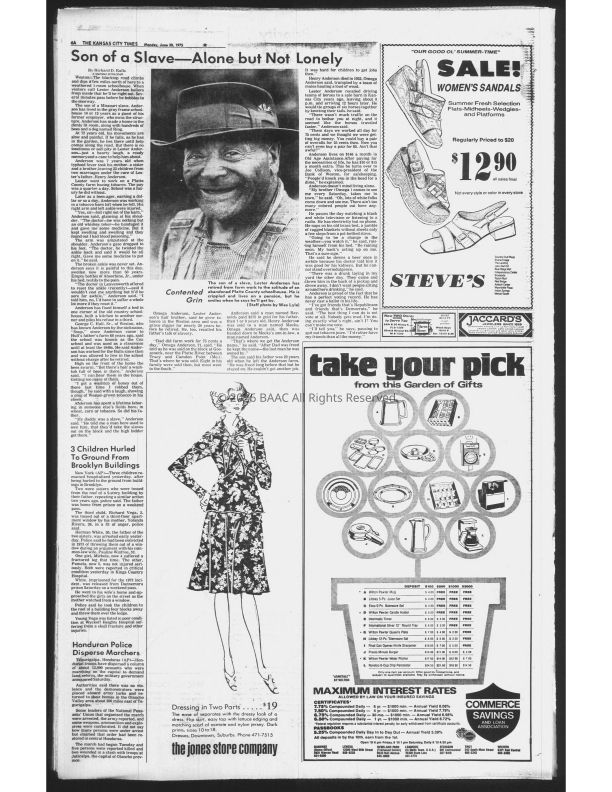
Photo caption - Contented Grin - The son of a slave, Lester Anderson has retired from farm work to the solitude of an abandoned Platte County schoolhouse. He is crippled and lives on a pension, but he smiles when he says he'll get by. Staff photo by Wes Lyle.
(Researcher's note: On September 1, 1854, James Meek and R. Meek, Jr. were signatories to resolutions signed by Weston, Missouri, citizens denouncing the pro-slavery Platte County Self-Defensive Association. The 1850 Platte County Census listed Richard Meek, Sr. (49 years old), Richard Meek, Jr. (30 years old), and James Meek (28 years old) living in Weston Township. Richard Meek Sr. died January 19, 1858. The 1860 Platte County Census listed James Meek, 41 years old from Indiana, wife Cynthia, and 8 children living in Marshall Township.)Date(s) of Creation
6/30/1975