Description
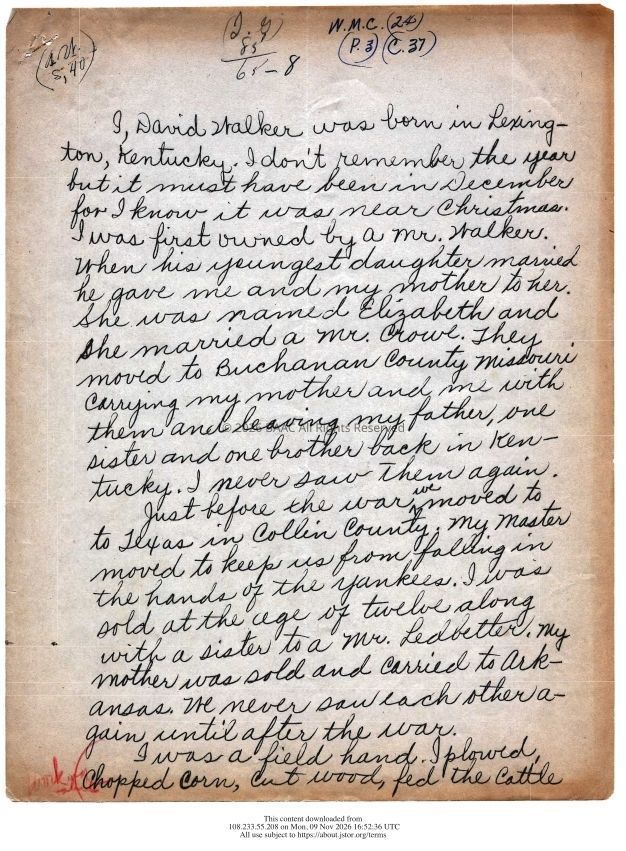
I, David Walker, was born in Lexington, Kentucky. I don’t remember the year but it must’ve been in December before I know it was near Christmas.
I was first owned by a Mr. Walker. When his youngest daughter married he gave me and my mother to her. She was named Elizabeth and she was married to a Mr. Crowe. They moved to Buchanan County, Missouri, carrying my mother and me with them and leaving my father, one sister, and one brother back in Kentucky. I never saw them again.
Just before the war we moved to Texas in Collin County. My master moved to keep us from falling in the hands of the Yankees. I was sold at the age of 12 along with a sister to a Mr. Ledbetter. My mother was sold and carried to Arkansas. We never saw each other again until after the war.
I was a field hand. I plowed, chopped corn, cut wood, fed the cattle and horses.
The home life was a fairly contented one. The children were ruled under very strict discipline. The parents treated their children or controlled them just like the master controlled them. On the whole the young folks were good and of very good moral character. They courted and married at an early age. The ceremony was performed by the couple jumping over a broom. If two on the same plantation married they got the consent of the master. If one of the couple lived on an adjoining plantation each would get the consent of their masters. Their masters would talk it over between them. If they agreed they gave their consent but each would keep his slave. The man would be allowed to visit his wife on Wednesday and Saturday nights. The children from this relationship would belong to the master who owned ‘gal.’
Sometimes there would be immoral relationship between the master and a slave ‘gal.’ In that case he would make a house girl out of her and she was not allowed to mix with the other slaves. The children from these relationships were subject to the same treatment as the other slaves.
When the Negroes seem to be slow about mating, they were forced to mate or marry. If the woman improved barren she was sold. Every man and woman who married were supposed to be loyal to each other and if found immoral were sold. Sometimes the master would sell husband away from life and mother away from children or vice versa.
They would issue you an allowance of ration a week. It would consist of meal, bacon, syrup, beans, and potatoes. On Sunday you were given enough flour for biscuits. If your allowance gave out you did without until your next allowance. Most of us would steal food, especially sweet potatoes, which we would roast in the ashes in the fireplace.
We were punished very severely and were punished for anything that displeases the master no matter how small the offense. He would strip us, tie us up, and whip us with switches roasted in the fire.
Our clothes were homespun. Mine were made by the white women because I had no mother to sew for me. Two garments were giving you a year. Pants, shirt, and coat made up our wardrobe. Our master did not furnish us underwear.
We had to get up at 4:00 in the morning and feed. We worked until 11:30. We ate dinner and went back to work at 1 o’clock. We had white overseers although a colored overseer was used sometimes. This didn’t help much because he had to treat us just like the white man said for him to do. On cold, bad days we worked on the inside shocking corn, repairing harnesses, and other inside jobs.
We could have dances on the quarters. They would allow us to dance until 12 o’clock. Negroes from neighboring plantations could attend if they got a pass from their master.
They were whipped if they did not have a pass when they went out without one. In the Fall when work slowed up and the harvest was over we were allowed to hunt and fish, also to gather nuts. At Christmas time my master would play Santa Claus to us. He would fill our socks with candy and apples.
We attended church with our master sometimes. They allowed some to join the church. You are not allowed to pray down on the quarters. If you did you turned your pot down so the sound would not go up to the big house for if the master caught some old pious Negro man or woman praying he would surely whip them.
I never heard of all these superstitious ideas until long after freedom.
We had built-in beds with rumble beds under them for the children. They would give us ticks to fill with straw. We had homemade stools and sometimes the mammy fell air to a rocking chair. Each cabin had its pot and skillet for cooking.
I didn’t like slavery because you were so badly treated. You never had enough to eat because of the hard work you had to do. They would make you grease your face with a meat skin and pretend that you had enough. You had to ask when you wanted to go off and had to be back at a certain time. The master would have immoral relationship with the slave girl. You were not allowed to express yourself regardless of how right you were. I married after slavery.
Interview by Mrs. Ethel Jones Everett, 571 N. East Street, Sherman, Texas. Professor T. R. Veal, Instructor
(Researcher’s note: See also NP.1229.01 "01/01/1931: Tracing Ancestry Clouded by Slavery Issue (David Walker)." Between 1929-1930 John B. Cade and his team of 36 Southern University interviewers compiled 299 reports of ex-slaves from 17 states and 1 country. Cade assigned each student the task of asking standard questions to each former slave. The questions were:
Name of state and county in which they were slaves
Name or names of owners
The type of slaves which they were, that is, house or field slave
The home and family life of the slaves, especially marriage, etc.
The food of the slaves
Punishment of the slaves
The working conditions of the slaves
Amusements of the slaves
Religious life of the slaves
Superstitions and customs of slaves
How they liked slavery
Plus any other pertinent information which they could give.
The Southern University John B. Cade Library has published the collection entitled "Opinions Regarding Slavery: Slave Narratives. 1822-1865.” The results of those interviews were also summarized in Cade's article "Out of the Mouths of Ex-Slaves” published in The Journal of Negro History, Volume 20, Number 3 (July 1, 1935), pp. 294-337.)Date(s) of Creation
7/1/1935