Description
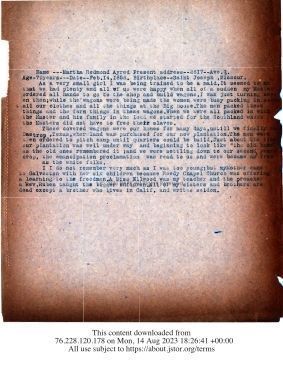
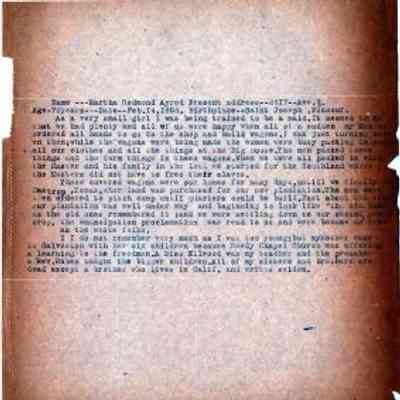
Name: Martha Redmond Ayred. Present Address: 2617 Ave. Q (Lubbock, Texas?) Age: 79 years. Date: February 14, 1856. Birthplace: Saint Joseph, Missouri.
As a very small girl I was being trained to be a maid. It seemed to me that we had plenty and all of us were happy when all of a sudden my Master ordered all hands to go to the shop and build wagons. I was just turning seven then (~1863); while the wagons were being made the women were busy packing in each all of our clothes and all the things at the Big house. The men packed these things and the farm things in these wagons.
When we were all packed in, with the Master and his family in the lead, we started for the Southland where the Masters did not have to free their slaves.
These covered wagons were our homes for many days, until we came (to) Bastrop Texas, where land was purchased for our new plantation. The men were then ordered to pitch camp until quarters could be build. Just about the time our plantation was well underway and beginning to look like “the old house” as the old ones remembered it, and we were settling down to our second year crop, the Emancipation Proclamation was read to us and we became as free as white folks.
I do not remember very much as I was too young; but my mother came to Galveston with her six children because Reedy Chapel Church was offering a learning to the freedmen. A Miss Ellwood was my teacher and the preacher, a Rev. Ruben, taught the bigger children. All of my sisters and brothers are dead except a brother who lives in California and writes seldom.
(Researcher’s note: Between 1929-1930 John B. Cade and his team of 36 Southern University interviewers compiled 299 reports of ex-slaves from 17 states and 1 country. Cade assigned each student the task of asking standard questions to each former slave. The questions were:
Name of state and county in which they were slaves
Name or names of owners
The type of slaves which they were, that is, house or field slave
The home and family life of the slaves, especially marriage, etc.
The food of the slaves
Punishment of the slaves
The working conditions of the slaves
Amusements of the slaves
Religious life of the slaves
Superstitions and customs of slaves
How they liked slavery
Plus any other pertinent information which they could give.
The Southern University John B. Cade Library has published the collection entitled "Opinions Regarding Slavery: Slave Narratives. 1822-1865.” The results of those interviews were also summarized in Cade's article "Out of the Mouths of Ex-Slaves” published in The Journal of Negro History, Volume 20, Number 3 (July 1, 1935), pp. 294-337.)Date(s) of Creation
7/1/1935