Description
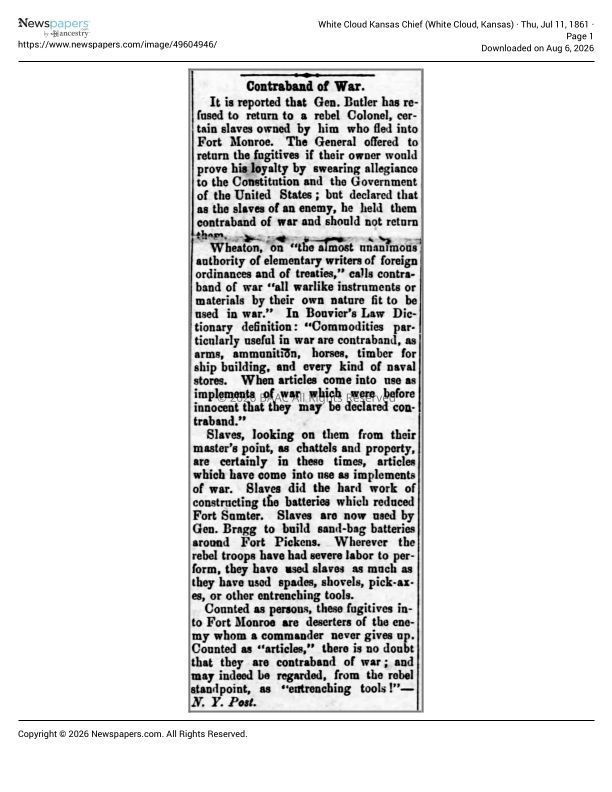
Contraband of War. - - It is reported that Gen. Butler has refused to return to a rebel Colonel certain slaves owned by him who fled into Fort Monroe. The General offered to return the fugitives if their owner would prove his loyalty by swearing allegiance to the Constitution and the Government of the United States; but declared that as the slaves of an enemy, he held them contraband of war and should not return them.
Wheaton, on “the almost unanimous authority of elementary writers of foreign ordinances and of treaties,” calls contraband of war ‘'all warlike instruments or materials by their own nature fit to be used in war.” In Bouvier’s Law Dictionary definition: '’Commodities particularly useful in war are contraband, as arms, ammunition, horses, timber for ship building, and every kind of naval stores. When articles come into use as implements of war which were before innocent that they may be declared contraband.”
Slaves, looking on them from their master’s point, as chattels and property, are certainly in these times, articles which have come into use as implements of war. Slaves did the hard work of constructing the batteries which reduced Fort Sumter. Slaves are now used by Gen. Bragg to build sand-bag batteries around Fort Pickens. Wherever the rebel troops have had severe labor to perform, they have used slaves as much as they have used spades, shovels, pick-axes, or other entrenching tools.
Counted as persons, these fugitives into Fort Monroe are deserters of the enemy whom a commander never gives up. Counted as “articles,” there is no doubt that they are contraband of war; and may indeed be regarded, from the rebel standpoint, as ’‘entrenching tools!” – New York Post.
(Researcher’s note: In May 1861 “At Fort Monroe in Hampton, Virginia, Union Maj. General Benjamin Butler refused to send three fugitives back into the bonds of slavery. He classified the escaping slaves as contraband of war. This term meant that once the fleeing slaves crossed Union army lines, they were classified as property. All enemy property that fell into Union hands constituted contraband and would not be returned.
Because of Butler's actions, a federal policy was instituted on August 6, 1861 - fugitive slaves were declared to be "contraband of war" if their labor had been used to aid the Confederacy in anyway. If found to be contraband, they were declared free.” https://www.nps.gov/articles/living-contraband-former-slaves-in-the-nation-s-capital-during-the-civil-war.htm)Date(s) of Creation
7/11/1861