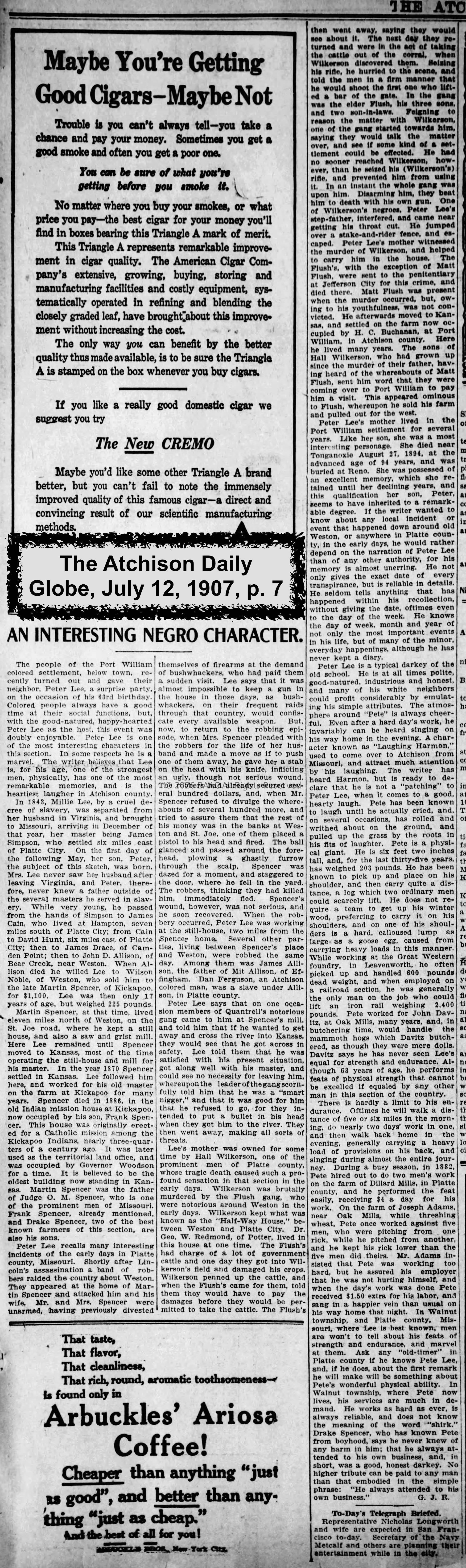
Description
The people of the Port William colored settlement, below town, recently turned out and gave their neighbor, Peter Lee, a surprise party, on the occasion of his 63rd birthday. Colored people always have a good time at their social functions, but, with the good-natured, happy-hearted Peter Lee as the host, this event was doubly enjoyable. Peter Lee is one of the most interesting characters in this section. In some respects he is a marvel. The writer believes that Lee is, for his age, one of the strongest men, physically, has one of the most remarkable memories, and is the heartiest laugher in Atchison County. In 1843, Millie Lee, by a cruel decree of slavery, was separated from her husband in Virginia, and brought to Missouri, arriving in December of that year, her master being James Simpson, who settled six miles east of Platte City. On the first day of the following May (May 1, 1844), her son, Peter, the subject of this sketch, was born. Mrs. Lee never saw her husband after leaving Virginia, and Peter, therefore, never knew a father outside of the several masters he served in slavery. While very young, he passed from the hands of Simpson to James Cain, who lived at Hampton, seven miles south of Platte City; from Cain to David Hunt, six miles east of Platte City; then to James Drace, of Camden Point; then to John D. Allison, of Bear Creek, near Weston. When Allison died he willed Lee to Wilson Noble, of Weston, who sold him to the late Martin Spencer, of Kickapoo, for $1,100. Lee was then only 17 years of age, but weighed 225 pounds. Martin Spencer, at that time, lived eleven miles north of Weston, on the St. Joseph Road, where he kept a still house, and also a saw and grist mill. Here Lee remained until Spencer moved to Kansas, most of the time operating the still-house and mill for his master. In the year 1870 Spencer settled in Kansas. Lee followed him here, and worked for his old master on the farm at Kickapoo for many years. Spencer died in 1886, in the old Indian mission house at Kickapoo, now occupied by his son, Frank Spencer. This house was originally erected for a Catholic mission among the Kickapoo Indians, nearly 3/4 of a century ago. It was later used as the territorial land office, and was occupied by Governor Woodson for a time. It is believed to be the oldest building now standing in Kansas. Martin Spencer was the father of Judge O. M. Spencer, who is one of the prominent men of Missouri. Frank Spencer, already mentioned, and Drake Spencer, two of the best known farmers of this section, are also his sons. Peter Lee recalls many interesting Incidents of the early days in Platte County, Missouri. Shortly after Lincoln's assassination a band of robbers raided the country about Weston. They appeared at the home of Martin Spencer and attacked him and his wife. Mr. and Mrs. Spencer were unarmed, having previously divested themselves of firearms at the demand of bushwhackers, who had paid them a sudden visit. Lee says that it was almost impossible to keep a gun in the house in those days, as bushwhackers, on their frequent raids through that country, would confiscate every available weapon. But, now, to return to the robbing episode, when Mrs. Spencer pleaded with the robbers for the life of her husband and made a move as if to push one of them away, he gave her a stab on the head with his knife, inflicting an ugly, though not serious wound. The robbers had already secured several hundred dollars, and, when Mr. Spencer refused to divulge the whereabouts of several hundred more, and tried to assure them that the rest of his money was in the banks at Weston and St. Joseph, one of them placed a pistol to his head and fired. The ball glanced and passed around the forehead, plowing a ghastly furrow through the scalp. Spencer was dazed for a moment, and staggered to the door, where he fell in the yard. The robbers, thinking they had killed him, immediately fled. Spencer’s wound, however, was not serious, and he soon recovered. When the robbery occurred, Peter Lee was working at the still-house, two miles from the Spencer home. Several other parties, living between Spencer’s place and Weston, were robbed the same day. Among them was James Allison, the father of Mit Allison, of Effingham. Dan Ferguson, an Atchison colored man, was a slave under Allison, in Platte County. Peter Lee says that on one occasion members of Quantrill's notorious gang came to him at Spencer’s mill, and told him that if he wanted to get away and cross the river into Kansas, they would see that he got across in safety. Lee told them that he was satisfied with his present situation, got along well with his master, and could see no necessity for leaving him, whereupon the leader of the gang scornfully told him that he was a “smart nigger” and that it was good for him that he refused to go, for they intended to put a bullet in his head when they got him to the river. They then went away, making all sorts of threats. Lee’s mother was owned for some time by Hall Wilkerson, one of the prominent men of Platte County, whose tragic death caused such a pro found sensation in that section in the early days. Wilkerson was brutally murdered by the Flush (Johann Floersch) gang, who were notorious around Weston in the early days. Wilkerson kept what was known as the “Half-Way House” between Weston and Platte City. Dr. George W. Redmond, of Potter (Kansas), lived in this house at one time. The Flush’s had charge of a lot of government cattle and one day they got into Wilkerson’s field and damaged his crops. Wilkerson penned up the cattle, and when the Flush’s came for them, told them they would have to pay the damages before they would be permitted to take the cattle. The Flush’s then went away, saying they would see about it. The neat day they returned and were in the act of taking the cattle out of the corral, when Wilkerson discovered them. Seizing his rifle, he hurried to the scene and told the men in a firm manner that he would shoot the first one who lifted a bar of the gate. In the gang was the elder Flush, his 3 sons, and two sons-in-law. Feigning to reason the matter with Wilkerson, one of the gang started towards him, saying they would talk the matter over, and see if some kind of a settlement could be effected. He had no sooner reached Wilkerson, however, than he seized his (Wilkerson's) rifle, and prevented him from using It. In an instant the whole gang was upon him. Disarming him, they beat him to death with his own gun. One of Wilkerson's negroes, Peter Lee's step-father, interfered, and came near getting his throat cut. He jumped over a stake-and-rider fence, and es caped. Peter Lee's mother witnessed the murder of Wilkerson, and helped to carry him in the house. The Flush's, with the exception of Matt Flush, were sent to the penitentiary at Jefferson City for this crime, and died there. Matt Flush was present when the murder occurred, but, owing to his youthfulness, was not convicted. He afterwards moved to Kansas and settled on the farm now occupied by H. C. Buchanan, at Port William in Atchison County. Here he lived many years. The sons of Hall Wilkerson, who had grown up since the murder of their father, having heard of the whereabouts of Matt Flush, sent him word that they were coming over to Port William to pay him a visit. This appeared ominous to Flush, whereupon he sold his farm and pulled out for the west. Peter Lee's mother lived In the Port William settlement for several years. Like her son, she was a most interesting personage. She died near Tonganoxie August 27, 1894, at the advanced age of 94 years, and was buried at Reno. She was possessed of an excellent memory, which she retained until her declining years, and this qualification her son, Peter, seems to have inherited to a remarkable degree. If the writer wanted to know about any local incident or event that happened down around old Weston, or anywhere in Platte County, in the early days, he would rather depend on the narration of Peter Lee than of any other authority, for his memory is almost unerring. He not only gives the exact date of every transpirance, but is reliable in details. He seldom tells anything that has happened within his recollection, without giving the date, ofttimes even to the day of the week. He knows the day of week, month and year of not only the most important events in his life, but of many of the minor, everyday happenings, although he has never kept a diary.
Peter Lee is a typical darkey of the old school. He is at all times polite, rood-natured, industrious and honest, and many of his white neighbors could profit considerably by emulating his simple attributes. The atmosphere her around “Pete" is always cheerful. Even after a hard day’s work, he invariably can be heard singing on his way home in the evening. A character known as "Laughing Harmon," used to come over to Atchison from Missouri, and attract much attention by his laughing. The writer has heard Harmon, but is ready to declare that he is not a "patching" to Peter Lee, when it comes to a good, hearty laugh. Pete has been known to laugh until he actually cried, and on several occasions, has rolled and writhed about on the ground, and pulled up the grass by the roots in his fits of laughter. Pete is a physical giant. He is 6 feet 2 inches tall, and, for the last 35 years, has weighed 203 pounds. He has been known to pick up and place on his shoulder, and then carry quite a distance, a log which two ordinary men could scarcely lift. He does not require a team to get up his winter wood, preferring to carry it on his shoulders, and on one of his shoulders is a hard, calloused lump as large as a goose egg, caused from carrying heavy loads in this manner. While working at the Great Western Foundry, in Leavenworth, he often picked up and handled 600 pounds dead weight, and when employed on a railroad section, he was generally the only man on the job who could lift an iron rail weighing 2,400 pounds. Pete worked for John Davitz, at Oak Mills, many years, and, in butchering time, would handle the mammoth hogs which Davitz butchered, as though they were mere dolls. Davitz says he has never seen Lee’s equal for strength and endurance. Although 63 years of age, he performs feats of physical strength that cannot be excelled if equaled by any other man in this section of the country. There is hardly a limit to his endurance. Ofttimes he will walk a distance of five or six miles in the morning, do nearly two days’ work in one, and then walk back home in the evening, generally carrying a heavy load of provisions on his back, and singing during almost the entire journey. During a busy season, in 1882, Pete hired out to do two men’s work on the farm of Dillard Mills, in Platte County, and he performed the feat easily, receiving $4 a day for his work. On the farm of Joseph Adams, near Oak Mills, while threshing wheat, Pete once worked against five men who were pitching from one rick, while he pitched from another, and he kept his rick lower than the five men did theirs. Mr. Adams insisted that Pete was working too hard, but he assured his employer that he was not hurting himself, and when the day’s work was done Pete received $1.50 extra for his labor, and sang in a happier vein than usual on his way home that night. In Walnut township, and Platte County, Missouri, where Lee is best known, men are wont to tell about his feats of strength and endurance, and marvel at them. Ask any “old-timer” in Platte County if he knows Pete Lee, and, if he does, about the first remark he will make will be something about Pete’s wonderful physical ability. In Walnut township, where Pete now lives, his services are much in demand. He works as hard as ever, is always reliable, and does not know the meaning of the word "shirk.” Drake Spencer, who has known Pete from boyhood, says he never knew of any harm in him; that he always attended to his own business, and, in short, was a good, honest darkey. No higher tribute can be paid to any man than that embodied in the simple phrase: “He always attended to his own business.” G. J. R.Date(s) of Creation
7/12/1907