Description
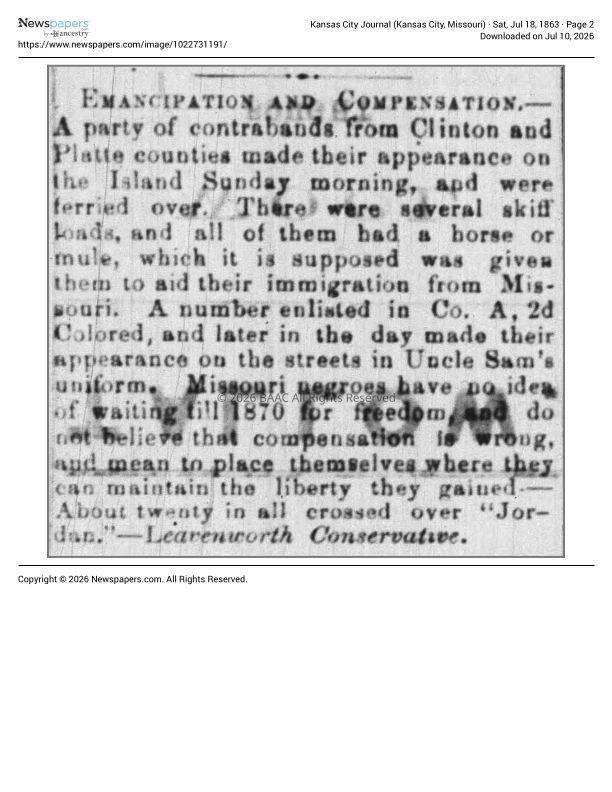
Emancipation and Compensation - - A party of contrabands from Clinton and Platte Counties made their appearance on the Island Sunday morning and were ferried over. There were several skiff loads, and all of them had a horse or mule, which it is supposed was given to them to aid their immigration from Missouri.
A number enlisted in Co. A, 2nd Colored, and later in the day made their appearance on the streets in Uncle Sam's uniform.
Missouri negroes have no idea of waiting till 1870 for freedom and do not believe that compensation is wrong, and mean to place themselves where they can maintain the liberty they gained. About 20 in all crossed over "Jordan." - Leavenworth Conservative
(Researcher’s note: The 2nd Kansas Colored Infantry was later redesignated the 83rd U.S. Colored Troops.
In May 1861 “At Fort Monroe in Hampton, Virginia, Union Maj. General Benjamin Butler refused to send three fugitives back into the bonds of slavery. He classified the escaping slaves as contraband of war. This term meant that once the fleeing slaves crossed Union army lines, they were classified as property. All enemy property that fell into Union hands constituted contraband and would not be returned.
Because of Butler's actions, a federal policy was instituted on August 6, 1861 - fugitive slaves were declared to be "contraband of war" if their labor had been used to aid the Confederacy in anyway. If found to be contraband, they were declared free.” https://www.nps.gov/articles/living-contraband-former-slaves-in-the-nation-s-capital-during-the-civil-war.htm)Date(s) of Creation
7/18/1863