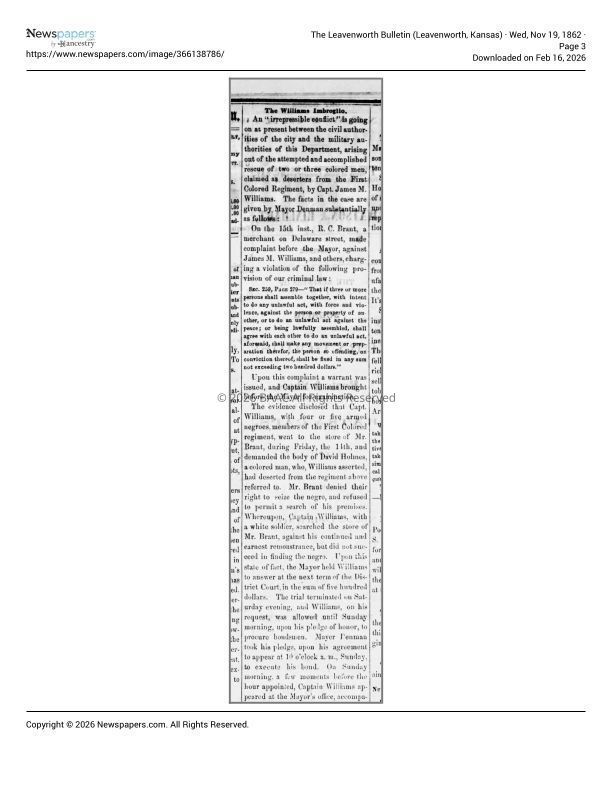
11/19/1862: The Williams Imbroglio.
Entry/Object ID
NP.0382.01Collection
Newspaper ArticlesArchive Items Details
Description
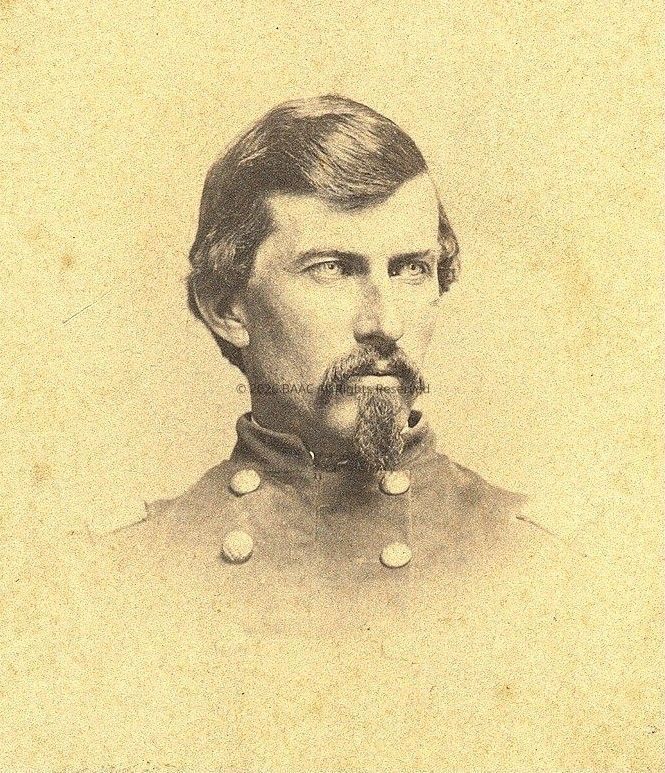
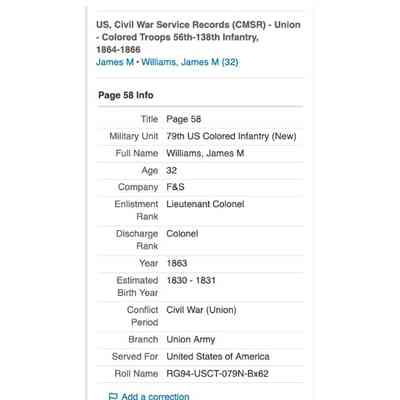
An “irrepressible conflict” is going on at present between the civil authorities of the city (Leavenworth, Kansas) and the military authorities of this Department, arising out of the attempted and accomplished rescue of 2 or 3 colored men, claimed as deserters from the First Colored Regiment by Capt. James M. Williams. The facts in the case are given by Mayor Denman substantially as follows: On the 15th inst. (November 15, 1862), R. C. Brant, a merchant on Delaware street, made complaint before the Mayor, against James M. Williams, and others, charging a violation of the following provision of our criminal law Section 259, Page 279 (text omitted). Upon this complaint a warrant was issued, and Captain Williams brought before the Mayor for examination. The evidence disclosed that Capt. Williams, with 4 or 5 armed Negroes, members of the First Colored Regiment, went to the store of Mr. Brant, during Friday, the 11th, and demanded the body of David Holmes, a colored man, who, Williams asserted, had deserted from the regiment above referred to. Mr. Brant denied their right to seize the negro, and refused to permit a search of his premises. Whereupon, Captain Williams, with a white soldier, searched the store of Mr. Brant, against his continued and earnest remonstrance, but did not succeed in finding the negro. Upon this state of fact, the Mayor held Williams to answer at the next term of the District Court, in the sum of $500 dollars. The trial terminated on Saturday evening, and Williams, on his request, was allowed until Sunday morning, upon his pledge of honor, to procure bondsmen. Mayer Denman took his pledge, upon his agreement to appear at 10 o’clock a.m., Sunday, to execute his bond. On Sunday morning, a few moments before the hour appointed, Captain Williams appeared at the Mayor's office, accompanied by 12 soldiers and a sergeant, fully armed, and inquired for two policemen, whom he said had arrested one of his colored soldiers and taken his arms, and that he wished to arrest the policemen and get the arms. The Mayor asked him if he was prepared to execute his bond, which he refused to, when he was reminded that he had violated his pledge. Williams replied that he had complied with his promise and left with the troops. Mayor Denman and District Attorney Fenlon immediately went to the Fort and applied to Col. Burris for assistance. While at the Fort, Capt. Williams and his detachment arrested the City Jailor, William Gillon, and released a negro confined for violation of a city ordinance, Williams claiming the negro as one of his colored soldiers. Williams and his force then left the city. The Mayor at once made a requisition upon Maj. Gen. Stone, for a sufficient force to enforce the laws and preserve the peace of the city. Before the order was executed Williams returned with an increased force, and left for the Fort. A warrant was issued, upon complaint of Gillon against Williams, for assisting the escape of a prisoner. Col. Burris saw the Mayor about this time and expressed his regret that any collision should occur between the civil and military authorities, saying that he would see Williams and try and induce him to come down and execute the required bonds On Monday morning the Mayor sent a note to Col. Burris by Marshal Jennings demanding the body of Captain Williams, to which the Col. made no reply, but referred it to Major Weed. The same afternoon the Mayor received a communication from Major Weed stating that he had referred the whole matter to Maj. Gen. Blunt for his decision, and had dispatched a messenger to his Headquarters with all the evidence in relation to the case. Major Weed at the same time enclosed a copy of an official letter addressed to him by Capt. J. M. Williams, accusing the Mayor and Policemen of Leavenworth of having entered into a conspiracy to break up and disband the 1st Regiment of Kansas Colored Volunteers under his command, and asking that the parties to the conspiracy be arrested and the charges investigated. Maj. Weed informed the Mayor that he requested Col. Burris to detail the force which accompanied Williams, but that he had no knowledge that Williams intended to use the force for the purpose of defying the civil authorities, but for the arrest of deserters. Thus stands this extraordinary and exceedingly complicated proceeding. The results will be important, but as to how it will end is not yet known. (Researcher's Note: From African American Registry - - James Monroe Williams was from Lowville, Lewis County, New York. Before the American Civil War, he was employed as a lawyer in his hometown. On July 12, 1861, Williams entered the Union Army as a captain in the 5th Kansas Cavalry Regiment and was appointed commander of Company F. The unit was organized at Leavenworth, Kansas, beginning that summer and into January of the following year. Williams and his regiment served in the Department of Kansas through June 1862 and then with the Department of Missouri that July. Williams resigned in the fall of 1862 to help organize and train the 1st Kansas Colored Infantry Regiment. The unit was raised that August at Fort Scott, Kansas, and he appointed its commander as a state militia colonel. He led his regiment into battle on October 29 during the Skirmish at Island Mound in Bates County, Missouri, the first-ever instance of Union Army colored soldiers in action. He was commissioned a Union Army lieutenant colonel on January 13, 1863, when his regiment was federalized as the 79th Regiment Infantry U.S. Colored Troops. On May 2, Williams was promoted to the rank of colonel, and on July 1-2, he fought at the Battle of Cabin Creek in the Indian Territory. About two weeks later, he led his regiment during the Battle of Honey Springs, and Williams was wounded in this fight. In December 1863, Williams was assigned command of Roseville, Arkansas, in the District of the Frontier, Department of Missouri. He participated in the Camden Expedition in southern and central Arkansas from March 23 to May 2, 1864. He then exercised brigade command at various times in the District of the Frontier and the VII Corps for the remainder of 1864 through the fall of 1865. Williams and the 79th Regiment Infantry also fought at the Battle of Fort Smith in western Arkansas on July 31, 1864. On October 1, 1865, Williams was mustered out of the volunteer service. He was also commissioned as a captain in the 8th U.S. Cavalry Regiment of the Regular Army on July 28, 1866, commanding Company I." More at https://aaregistry.org/story/james-m-williams-born/)Date(s) of Creation
11/19/1862Other Names and Numbers
Other Names
Name Type
Free BlacksOther Name
Holmes, DavidName Type
EnslavedOther Name
None IndicatedName Type
EnslaverOther Name
None IndicatedOther Numbers
The Leavenworth Bulletin (Leavenworth, KS, 1862-1871): 11/19/1862, p. 3