Description
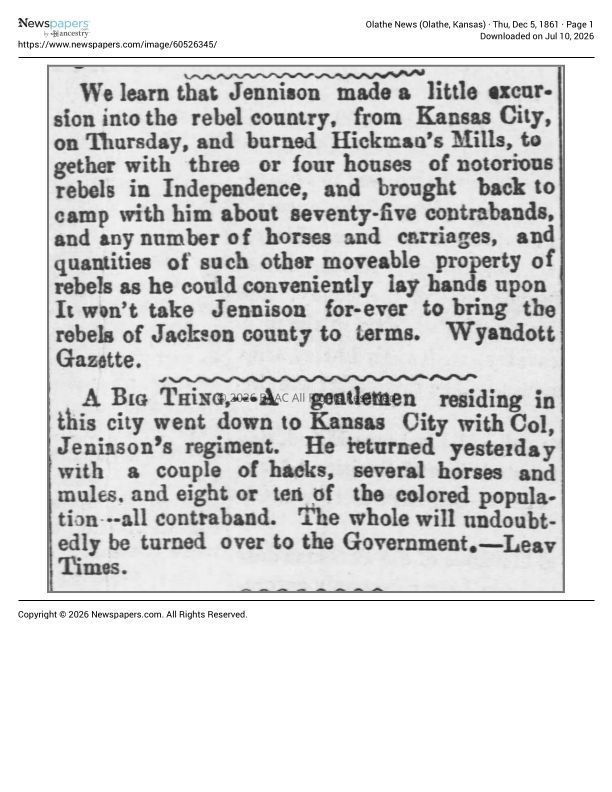
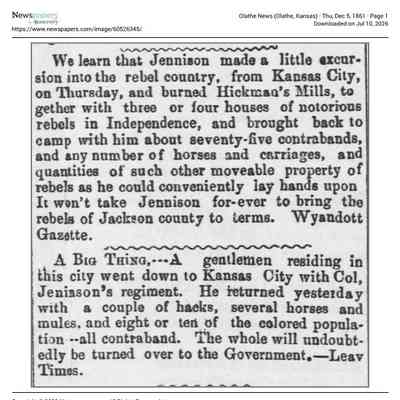
We learn that Jennison made a little excursion into the rebel country, from Kansas City, on Thursday, and burned Hickman’s Mills, together with three or four houses of notorious rebels in Independence, and brought back to camp with him about 75 contrabands, and any number of horses and carriages, and quantities of such other moveable property of rebels as he could conveniently lay hands upon. It won’t take Jennison forever to bring the rebels of Jackson county to terms. Wyandott Gazette.
(Researcher’s note: In May 1861 “At Fort Monroe in Hampton, Virginia, Union Maj. General Benjamin Butler refused to send three fugitives back into the bonds of slavery. He classified the escaping slaves as contraband of war. This term meant that once the fleeing slaves crossed Union army lines, they were classified as property. All enemy property that fell into Union hands constituted contraband and would not be returned.
Because of Butler's actions, a federal policy was instituted on August 6, 1861 - fugitive slaves were declared to be "contraband of war" if their labor had been used to aid the Confederacy in anyway. If found to be contraband, they were declared free.” https://www.nps.gov/articles/living-contraband-former-slaves-in-the-nation-s-capital-during-the-civil-war.htm)Date(s) of Creation
12/5/1861