Description
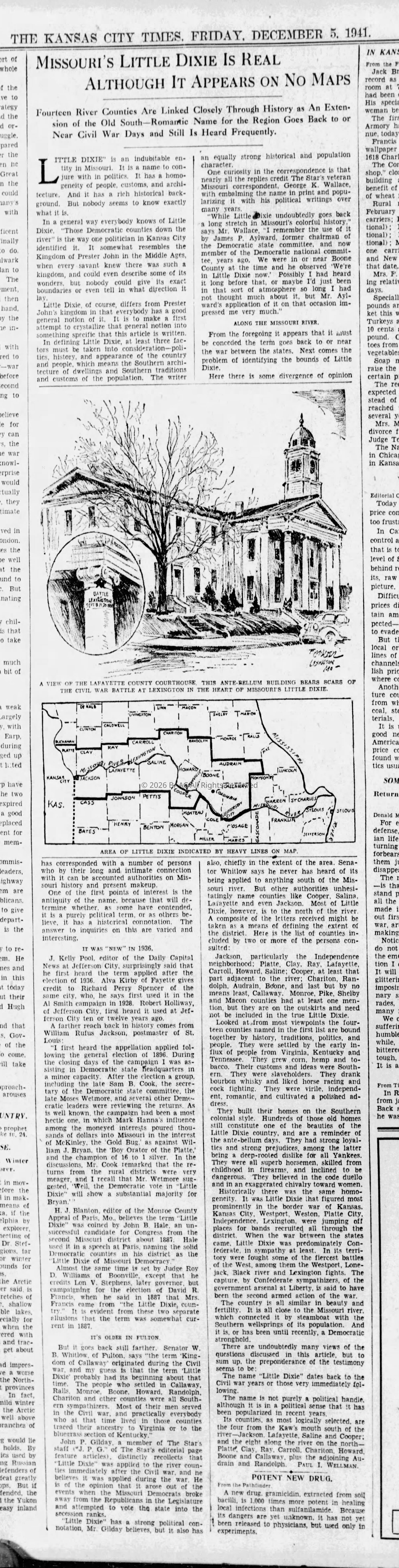
"Missouri's Little Dixie is Real Although It Appears on No Maps - Fourteen River Counties Are Linked Closely Through History as an Extension of the Old South - Romantic Name for the Region Goes Back to or near Civil War Days and Still is Heard Frequently" - - (excerpted from longer article) - - Here is the list of (Little Dixie) counties included by two or more of the persons consulted:
Jackson, particularly the Independence neighborhood: Platte, Clay, Ray, Lafayette, Carroll, Howard, Saline, Cooper, at least that part adjacent to the river; Chariton, Randolph, Audrain, Boone, and last but by no means least, Callaway. Monroe, Pike, Shelby, and Macon counties had at least one mention, but they are on the outskirts and need not be included in the true Little Dixie.
Looked at from most viewpoints the fourteen counties named in the first list are bound together by history, traditions, politics, and people.
They were settled by the early influx of people from Virginia, Kentucky, and Tennessee. They grew corn, hemp and tobacco. Their customs and ideas were Southern. They were slaveholders. They drank bourbon whisky and liked horse racing and cock fighting. They were virile, independent, romantic, and cultivated a polished address.
They built their homes on the Southern colonial style. Hundreds of those old homes still constitute one of the beauties of the Little Dixie country, and are a reminder of the ante-bellum days. They had strong loyalties and strong prejudices, among the latter being a deep-rooted dislike for all Yankees. They were all superb horsemen, skilled from childhood in firearms, and inclined to be dangerous. They believed in the code duello and in an exaggerated chivalry toward women.
Historically there was the same homogeneity. It was Little Dixie that figured most prominently in the border war of Kansas. Kansas City, Westport, Weston, Platte City, Independence, Lexington, were jumping off places for bands recruited all through the district
When the war between the states came, Little Dixie was predominately Confederate, in sympathy at least. In its territory were fought some of the fiercest battles of the West, among them the Westport, Lone Jack, Black River, and Lexington fights. The capture by Confederate sympathizers of the government arsenal at Liberty is said to have been the second armed action of the war.
The country is all similar in beauty and fertility. It Is all close to the Missouri River, which connected it by steamboat with the Southern wellsprings of its population. And it is, or has been until recently, a Democratic stronghold.Date(s) of Creation
12/5/1941