Description
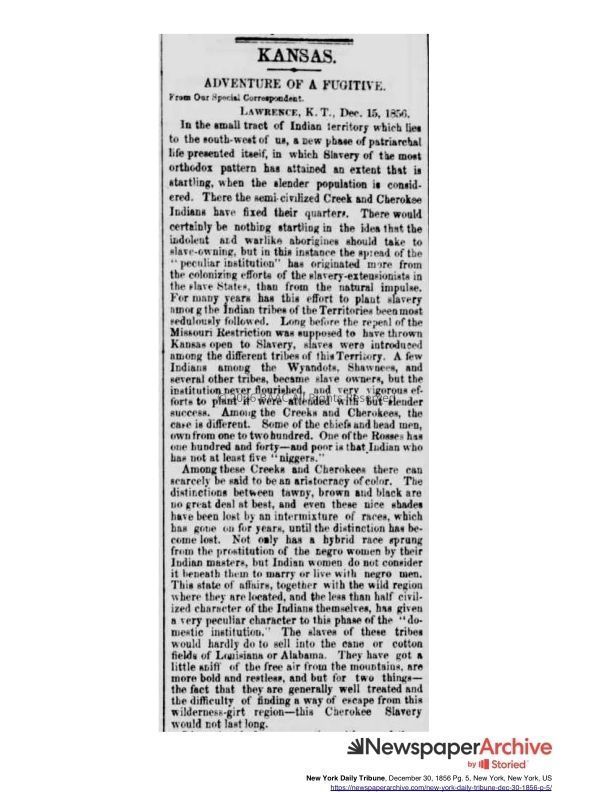
Kansas. - Adventure of a Fugitive - Lawrence, Kansas Territory, December 15, 1856. - In a small tract of Indian territory which lies to the southwest of us, a new phase of patriarchal life presented itself, in which slavery of the most orthodox pattern has a detained an extent that is startling, when the slender population is considered.
There the semi-civilized Creek and Cherokee Indians have fixed their quarters. There would certainly be nothing startling in the idea that the indolent and war like aborigines should take to slave owning, but in this instance the spread of the “peculiar institution” has originated more from the colonizing efforts of the slavery extensionists in the slave states, than from the natural impulse.
For many years has this effort to plant slavery among the Indian tribes of the territories been most sedulously followed. Long before the repeal of the Missouri Restriction was supposed to have thrown Kansas open to slavery, slaves were introduced among the different tribes of this territory. A few Indians among the Wyandots, Shawnee and several other tribes, became slave owners, but the institution never flourished, and very vigorous efforts to plant it were attended with but slender success.
Among the Creeks and Cherokees, the case is different. Some of the chiefs and head men own from 1 to 200. One of the Rosses has 140 and poor is that Indian who has not at least 5 “niggers.”
Among these Creeks and Cherokees there can scarcely be said to be an aristocracy of color. The distinctions between tawny, brown, and black are no great deal at best, and even these nice shades have been lost by an intermixture of the races, which has gone on for years, until the distinction has become lost. Not only has a hybrid race sprung from the prostitution of the Negro women by their Indian masters, but Indian women do not consider it beneath them to marry or live with Negro men.
This state of affairs, together with the wild region where they are located, and the less than half civilized character of the Indians themselves, has given a very peculiar character to this phase of the “domestic institution.” The slaves of these tribes would hardly do to sell into the cane or cotton fields of Louisiana or Alabama. They have got a little sniff of the free air from the mountains, are more bolded and restless, and but for two things - the fact that they are generally well treated and the difficulty of finding a way of escape from this wilderness-girt region - this Cherokee slavery would not last long.
I have just had a conversation with one of these who made his escape last Summer. He is a bold, independent looking specimen. His father was a Negro and his mother was an Indian woman, and he says he was by right free. According to the theory of Negro descent by the mother, I suppose this is strictly correct; but interest, when it enters into conflict with even well-established opinion, will overthrow it, and even more powerful obstacles. And so Williamson - that was the name of the man - was the slave of somebody.
Last summer, some of the Creek Indians found it necessary, or made it suit their convenience, to go to war with their neighbors, the Comanches. As the Comanches are not to be trifled with, an old Creek Chief, who with a handful of men was endeavoring to hold his own in western Kansas, being sorely pressed, sent to the Creek and Cherokee Nation for assistance. The result will illustrate Cherokee slavery.
The Indians persuaded their slaves that the Creek Chief in question preferred them as warriors; and accordingly, a force of nearly 800, most of them slaves, was (according to my informant) mustered for the service. Glad, doubtless, to exchange the plow and hoe for weapons of war, this terrible army marched northward to fight for their masters. With poor arrangements for ambulance and a miserable commissariat, they made much slow progress.
A few days after they started, one or two slaves, who had not volunteered at first, followed and overtook the cortege. These latter were in turn followed as fugitive slaves, and were forcibly taken back – it being explained that they could not go, as they had not volunteered at first.
While this army of slaves was thus slowly marching northward, a Civil War was raging among the white belligerents in Kansas. Whether from this fact, or a general desire to guard the interests of slavery, some white residents among or near the Cherokees, who were “sound on the goose,” used their efforts to stop the expedition. They told the Indian slave holders of the danger of permitting their slaves to acquire such a warlike character, and they finally succeeded in hardening the hearts of these second Pharaohs, so that they “would not let the people go. After having gone some distance, the expedition was overtaken and ordered home.
Among those who went with this expedition was this man Williamson. Having come so far to oblige his master, he concluded to journey further to accommodate himself. He escaped from the party, and succeeded in making his way to Osawatomie, at which place he presented in himself shortly before the battle and burning of that place in August. (Osawatomie, Kansas, was burned on August 30, 1856, during the Battle of Osawatomie in the Bleeding Kansas era.) Although he can speak the English language fluently, he would not betray his knowledge of it, or talk in anything but the Indian, until he was satisfied that he was among friends. I asked him what induced him to seek the white settlements in this quarter.
“I heard of the difficulties,” he said, “and that there was more of liberty in this quarter,” and then added with quiet manner, “The whole party would have come had they known they were so near, and matters here were as they are.”
Only think of such a hybrid addition to Slavery-ruled and “black law” protected Free-Soil-ism that would rule Kansas. But I must briefly state his adventure, which occurred about a week ago:
A few weeks ago, Williamson crossed the Kansas River to the north side, and hired himself to a Free State man near the Stranger Creek. There his principal duty was taken care of a number of horses. Eight days ago two Pro-Slavery men (ruffians, rather) passed that way, and noting Williamson concluded that he would make a fine prize. As they were riding past they stopped and spoke to him, and told him they were going to Lecompton.
Shortly afterward they returned, when he was at the stable, and rode up to him. After some conversation one of them eyed Williamson very sharply, and said:
“You belong to old Mr. (unnamed) in Platte County.”
“No, I don’t. I never was in Platte County,” said Williamson.
“Oh, you need not deny it. We know you mighty well, and know all about it.
“You’ve seen the hand-bill offering a reward for and describing this man,” said Ruffian number one to Ruffian number two, in a familiar tone.
“Yes, and he’s just the description,” was the response.
Williamson, who is not a man to be trifled with, hereupon began to talk very sharp to the two men, and, as he said, “told them what he thought of them.”
After a good deal of talk the two men pulled out their revolvers and pointed them at Williamson, who stood in the stable door. The Free State man, by whom he was hired, was in the stable, but as soon as he saw the pistols, cried, “Let me out! Don’t shoot me!” and having secured his own person, left the other parties to settle their difficulties as they pleased.
“Take the road, and go before us!” ordered one of the men.
Williamson paid no attention to this, but left the stable and walked directly for the house.
“Damn you, take the road!” shouted they, seeing he paid no attention to them. He walked steadily to the house. One of the men began firing at him. The first two shots missed their aim but at the third fire the ruffian hit Williamson near the region of the heart. The ball glanced off the rib, saving the vitals, but inflicting a severe flesh wound.
Williamson ran into the house and got a rifle. The man who had shot him turned and fled. Williamson, fired by pain and rage, followed him fleetly on foot. There was a chase. The coward horseman leaped his horse down a bank, and rode into the brush, so that his pursuer lost sight of him.
Disappointed, he turned on the other who had remained. The man was for riding off but Williamson told him if he did he was a dead man.
Although armed with a revolver, this ruffian began to beg for his life. “It was only a drunken frolic, “he said, and declared that he had not shot.
Williamson at this moment discovered that he had lost the cap from his rifle, in the chase after the first man, but he ordered the man from his horse and compelled him to give up his revolver, of which he got possession. He showed it to me. It was a 4-inch Colt. His wound is healing, and he has heard no more of the two ruffians.
But such a “frolic” is a mere trifle for a Kansas “Law-and-Order” man.Date(s) of Creation
12/30/1856