Name/Title
[Sex is Not a Dirty Word Pinback Button]Entry/Object ID
2024.01.19Tags
OrganizationsDescription
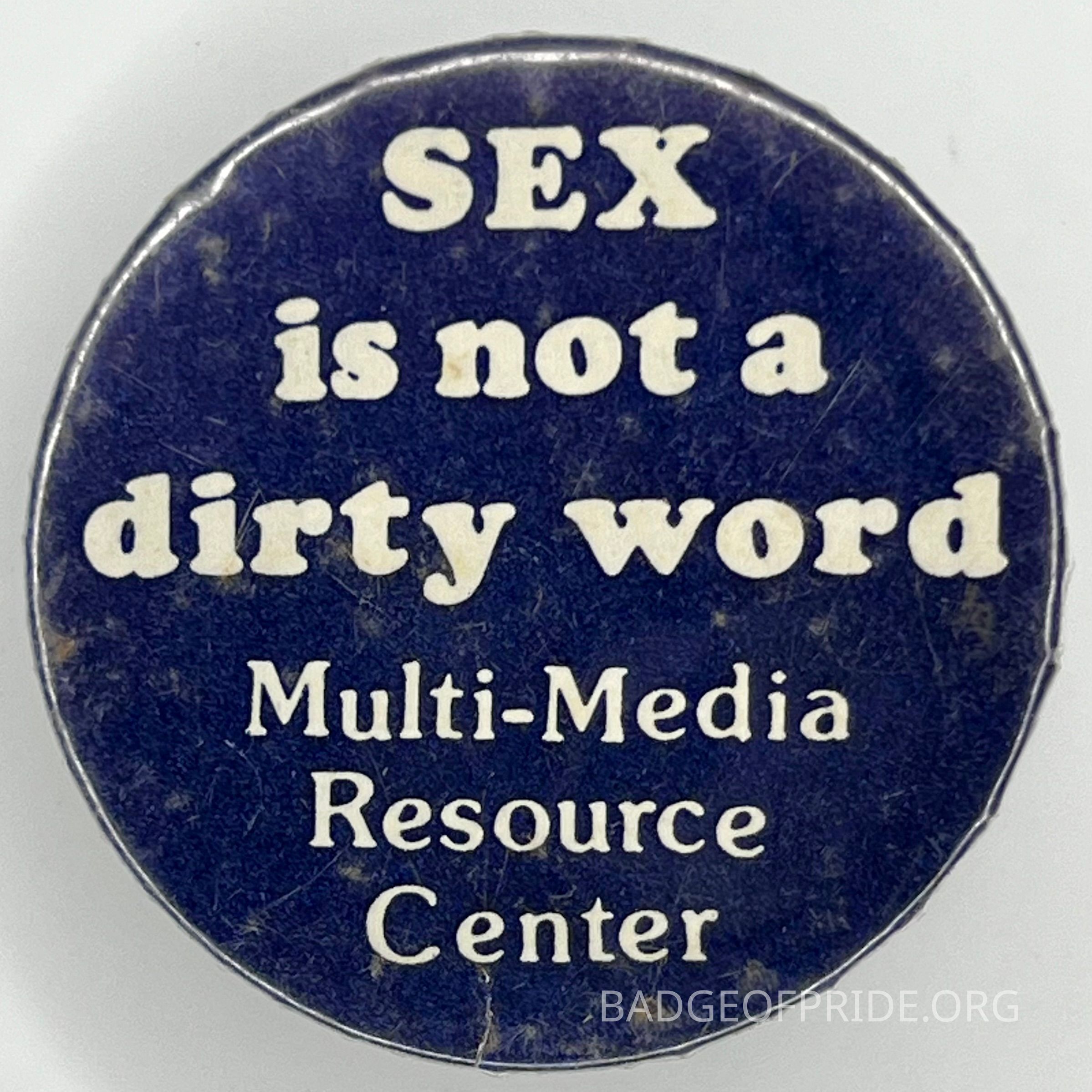
A circular, blue pinback button reading in white text "Sex is not a dirty word, Multi-Media Resource Center." Scratches and worn parts of the pin are visible on its surface.Item Type
Pinback buttonContext
From Lucy Talbot Allen: "In 1968, a coalition of sex-positive, politically progressive San Francisco religious leaders and homophile activists founded the National Sex Forum (NSF). Led by the Methodist Reverend Dr. Ted McIlvenna, the NSF began producing films the following year, and was soon supplemented by a distribution arm called the Multi-Media Resource Center (MMRC). The MMRC distributed both NSF films – most of them directed by McIlvenna’s friend and fellow minister Laird Sutton – and erotic avant-garde cinema by a host of filmmakers from the Bay Area and beyond, among them James Broughton, Gunvor Nelson, Barbara Hammer, Jerry Abrams, Jan Oxenberg, and Honey Lee Cottrell.
The MMRC was radical not only in its ethos of sexual freedom and openness as compatible with Christian doctrine, but also in its framing of experimental film as a form of sex education. While some films produced by the NSF consist primarily of structured group conversations on topics of sex and sexuality, many depict real couples and friends engaging in unsimulated and unscripted sex. Termed “pattern films” or “sexual cinéma vérité,” they reflect McIlvenna’s belief that “almost all sex problems have been directly related to either a lack of information or else a religiously reinforced sex-negative attitude.”
The films of the MMRC concern various aspects of human sexuality and sex education. Many address queer sexuality, women’s sexual autonomy and pleasure, the sex lives of people with physical disabilities, and the intersection of sexuality and aging. Produced in San Francisco beginning in the late 1960s, in the midst of the free love, women’s liberation, gay liberation, and disability rights movements, these films shed light on the historical context from which they emerged. They also played a key role in the development and composition of Sexual Attitude Reassessment, or SAR, a technique originated by McIlvenna and his collaborators that involved multi-day intensive sessions of sexually explicit motion picture and slide film and accompanying discussion. Crucial to the practice of humanistic sexology embodied by McIlvenna’s later venture, the Institute for the Advanced Study of Human Sexuality, SAR is used to this day – albeit in a modified form – in the training and certification of sex educators and therapists.
Despite its contacts with legendary avant-garde filmmakers like Broughton and Hammer, and its long afterlife in the form of McIlvenna’s Institute (which only ceased operations in the mid-2010s, shortly before his death), the MMRC is little-known today. This series will introduce a modern audience to a host of works that have never (or very rarely) been shown theatrically. In the following programs, films that were distributed by the MMRC are paired with those that could have been: erotic avant-garde, educational, and agitprop films from the 1960s and ’70s that share an ethos of free sexual expression." (Linked in this record)Collection
Adrian J. Cardwell CollectionMade/Created
Date made
circa 1970 - circa 1980Time Period
20th CenturyPlace
City
San FransiscoState/Province
CaliforniaLocation
PacificRegion
WestContinent
North AmericaLexicon
Nomenclature 4.0
Nomenclature Secondary Object Term
Button, PoliticalNomenclature Primary Object Term
Symbol, PoliticalNomenclature Sub-Class
Belief SymbolsNomenclature Class
Personal SymbolsNomenclature Category
Category 08: Communication ObjectsGetty AAT
Concept
LGBTQ+, memorabilia, insignia buttonsOther Names
Name Type
Organization NameOther Name
Multi-Media Resource Center (MMRC)Valuations
Valuation Type
Donor EstimateValue
$5.00Date
Sep 22, 2026Create Date
September 22, 2026Update Date
October 25, 2026