Name/Title
1st SGT E-8 First Sergeant ASU Blue PatchEntry/Object ID
2022.C.FIC.15Description
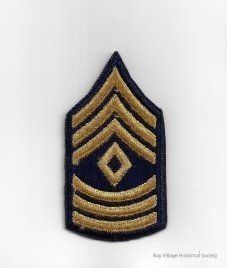
Men's 1st SGT E-8 First Sergeant ASU Blue Rank Chevrons
Navy blue backing with three chevrons pointing up, a diamond and three arcs below facing up.
In 1920, the rank system was simplified, and the rank stripes were reduced to 3.125 inches in width. The rank of sergeant major was discontinued and the confusing system of trade badges and rank insignia was abolished. Branch-of-service colored stripes were abandoned in favor of standard buff-on-blue stripes. The use of bars under chevrons to designate senior support arm NCOs was abolished, and all branches used arcs under chevrons to denote senior NCOs. The rank insignia was reduced to seven grades and eight ranks (the first sergeant was considered a senior grade of technical sergeant) and were numbered from "G1" for the highest rank (master sergeant) to "G7" for the lowest (private second class). Subdued olive-drab-on-khaki stripes were created for wear with the class C khaki uniform.
The rank of specialist was adopted. It was grade G-6 but received a pay bonus from $5 (specialist sixth class) to $25 (specialist first class). Specialists had the same single chevron of a private first class but were considered between the ranks of private first class and corporal in seniority. This was very confusing, as the difference between a private first class and a specialist could not be determined at first glance, in addition to any specialty they may have had, as trade badges had been eliminated. Unofficial insignia adopted by post commands granted specialists one to six arcs under their chevron (ranging from one for specialist sixth class to six for specialist first class) to indicate their grade, and trade badges inset between their stripes to indicate their specialty.
1942–1948
This section does not cite any sources. Please help improve this section by adding citations to reliable sources. Unsourced material may be challenged and removed. (November 2020) (Learn how and when to remove this template message)
See also: United States Army enlisted rank insignia of World War II § 1942–1948
In 1942, there were several overdue reforms. The pay was increased for all ranks for the first time in two decades, and combat pay was introduced. The rank of the first sergeant was now considered a junior version of master sergeant and the confusing specialist ranks were abolished. The specialist ranks were replaced by the distinct ranks of technician third grade (equivalent to a staff sergeant), technician fourth grade (equivalent to a sergeant), and technician fifth grade (equivalent to a corporal). Technicians were inferior to non-commissioned officers of the same grade but superior to all grades below them. They had the same insignia as the regular rank of their grade, but with a cloth "T" inset below their stripes. The subdued insignia was abolished, but could still be worn with the Class C khaki uniform until they wore out. https://en.wikipedia.org/wiki/United_States_Army_enlisted_rank_insigniaCollection
Military CollectionRelationships
Related Entries
Notes
2022.C.FIC.18, 2022.C.FIC.19, 2022.C.FIC.20