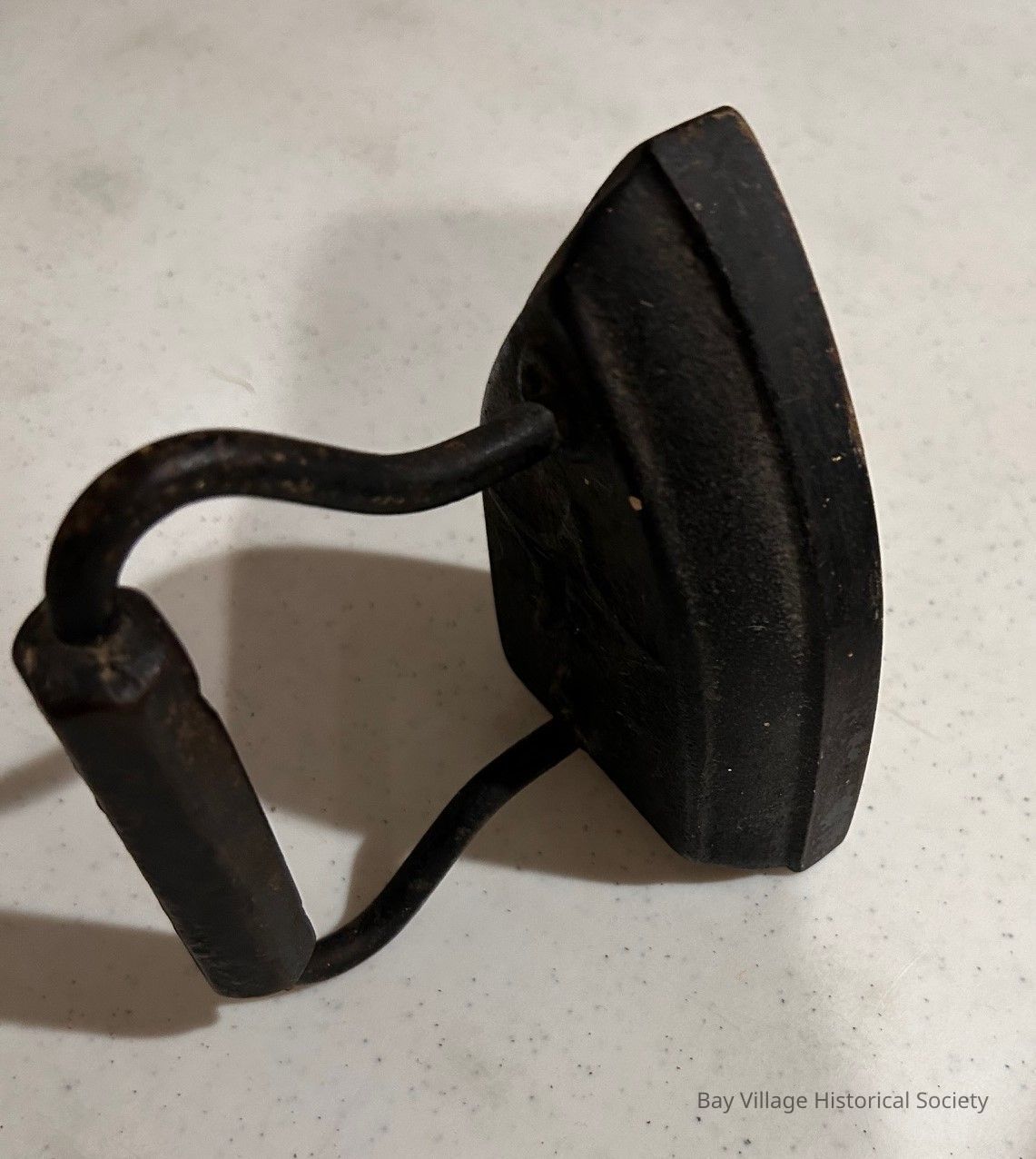
Name/Title
FlatironEntry/Object ID
E.2024.031Description
Flatiron with a six sided handle having a raised edge down the center. Handle curves on the ends but go down directly to the iron base. On the handle is imprinted GENEVA ILL. [See information below.] "6" on the base.
Flatirons could be heated atop cast iron stoves, making the job much easier and cleaner than fire. By 1870, wooden handles were used, preventing users from receiving burns, as wood does not retain heat in the manner of iron. Gas irons were patented in the 1870s, making the devices even easier to use.
Flat irons, sad irons
1 flatiron with a heavy base, 2 smallerBlacksmiths started forging simple flat irons in the late Middle Ages. Plain metal irons were heated by a fire or on a stove. Some were made of stone, like these soapstone irons from Italy. Earthenware and terracotta were also used, from the Middle East to France and the Netherlands.
Flat irons were also called sad irons or smoothing irons. Metal handles had to be gripped in a pad or thick rag. Some irons had cool wooden handles and in 1870 a detachable handle was patented in the US. This stayed cool while the metal bases were heated and the idea was widely imitated. (See these irons from Central Europe.) Cool handles stayed even cooler in "asbestos sad irons". The sad in sad iron (or sadiron) is an old word for solid, and in some contexts this name suggests something bigger and heavier than a flat iron. Goose or tailor's goose was another iron name, and this came from the goose-neck curve in some handles. In Scotland people spoke of gusing (goosing) irons.
You'd need at least two irons on the go together for an effective system: one in use, and one re-heating. Large households with servants had a special ironing-stove for this purpose. Some were fitted with slots for several irons, and a water-jug on top.
At home, ironing traditional fabrics without the benefit of electricity was a hot, arduous job. Irons had to be kept immaculately clean, sand-papered and polished. They must be kept away from burning fuel, and be regularly but lightly greased to avoid rusting. Beeswax prevented irons sticking to starched cloth. Constant care was needed over temperature. Experience would help decide when the iron was hot enough, but not so hot that it would scorch the cloth. A well-known test was spitting on the hot metal, but Charles Dickens describes someone with a more genteel technique in The Old Curiosity Shop. She held "the iron at an alarmingly short distance from her cheek, to test its temperature..."
Box iron with wooden handle pressing bright clothThe same straightforward "press with hot metal" technique can be seen in Egypt where a few traditional "ironing men" (makwagi) still use long, heavy pieces of iron, pressed across the cloth with their feet. Berber people in Algeria traditionally use heated metal ovals on long handles, called fers kabyles (Kabyle irons) in France, where they were adopted for intricate ironing tasks. http://www.oldandinteresting.com/antique-irons-smoothers-mangles.aspx
Housewives took great care of their irons to keep the ironing surface clean. The surface was sanded and either a bit of grease or more often beeswax was rubbed on the surface to make sure it glided over the cloth and didn’t scorch material.
Although folding ironing board were available, few households owned one. Instead, a thick cloth would be laid on the kitchen table or on a board laid between two chairs as an ironing surface. The lower surface on the chair made it easy for a child to handle the chore.
... clever housewife invented a removal wooden handle.
Mary Florence Potter was nineteen when she applied for a patented for her removable wooden handled flat iron in 1871. She was one of only a few women issued a patent during the 1800s.
The only way she could successfully sell her invention was by selling the patent to The American Manufacturing Company. They sold Mrs. Potts flat iron as a kit containing two irons and a wooden handle.
The wood did not conduct heat, therefore making ironing far safer.
They sold her flat iron from 1876 to 1951. https://www.hhhistory.com/2021/02/sadirons-flutting-irons-and-bit-of.html
The W. H. Howell Company of Geneva, Illinois was a leading producer of cast iron sad irons, trivets and fluters from the mid 1800s into the early 1900s. But as the availability of electricity increased, the demand for those devices decreased and they eventually became obsolete. https://trivetology.com/2021/11/15/w-h-howell-company-sad-iron-stands/Collection
Pioneer DaysDimensions
Height
5 inWidth
3-1/4 inLength
5-1/4 inDimension Notes
Handle 3.5"