Name/Title
Nancy Ann Storybook DollEntry/Object ID
2023.Y.FIC.41Description
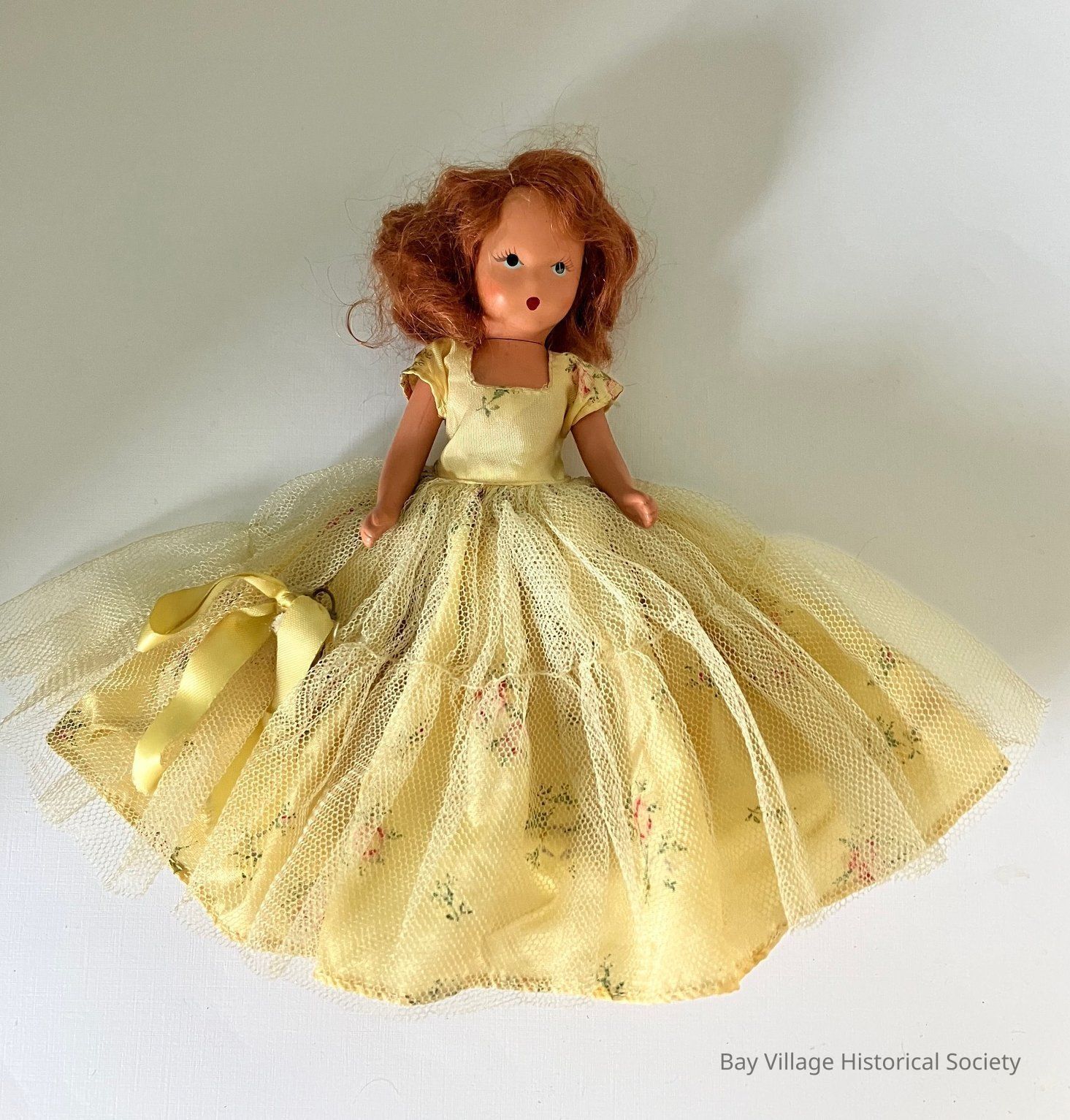
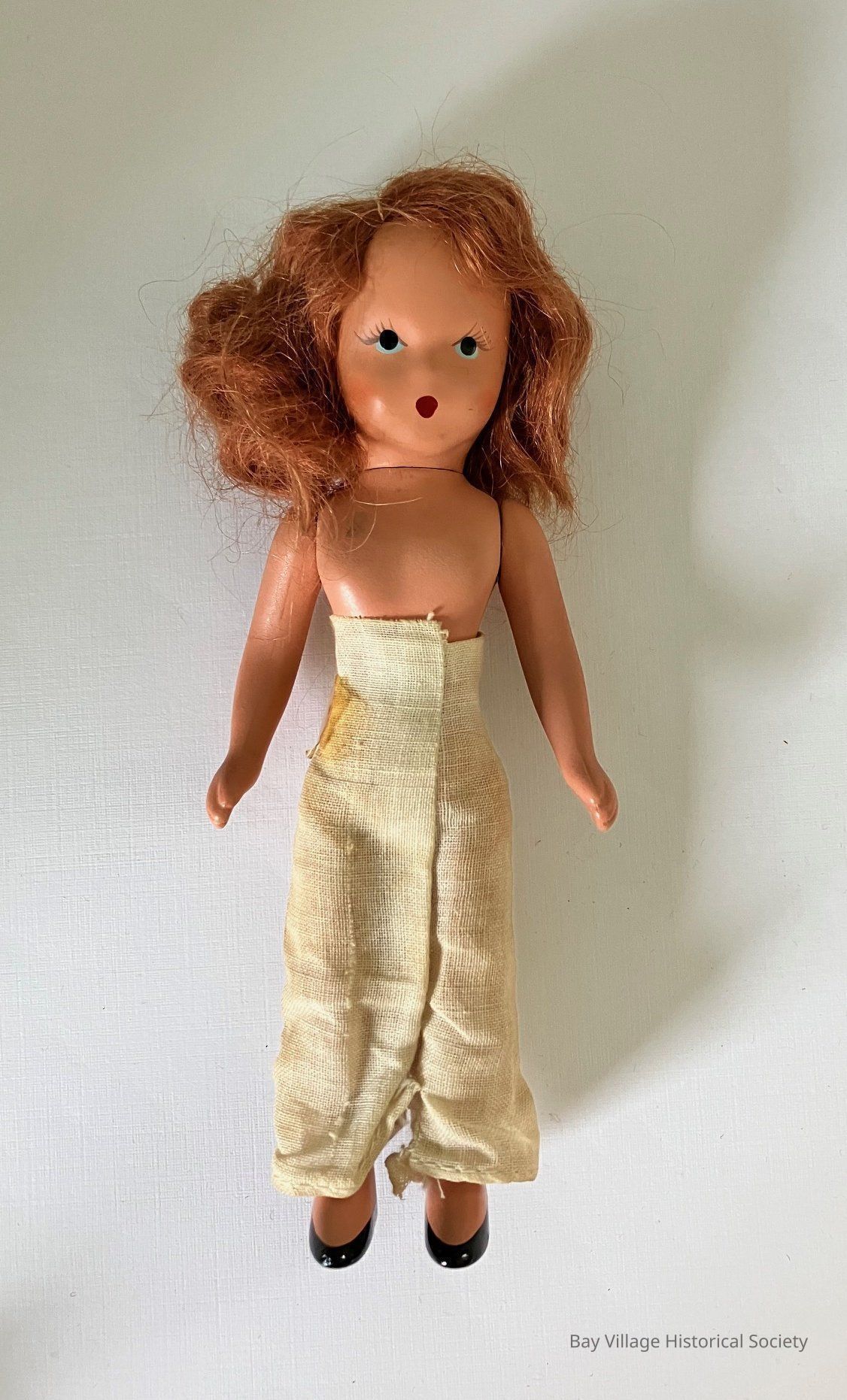
Nancy Ann Storybook Doll. Red mohair wig that is stitched across the top. Blue painted and top lashes, red mouth, formed nose. Painted bisque (about 1960 they switched to plastic). Head, arms and legs turn. Painted black slippers. Not jointed arms and legs at knee and elbow.
Pantaloons are muslin and are taped on with scotch tape possibly from the factory.
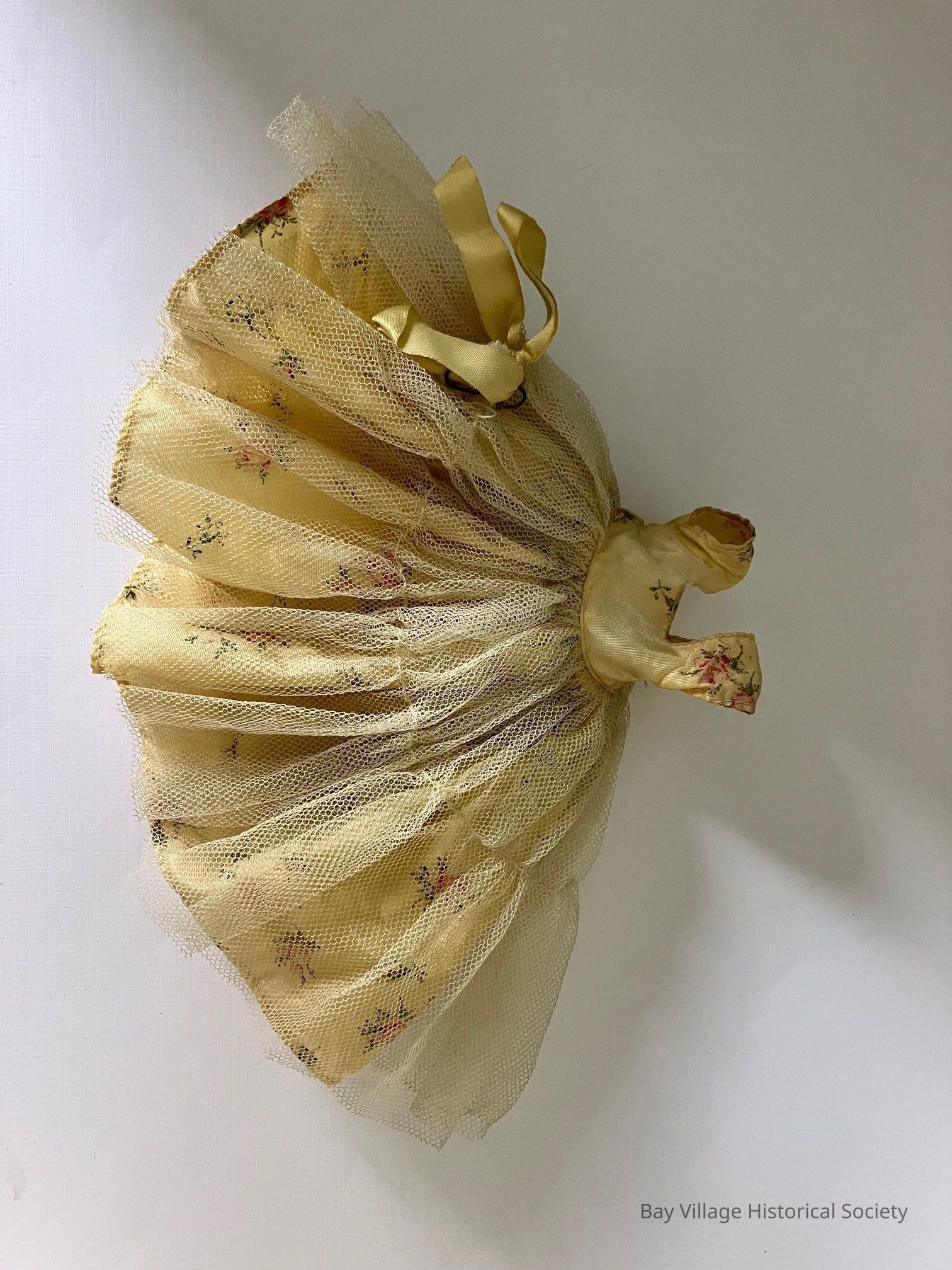
B. Yellow print taffeta dress with yellow net overskirt that is stitched horizontally half way down and attached at the waist. The overskirt has a white flower attached with yellow satin ribbon. Square neck and attached cap sleeve. Single snap at the back where it comes to a V.
Patterns were published and people were encouraged to make shelves to display all of these affordable dolls. They were designed so a middle class family was able to purchase.
Nancy Ann Abbott, Doll Maker On Coast and Ex-Actress, Dies
SAN MATEO, Calif., Aug. 11 (AP) — Nancy Ann Abbott, designer and manufacturer of Nancy Ann Storybook Dolls, died yesterday. She was 63 years old.
Miss Abbott's doll-making enterprise was inspired more than 20 years ago when she dressed a doll as a favor to a friend.
She was a founder of the San Francisco Orchid Society.
Like most little girls, Nancy Ann Abbott loved dolls. Unlike most, she used this enthusiasm to gain wealth and fame. She founded the Nancy Ann Storybook Dolls concern and at one time was the most widely known doll manufacturer on the West Coast.
Like many another young American woman, she went to Hollywood in the nineteen-twenties to try to get into motion pictures. She moved up from bit dancing parts to leads in a few Westerns.
Contemporaries remember her as a red-haired, blue-eyed womand from San Francisco who might make the grade in pictures. She had always liked to dress dolls. One day a friend asked her to dress a doll as a gift.
She did a few simple things to a small ceramic doll. Many who saw it wanted one like it and in a few days she had several hundred orders. She called it “Hush-a-bye Baby.” As she put it:
“The idea Became so popular that I had to drop it; I couldn't (fill all the orders.”
In 1944 Miss Abbott was the mainspring in Nancy Ann Dressed Dolls, Inc. Business was so good in her San Francisco studio that she had to have all her telephone lines disconnected so work could proceed on the enormous backlog of orders.
She interrupted her journeys into toyland to fill a $50,000 contract for cups, platters and dishes for Navy hospitals during World War II.
Later, Miss Abbott's doll production increased, with about 10,000 a day moving out of her plants at Berkeley and Stockton in California. She also turned out nests of kitchen bowls.
In 1943 Miss Abbott's doll enterprises were grossing $1 million a year.
https://www.nytimes.com/1964/08/12/archives/nancy-ann-abbott-doll-maker-on-coast-and-exactress-dies.html
There were hundreds of styles of storybook dolls. They would run out of fabric when producing and just rename the doll with new fabric. They could be associated with stories, nursery rhymes, holidays, etc. Designer was the name of the designer, the company was out of California. Barb Comienski 2.8.2023
The Story Behind The "Storybook" Dolls
Smack Dab In The Middle: Design Trends Of The Mid-20th Century
May 21, 2021
Back in the 1940s and 50s, every little girl had one. Scratch that. Back in the 1940s and 50s, every little girl had lots of them. They were Nancy Ann Storybook Dolls, and they bridged the gap between Tiny Tears and Barbie.
Doll designer Nancy Ann Abbott was born in 1901 and studied at the College of Arts and Crafts in Oakland, Calif. However, Hollywood beckoned, and Nancy moved there in search of a film career, scoring minor roles in such movies as 42nd Street.
To while away the time between takes, Nancy put her arts and crafts talents to good use. Tiny dolls were dressed in outfits Nancy stitched up, resembling the costumes in whatever movie she was working on. The finished products were given as gifts to her friends on the set.
When dreams of a Hollywood career dimmed, Nancy moved to San Francisco and opened a bookshop. With the Depression still in full swing, she saved pennies by decorating the shop with her beautifully dressed dolls. The dolls attracted more sales than the books, and Nancy finally accepted what folks had been telling her all along: You should be designing full time! In 1936, the Nancy Ann Dressed Dolls Company was ready for business. Its assets were $125 in capital, Nancy's apartment (outfitted with a kiln, sewing machine, and ironing board), and, most importantly, Nancy's talent and boundless energy (16 to 18 hour days were the norm).
Despite her Hollywood experience, Nancy Ann was inherently shy. Luckily for her, business associate Allan (Les) Rowland, who joined forces with her in 1937, was not. The company's financial and promotional guru, Rowland quickly sewed up a contract for Hush-a-Bye Baby dolls, their made-in-Japan bodies clothed in outfits by Nancy. Sales blossomed, and the firm?s headquarters moved from Nancy's apartment, eventually landing at The Doll House in downtown San Francisco.
Although the early Storybook series, starring such familiar faces as Red Riding Hood and Little Bo Peep, was an Abbott favorite, the Storybook umbrella soon covered numerous additional series (Around the World Dolls, Dolls of the Month, etc.). By 1942, Nancy Ann Storybook Dolls were raking in over a million dollars a year. By 1943, there were 125 different doll characters in the inventory. When the 1940s ended, Nancy Ann was the country's largest doll producer. The peak came in the 1950s, with the firm churning out over 12,000 dolls a day.
Most dolls could be dressed in an endless array of outfits. But when it came to Nancy Anns, each doll arrived in a unique, almost impossible-to-remove costume. If you wanted a different look, then you (or more likely Mom) bought another Nancy Ann. At 65 cents to $1.95, an entire sorority of the dolls was within the range of almost every pocketbook.
The major enticement Those costumes. Each Nancy Ann was extravagantly arrayed in lavish taffetas and organdies, often trimmed with imported lace. Mohair wigs were topped off with eye-catching picture hats, oversize bows, and other headpieces. The bisque (later, plastic) dolls themselves, with their fixed expressions, weren't the selling point. It was Nancy Abbott's wonderfully detailed costumes that had collectors clamoring. And it wasn't just little girls driving sales. As one department store noted, Nancy Ann fans ranged from 6 to 60. Plus, at an average 5.5 inches high, even a bevy of them didn't take up much room.
After Nancy Abbott's death in 1964, the company was sold, although various reinterpretations of her Storybook dolls have been released over the ensuing years. Competitors such as K & H and Dollcraft periodically brought out their own storybook dolls, but it's the official Nancy Anns that continue, as the ads promised, to make your eyes sparkle. For today's collectors, the work of the original Doll Lady remains readily attainable; over 2,000 Storybook Dolls were recently listed on eBay, most priced under $20. Nancy Ann Abbott's Little Stars of Toyland continue to captivate.
Nancy Ann dolls courtesy of Jan Andreasen.
https://antiquesandauctionnews.net/articles/The-Story-Behind-The-%22Storybook%22-Dolls/
All photos by Donald-Brian Johnson.Dimensions
Height
6-1/2 inWidth
1-3/4 inDepth
1-1/2 inRelationships
Related Person or Organization
Person or Organization
Abbot, Nancy Ann