Tracing the picturesque old Bay Village Newspaper Clipping

Newspaper clipping between pages 72 and 73 of Aldrich/Rose Album (left): Origsize: H 12" x W 9.5"; Origformat: Print-Photographic; Resolution: 600 DPI
Newspaper clipping between pages 72 and 73 of Aldrich/Rose Album (left)

Origsize: H 12" x W 9.5"; Origformat: Print-Photographic; Resolution: 600 DPI

Name/Title

"Tracing the picturesque old Bay Village" Newspaper Clipping

Entry/Object ID

2021.01.1.038

Scope and Content

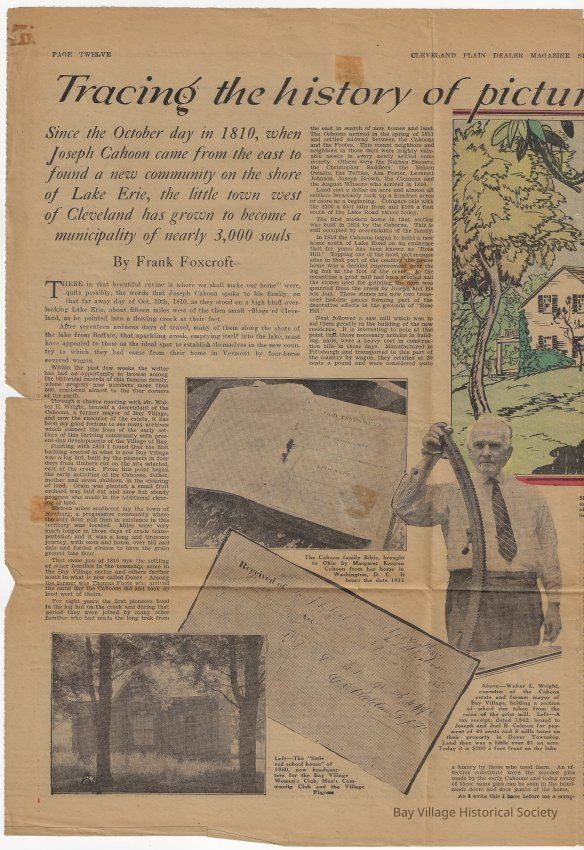
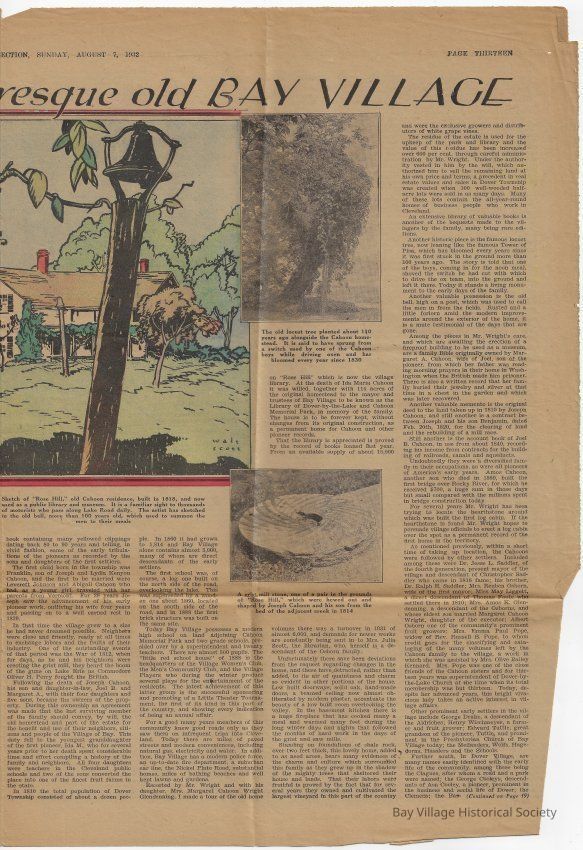
Found between paged 72 and 73: single sheet from Cleveland Plain Dealer Magazine Section, Sunday, August 7, 1932, page twelve and thirteen. "Tracing the picturesque old Bay Village" by Frank Foxcroft. "Since the October day in 1810, when Joseph Cahoon came from the east to found a new community on the shore of Lake Erie, the little town west of Cleveland has grown to become a municipality of nearly 3,000 souls." Discusses the Cahoons arrival in Dover. States Thomas Foote arrived the same day which is incorrect. Mentions early settlers. Relays information from Ida's book regarding their early days and building the gristmill and sawmill when they heard Commodore Oliver Perry's guns on Lake Erie. Discusses building Rose Hill and having nails brought from Pittsburgh and transported by wagon they retailed at 30 cents/pound and considered a luxury. Wooden pins were used instead as can be seen in the doors and door jambs. First child born was [Joseph] Franklin to Joseph and Lydia. First marriage of Leverett Johnson and Abigail Cahoon. Joseph lived four years after Lydia. Following Joseph's death, Joel and Margaret A. with their four daughters and five sons became the owners of the property. He wrote a will saying the last surviving child would pass the land to the city. All four daughters were teachers. 1810 about a dozen people lived in Dover. In 1860 it had grown to 1,814 and Bay Village alone 3,000. The first school was a log one on the north side of the road...superseded by a wooden one about 1860, located on the south side of the road, and in 1888 the first brick structure was built on the same site. Today...modern high school and two grade schools...superintendent and twenty teachers...500 students. The "little red school house" of 1888 is the headquarters of the Village Women's Club and the Men's Community Club and the Village Players who during the winter months produce several plays for the entertainment of residents. Discusses the quaintness with the low doorways, solid oak, handmade doors, a beamed ceiling now almost obliterated. In the basement is a large fireplace that has cooked many meals and warmed many feet. Foundations of shale rock, over two feet thick...that their labors were fruitful is proved by the fact that for several years they owned and cultivated the largest vineyard in this part of the country and were exclusive growers and distributors of white grape vines. The residue of the estate is used for upkeep of the park and the library and the value of this residue has been increased over 600 percent through careful administration by Mr. Wright. Under the authority vested in him to sell the remaining land at his own price and terms, a precedent in real estate values and sales in Dover Township was created when 100 well-wooded half acre lots were sold in as many days. Many of these lots contain the all-year-round homes of business people who work in Cleveland. An extensive library of valuable book is another of the bequests...many being rare editions. Another historic piece is the famous locust tree, now leaning like the famous Tower of Pisa, which has bloomed every year since it was struck in the ground more than 100 years ago. The story is told that one of the boys, coming in for the noon meal, shoved the switch he had cut with which to drive the ox team, into the ground and left it there. Today it stand a living monument to the early days of the family. Another valuable possession is the old bell, high on a post, which was used to call the men in from the fields. Rusted and a little forlorn amid the modern improvements around the exterior of the home, it is a mute testimonial of the days that are gone. Among the pieces in Mr. Wrights care, and which are awaiting the erection of a fireproof building to be used as a museum are a family Bible originally owned by Margaret A. Cahoon...from which her father was reading morning prayers in their home in Washington when the British made him prisoner. There is also a written record that her family buried their jewelry and silver at that time in a chest in the garden and which was later recovered. Another valuable manumit is the original deed to the land taken up in 1810 by Joseph Cahoon and still another is a contract between Joseph and his son Benjamin, dated Feb. 20the, 1820, for the clearing of land and the rebuilding of a mill race. ...account book of Joel B. Cahoon, in use from about 1840, recording his income from contracts for the building of railroads, canals and aqueducts. ...Amos Cahoon, another son who died in 1860, built the first bridge over Rocky River, for which he received $700, a huge sum in those days. For several years Mr. Wright has been trying to locate the hearthstone around which was built the first log cabin. If the hearthstone is found Mr. Wright hopes to persuade village officials to erect a log cabin over the spot as a permanent record of the first home of the territory. Features photographs and sketches: Far left: "The 'little red school house' of 1860, now headquarters for the Bay Village Women's Club, Men's Community Club and the Village Players" Top left: "The Cahoon family Bible, brought to Ohio by Margaret Kenyon Cahoon from her home in Washington, D. C. It bears the date 1811" Bottom left: "A tax receipt, date 1842, issued to Joseph and Joel B. Cahoon for payment of 49 cents and 8 mills taxes on their property in Dover Township. Land then was a little over $1 an acre. Today it is $200 a foot front on the lake" Middle: "Sketch of 'Rose Hill,' old Cahoon residence, built in 1818, and now used as a public library and museum. It is a familiar sight to thousands of motorist who pass along Lake Road daily. The artist has sketched in the old bell, more than 100 years old, which used to summon the men to their meals" Middle, inset: "Walter E. Wright, executor of the Cahoon estate and former mayor of Bay Village, holding a section of wheel rim taken from the ruins of the grist mill" Top right: "The old locust tree planted about 110 years ago alongside the Cahoon home-stead. It is said to have sprung from a switch used by one of the Cahoon boys while driving oxen and has bloomed every year since 1830" Bottom right: "A grist mill stone, one of a pair in the grounds of 'Rose Hill,' which were hewed out and shaped by Joseph Cahoon and his son from the bed of the adjacent creek in 1814"

Collection

Aldrich Family Collection

Relationships

Related Person or Organization

Person or Organization

Bassett, Nathan

Person or Organization

Brown, Joseph

Person or Organization

Cahoon, Amos (son of Jos.)

Person or Organization

Cahoon, Benjamin (son of Jos.)

Person or Organization

Cahoon, Ida M.

Person or Organization

Cahoon, Joel B.

Person or Organization

Cahoon, Joseph

Person or Organization

Cahoon, Joseph Franklin

Person or Organization

Cahoon, Lydia Kenyon

Person or Organization

Glendenning, Margaret Cahoon Wright

Person or Organization

Johnson, Leverette

Person or Organization

Oviatt, Nelson

Person or Organization

Perry, Commodore Oliver Hazard

Person or Organization

Perry, Oliver

Person or Organization

Porter, Asa

Person or Organization

Saddler, Christopher

Person or Organization

Scott, Julia Osborn

Person or Organization

Winsor, August

Person or Organization

Wright, Walter E.

Person or Organization

Cahoon, Margaret Dickson
Related Entries

Notes

NP.01.009