Note Type
1992 Inventory NotesNote
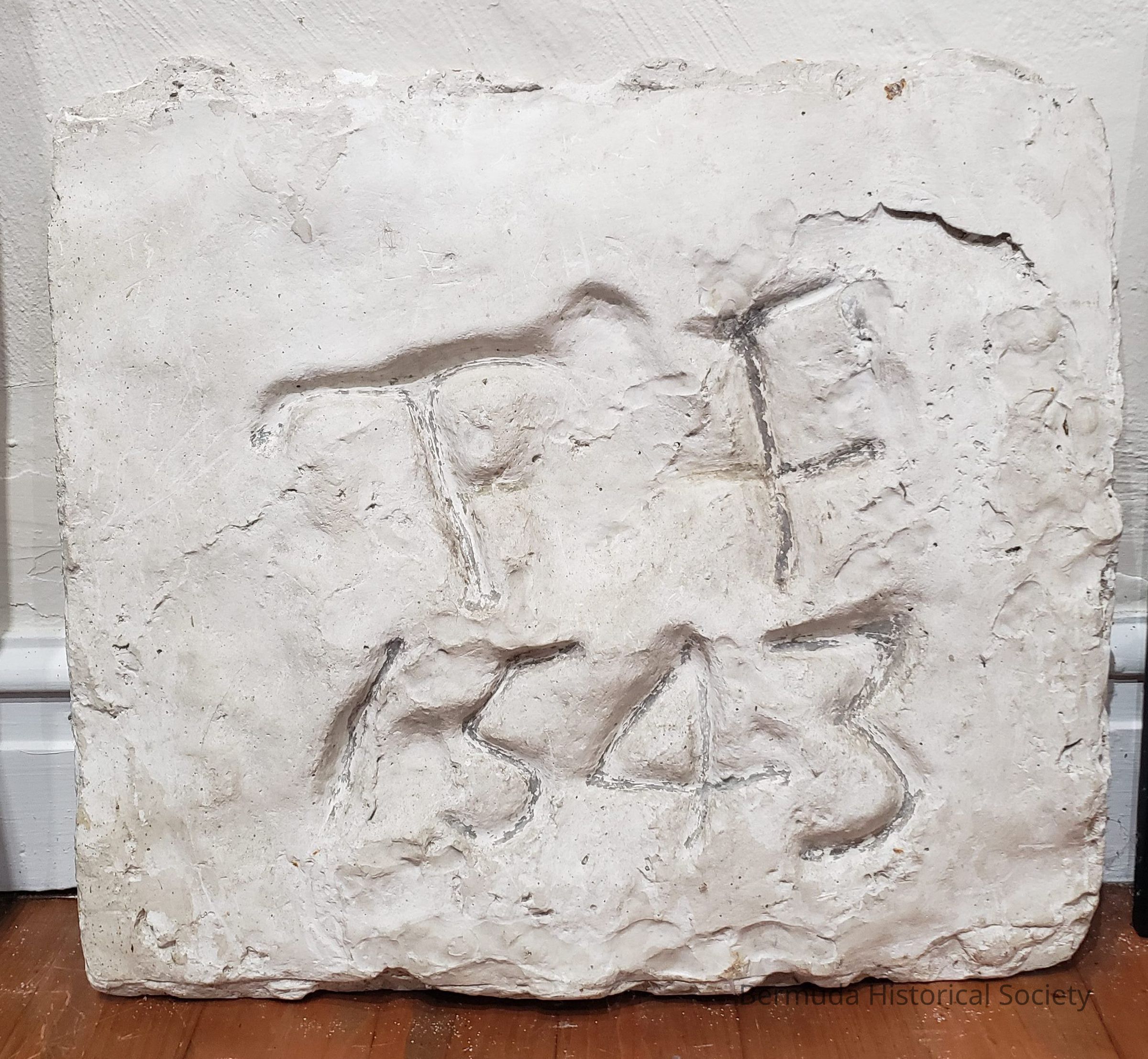
This is a plaster of Paris cast of the carving on the face of a rock some 20 feet above sea level, located near Spittal Pond, South Shore, showing initials that appear to be "F", "T", a cross, and the date, 1543. (This date was 66 years before the shipwreck of the "Sea Venture", when 150 castaways came ashore and spent 42 weeks). Perhaps the inscription of a stranded mariner, possibly Portuguese, Spanish, or French (from the cross) when Bermuda was completely uninhabited by humans and only very few mariners in distress visited, before they sailed off again after effecting necessary repairs to their vessels.
The initials may even have been those of Hernando Camelo, of the island of San Miguel (St. Michael) in the Azores, who was supposed to have landed in Bermuda in 1543 with an expedition, claimed the territory for Spain, and was even appointed as Governor and Captain General, with the intention of inhabiting and colonising it. However, in his book Memorials of the Bermudas, first published in 1876, Governor-historian John Henry Lefroy argues that the letters did not belong to Camelo - and were probably those of a shipwrecked mariner. Lefroy stated that the place was not one which would ever have been selected for a commemorative inscription by a leader of an expedition, such as Camelo.
Most Bermudians and tourists are unaware of how this plaster cast of the inscription became one of the artifacts of the Society. In 1893, a Mr. Cunningham, of Chicago, Illinois, after much labour, secured a perfect cast of the Spittal Pond-area inscription, of which he presented a copy in lead to the colony, at what was then the Bermuda Natural History Museum at Par-la-ville. Mr. Cunningham was of the positive opinion that "Theodore Ferdinando Camelo carved the initials of his full name, and that the depression in the rock between the letters T and F and the Cross of St. George indicates the location of the letter C, the identity of which has been destroyed by the disintegration of the centre of that letter; the prospect of its further speedy obliteration by decay invests it with peculiar interest. "
Sir James Willcocks, Governor of Bermuda from 1917-1922, was particularly interested in this ancient inscription and he had it covered with a sheet of heavy glass in order, as far as possible, to preserve it from further destruction by the ravages of time or the vandal hands of persons making their own initials on the same rock. The inscription is also described on pp. 24-25 in the book Bermuda's Story, by the late Terry Tucker and in the Summer Quarter 1962 edition of the Bermuda Historical Quarterly, in the articles titled "Spanish Rock Inscription of 1543" (with illustrations) and "Portuguese Epigraphy in Bermuda 1543" (by J. Vidago).
The cross on the Spanish Rock inscription - a warning against evil spirits it appears to have been - illustrates the terror which had penetrated the hearts of seafarers of the time. Even though the Spanish, Portuguese, and French may have appreciated the value of pre-colonial Bermuda in some respects, old superstitions held them at a distance. They did not fear to cross arms with men, but unseen wraiths were dangerous enemies. None cared to penetrate the veil of mystery that enshrouded the islands until the Englishman Henry May, in a French ship captained by M. de la Barbotiere, was wrecked on the reefs in 1593.
The cast, as we see it today, is 16.5" x 16" and is mounted on the wall in the Somers Room of the Museum, near the exit to the street. [Somers Room Southern Wall]
Plaster of Paris of carving on the face of a rock located near Spittal Pond, South Shore, Smiths Parish, showing initials that appear to be “F”, “T”, a cross, and the date 1543. (This date was 66 years before the shipwreck of the “Sea Venture” when 150 castaways came ashore and spent 42 weeks). Perhaps the inscription of a stranded mariner, possibly Portuguese, Spanish, or French (from the cross), when Bermuda was completely uninhabited by humans, and only very few mariners in distress visited before they sailed off again after effecting necessary repairs to their vessels. As described on pp. 24-25 in the book “Bermuda’s Story” by the late Terry Tucker and in the Summer Quarter 1962 edition of the Bermuda Historical Quarterly, in the articles titled “Spanish Rock Inscription of 1543” (with illustrations) and “Portuguese Epigraphy in Bermuda 1543 (by J. Vidago). Cast is 16.5” x 16”. [Somers Room South Wall].