99th Fighter Squadron Insignia Patch
Clothing/Dress/Costume
Black Heritage Library
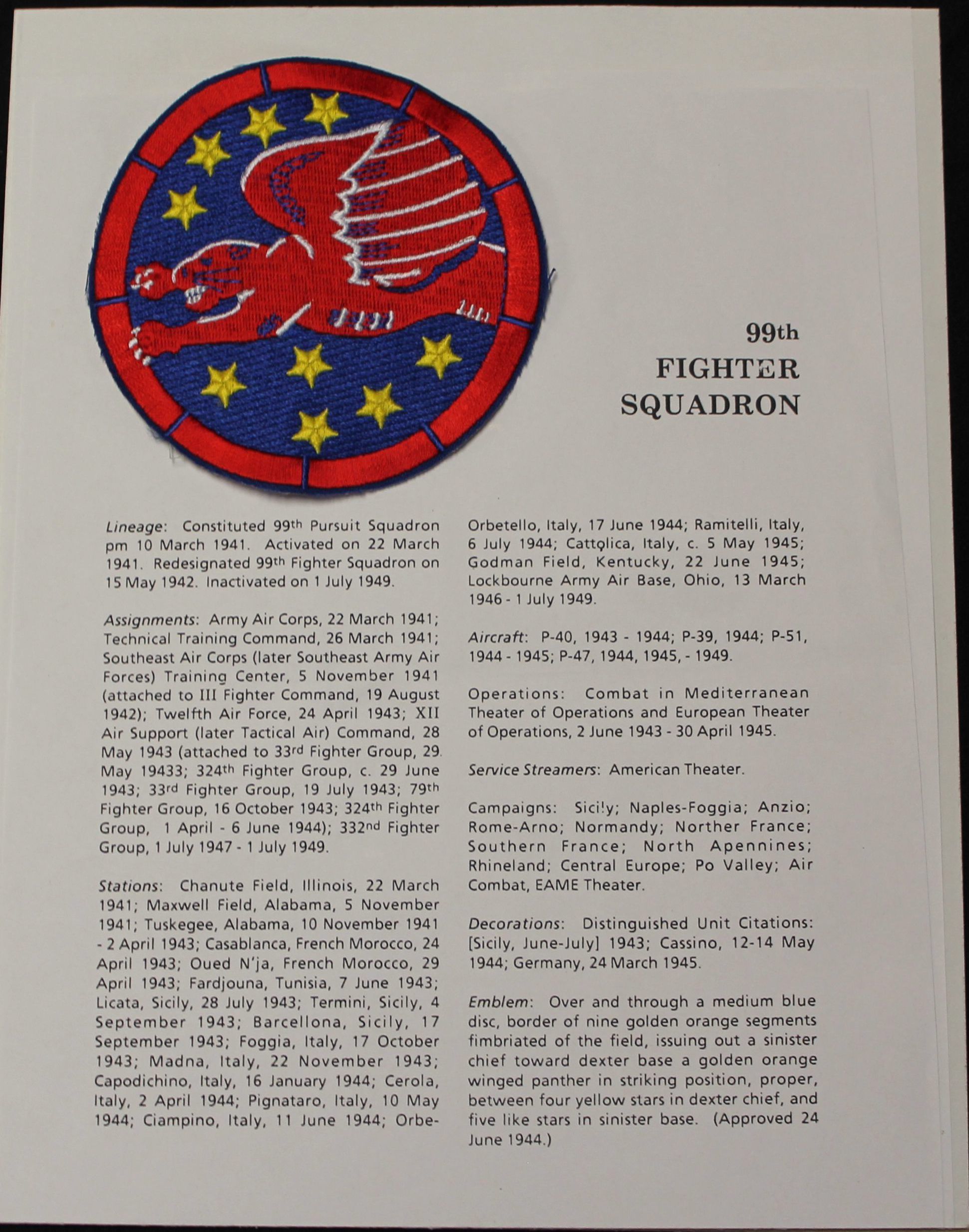
Patch with explanation
Text reads: 99th FIGHTER SQUADRON Lineage: Constituted 99th Pursuit Squadron pm 10 March 1941. Activated on 22 March 1941. Redesignated 99th Fighter Squadron on 15 May 1942. Inactivated on 1 July 1949. Assignments: Army Air Corps, 22 March 1941; Technical Training Command, 26 March 1941; Southeast Air Corps (later Southeast Army Air Forces) Training Center, 5 November 1941 (attached to III Fighter Command, 19 August 1942); Twelfth Air Force, 24 April 1943; XII Air Support (later Tactical Air) Command, 28 May 1943 (attached to 33rd Fighter Group, 29. May 19433; 324th Fighter Group, c. 29 June 1943; 33rd Fighter Group, 19 July 1943; 79th Fighter Group, 16 October 1943; 324th Fighter Group, 1 April 6 June 1944); 332nd Fighter Group, 1 July 1947-1 July 1949. Stations: Chanute Field, Illinois, 22 March 1941; Maxwell Field, Alabama, 5 November 1941; Tuskegee, Alabama, 10 November 1941 - 2 April 1943; Casablanca, French Morocco, 24 April 1943; Oued N'ja, French Morocco, 29 April 1943; Fardjouna, Tunisia, 7 June 1943; Licata, Sicily, 28 July 1943; Termini, Sicily, 4 September 1943; Barcellona, Sicily, 17 September 1943; Foggia, Italy, 17 October 1943; Madna, Italy, 22 November 1943; Capodichino, Italy, 16 January 1944; Cerola, Italy, 2 April 1944; Pignataro, Italy, 10 May 1944; Ciampino, Italy, 11 June 1944; Orbe- Orbetello, Italy, 17 June 1944; Ramitelli, Italy, 6 July 1944; Cattolica, Italy, c. 5 May 1945; Godman Field, Kentucky, 22 June 1945; Lockbourne Army Air Base, Ohio, 13 March 1946 1 July 1949. Aircraft: P-40, 1943 1944; P-39, 1944; P-51, 1944-1945; P-47, 1944, 1945, - 1949. Operations: Combat in Mediterranean Theater of Operations and European Theater of Operations, 2 June 1943 - 30 April 1945. Service Streamers: American Theater. Campaigns: Sicily; Naples-Foggia; Anzio; Rome-Arno; Normandy; Norther France; Southern France; North Apennines; Rhineland; Central Europe; Po Valley; Air Combat, EAME Theater. Decorations: Distinguished Unit Citations: [Sicily, June-July] 1943; Cassino, 12-14 May 1944; Germany, 24 March 1945. Emblem: Over and through a medium blue disc, border of nine golden orange segments fimbriated of the field, issuing out a sinister chief toward dexter base a golden orange winged panther in striking position, proper, between four yellow stars in dexter chief, and five like stars in sinister base. (Approved 24 June 1944.)