Djembe
Object/Artifact
Black Heritage Library
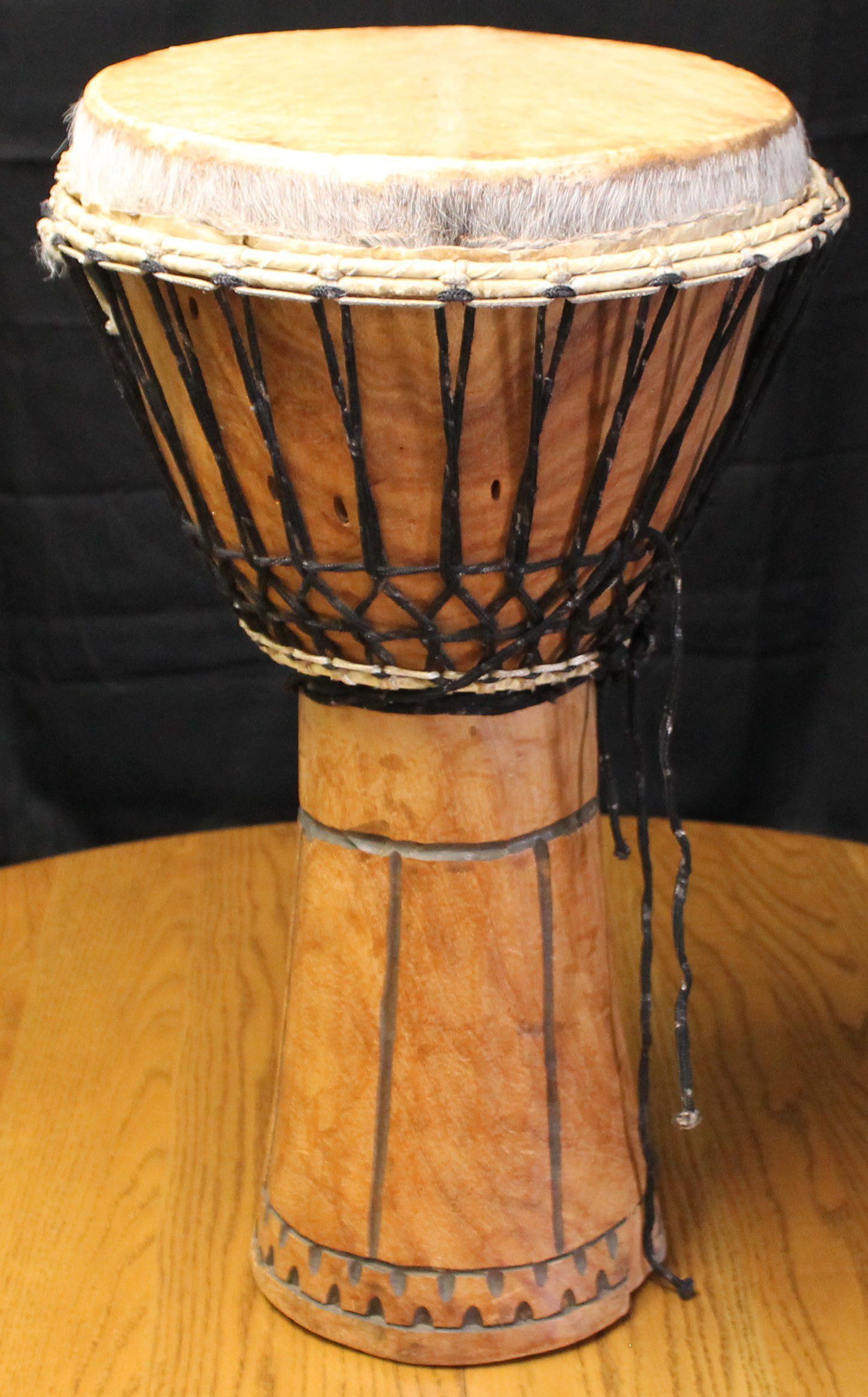
Djembe
A drum made of skin and wood with decorative rope pulling the skin taut. The body is tapered in an hourglass shape with a shorter top and longer base. The body is carved with lines down the bottom half.
Overview
Description
This djembe is a powerful example of African percussion design, uniting sculptural form, acoustic precision, and ceremonial presence. Carved in a pronounced goblet shape, the drum is engineered to project sound with remarkable clarity, while the taut skin head and rope tuning system reveal the careful balance between natural material and technical control. Its structure is not merely functional; it is visually authoritative, with the flaring upper body, narrowed waist, and solid base giving the instrument a commanding vertical rhythm even in stillness. What gives the djembe its significance is its extraordinary expressive range. Played with the hands, it is capable of producing deep bass tones, sharp slaps, and resonant open notes, allowing a single instrument to carry both pulse and dramatic accent. In performance, the djembe often does more than accompany movement; it shapes atmosphere, directs energy, and anchors communal exchange through rhythm. Its voice is immediate and physical, making it central not only to music, but to ceremony, dance, and collective gathering. The instrument’s visual qualities reinforce this sense of importance. The rope lattice around the drumhead introduces a strong pattern of tension and order, while the carved body preserves the presence of the wood as a living material shaped into disciplined form. The incised decoration near the base adds a final note of refinement, confirming that the djembe belongs equally to the worlds of craft and performance. As an object, it stands as both instrument and sculpture: a vessel of rhythm, memory, and cultural continuity.Context
History and more information on the djembe can be found here: https://www.drumconnection.com/africa-connections/history-of-the-djembe/Collection
InstrumentsCataloged By
[email protected]Use
A percussion instrument for use in ceremony and dance. It is played with the musician's hands.
Materials
Wood, Skin, rope