Maraca
Object/Artifact
Black Heritage Library
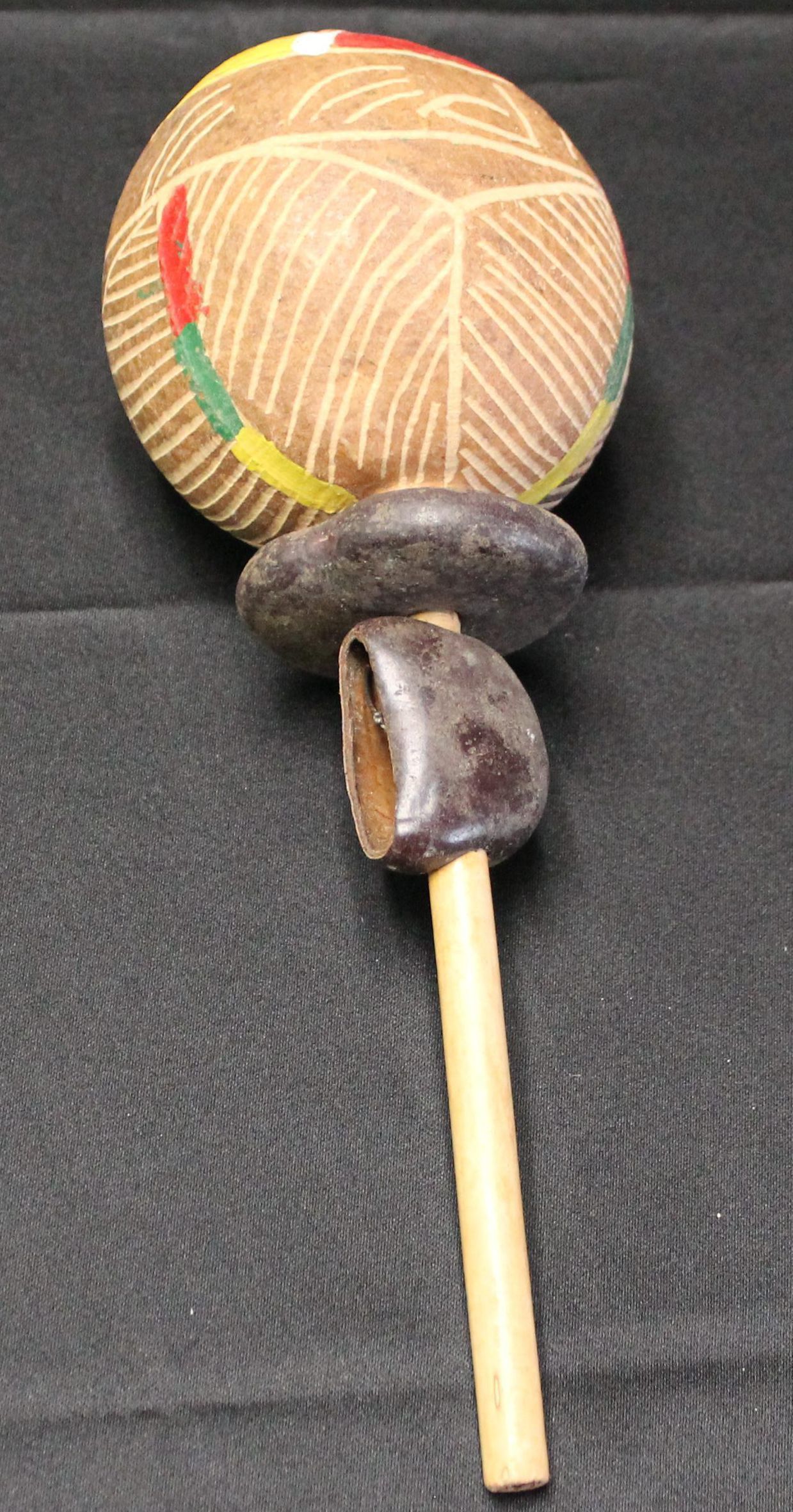
Side view of the maraca
A side view of the maraca showing the intricate carved patterns on the body and the painted lines.
Overview
Description
This maraca is especially notable for the richness of its surface treatment and the unusual complexity of its construction. The rounded body is covered with incised linear patterning that gives the instrument a strong sense of texture and visual movement, while the bands of red, yellow, and green introduce a measured but vivid chromatic accent. Rather than relying on a smooth painted finish alone, the object uses carved lines to animate the form, turning the body of the maraca into a carefully worked decorative field. What makes the instrument particularly compelling is the way its design extends beyond the resonating chamber itself. The dark rounded and cup-like elements near the handle create a more elaborate transitional zone between body and shaft, giving the maraca a sculptural articulation not often seen in simpler percussion forms. This added structural complexity suggests that the object was conceived not only as a tool for producing rhythm, but as a crafted object whose silhouette and detailing mattered deeply. As a musical instrument, the maraca retains its essential purpose: to convert movement into patterned sound through the shifting contents of its hollow body. Yet in museum terms, its significance lies equally in the sophistication of its making. The incised decoration, controlled color accents, and layered handle construction elevate it beyond functional percussion and place it within a broader tradition of objects in which sound, ornament, and form are inseparably linked.Collection
InstrumentsCataloged By
[email protected]Created By
[email protected]Create Date
June 20, 2023Updated By
[email protected]Update Date
April 22, 2026Use
Music