Maraca
Object/Artifact
Black Heritage Library
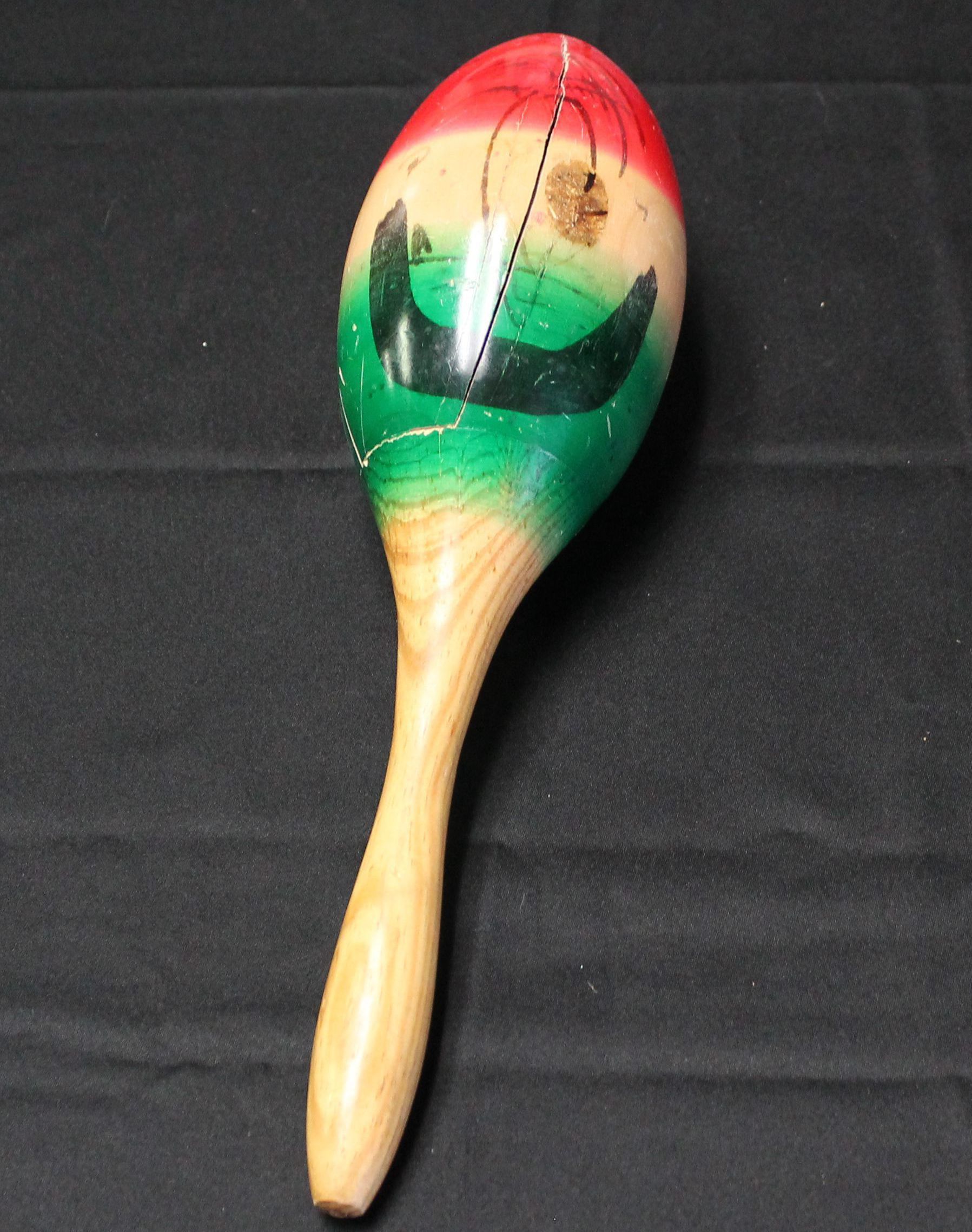
Maraca
A close up of the maraca showing the gradient painting on the body, and a crack running through the shaker.
Overview
Description
This maraca is a striking example of how a compact percussion instrument can hold both rhythmic purpose and strong visual character. Its elongated wooden handle leads into a rounded resonating body whose painted surface immediately commands attention. The bands of red, cream, green, and black give the object a bold graphic identity, transforming it from a simple sound-producing tool into an artifact of performance and display. Even in stillness, the maraca suggests movement, energy, and pulse. What gives the maraca its significance is the directness of its musical function. Sound is created through motion alone: with each shake, the enclosed contents strike against the hollow body, producing a crisp, repeating rhythm. That simplicity is part of the instrument’s power. It does not rely on elaborate mechanics, but on the controlled gesture of the performer, making rhythm an extension of the hand and arm. In this sense, the maraca is both instrument and physical expression, translating movement into audible structure. The visible wear and cracking across the painted body add another layer of meaning. These marks do not diminish the object’s importance; rather, they record its age, use, and material history. The maraca thus carries not only sound, but evidence of lived performance. As a museum object, it stands at the intersection of craft, color, and rhythm—an instrument whose formal clarity and worn surface together speak to its enduring role as both musical tool and cultural artifact.Collection
InstrumentsCataloged By
[email protected]Created By
[email protected]Create Date
June 20, 2023Updated By
[email protected]Update Date
April 20, 2026Use
Music