Mbira (primitive)
Object/Artifact
Black Heritage Library
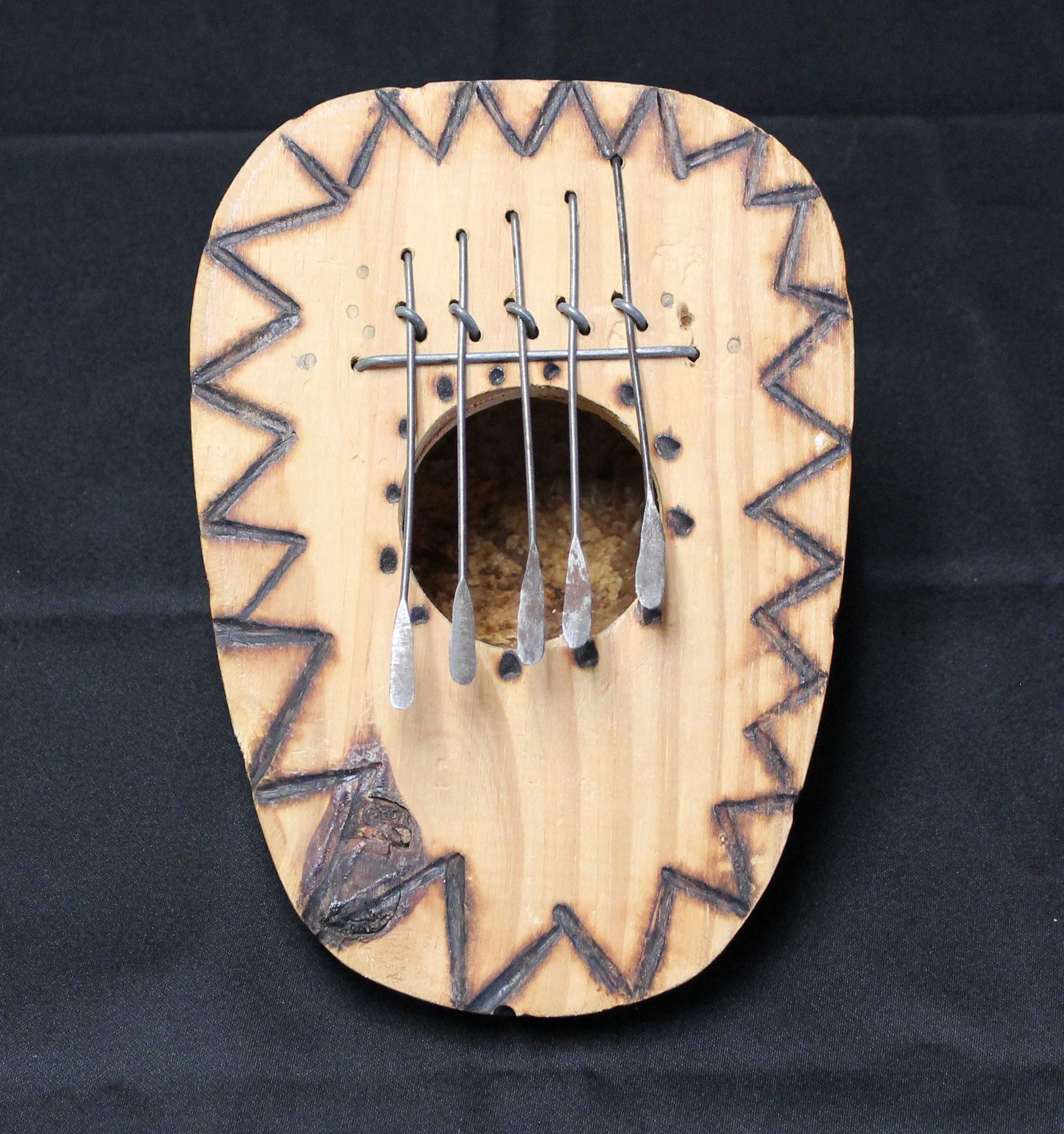
Top view
A top view of a wooden Mbira with decorative zigzags burned around the edges.
Overview
Description
This mbira, in its more stripped-down and elemental form, offers a powerful view of the instrument reduced to its essential acoustic logic. The board is irregular and hand-shaped rather than formally rectilinear, and the metal tines are fewer, longer, and more widely spaced, giving the object a raw directness that distinguishes it from more elaborately finished examples. The circular opening at the center serves as both sound chamber and visual anchor, while the burned zigzag pattern around the perimeter frames the instrument with a strong ornamental rhythm. What makes this mbira especially compelling is the visibility of its making. The wire tines, the simple crossbar, the scorched decorative border, and the slightly uneven contours all preserve a sense of immediacy, as though the instrument’s construction remains legible on its surface. That legibility gives the object a remarkable presence: it feels less polished than some later or more formalized variants, but no less intentional. On the contrary, its restraint emphasizes the ingenuity of the mbira’s design—how a few fixed metal tongues, a resonating cavity, and a shaped wooden body can produce melody, pulse, and tonal depth. As a museum object, this example is significant for the way it foregrounds process, material, and acoustic principle. The darkened zigzag motif introduces a visual cadence that echoes the instrument’s musical function, while the central aperture reminds the viewer that sound here emerges from resonance as much as from touch. It stands as a concise and evocative expression of musical craftsmanship, showing how even the most reduced instrument can embody structural intelligence, decorative sensibility, and deep expressive potential.Collection
InstrumentsCataloged By
[email protected]Created By
[email protected]Create Date
June 20, 2023Updated By
[email protected]Update Date
April 22, 2026Use
Music