Talking Drum
Object/Artifact
Black Heritage Library
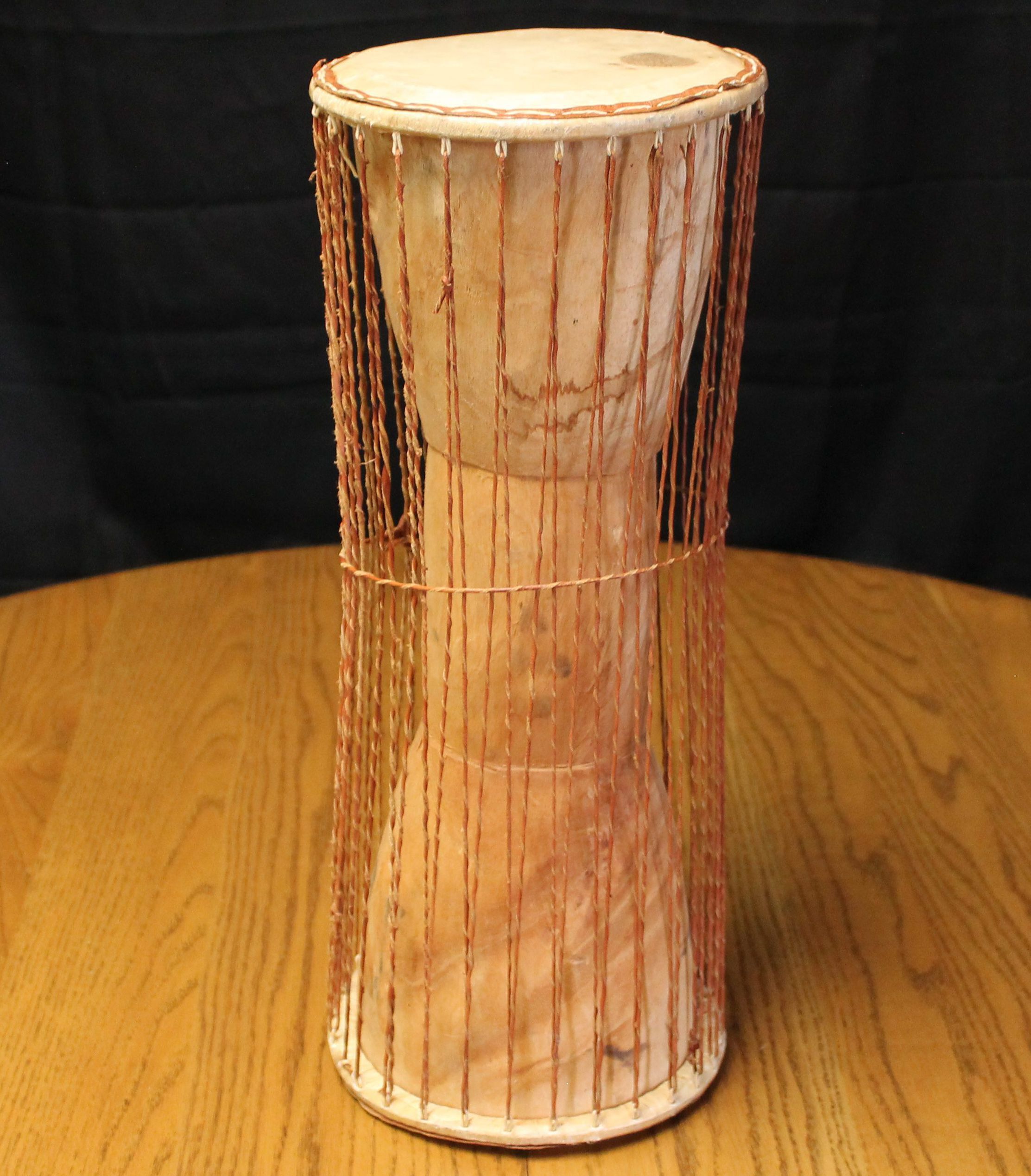
Talking drum
A side view of a double-ended hourglass shaped drum with twine stretched from end to end. The twine is two-toned: orange and a lighter cream color twisted together. The drum can be controlled by squeezing the twine to change the tautness of the drumming surface.
Overview
Description
This talking drum is a compelling example of musical design shaped around responsiveness, tension, and expressive control. Its elegant hourglass body immediately signals its identity: the narrowing center is not merely sculptural, but essential to the instrument’s acoustic logic. The vertical cords running between the drumheads form a visible system of tension, binding the top and bottom into a single responsive structure. Visually, the instrument is defined by this interplay between smooth carved wood and the fine linear web of cord, giving it both architectural clarity and rhythmic surface energy. What gives the talking drum its particular significance is its capacity for modulation. Unlike many drums that produce a fixed tone, this instrument is designed to vary pitch through pressure applied to the cords, allowing the player to alter tension while striking the drumhead. That ability gives the drum an unusually expressive voice—one capable of inflection, contour, and tonal movement that can resemble the cadences of speech. In this sense, the instrument occupies a special position within percussion, where rhythm and pitch begin to converge. As a museum object, the talking drum is notable for the precision with which form and function are united. The hourglass silhouette is graceful, but every curve serves the larger acoustic design. The cords are visually delicate yet structurally essential, and the taut drumhead completes a system in which gesture, pressure, and sound are inseparable. The result is an instrument of both formal elegance and remarkable expressive sophistication—an object that transforms wood, skin, and cord into a medium of rhythm, communication, and musical intelligence.Context
This link talks a bit more about the importance of talking drums in African Cultures: https://understandingslavery.com/artefact/talking-drum-from-the-asante-of-ghana/Collection
InstrumentsUse
Music
Materials
Wood, Skin, twine