Y-Rattle
Object/Artifact
Black Heritage Library
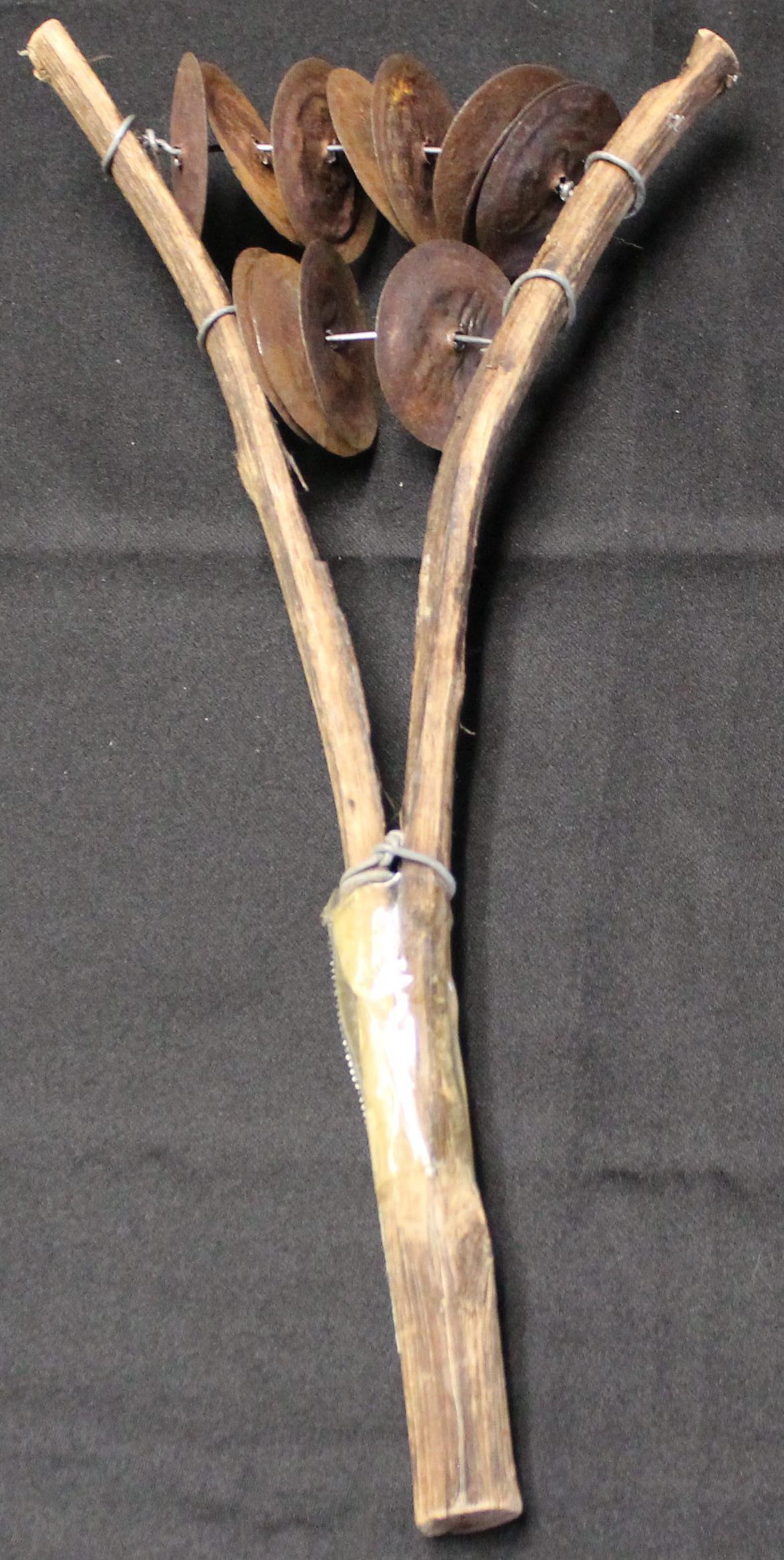
Y-Rattle
A front view of the forked rattle showing the two rows of metal disks suspended between the two sides of the forked end.
Overview
Description
This instrument is a striking study in rhythmic motion shaped through an almost skeletal economy of means. A natural forked branch forms the core of the object, its bifurcated upper arms supporting a series of suspended metal discs that are threaded, spaced, and loosely fixed so that they can vibrate and collide in movement. The result is an instrument whose sound emerges not from resonance within a chamber, but from the metallic interaction of separate elements activated by shaking. Its form is at once utilitarian and sculptural, preserving the irregularity of the branch while organizing the discs into a concentrated field of percussive potential. What makes the object especially compelling is the tension between raw material and deliberate construction. The wood retains its natural contour and asymmetry, giving the instrument an organic immediacy, yet the attached discs introduce repetition, balance, and metallic density. This contrast is central to its visual and acoustic identity. The natural fork creates a stable spread for the sounding elements, while the rows of discs transform that open structure into a zone of vibration, shimmer, and rhythmic agitation. The instrument thus stages a dialogue between nature and fabrication, between branch and metal, between still form and animated sound. As a museum object, it is notable for the clarity with which it reveals its own making. The bindings, rods, and suspended discs remain fully legible, allowing the viewer to see precisely how sound would be produced. Nothing is hidden; the object’s mechanics are part of its visual presence. That transparency gives it a particular authority, emphasizing instrument-making as an act of intelligent assembly rather than ornamental excess. The result is a work of remarkable directness—an artifact in which branch, metal, and motion are brought together to create a percussion instrument of raw elegance and tactile power.Collection
InstrumentsCataloged By
[email protected]Created By
[email protected]Create Date
September 26, 2023Updated By
[email protected]Update Date
April 22, 2026Use
Musical instrument