Name/Title
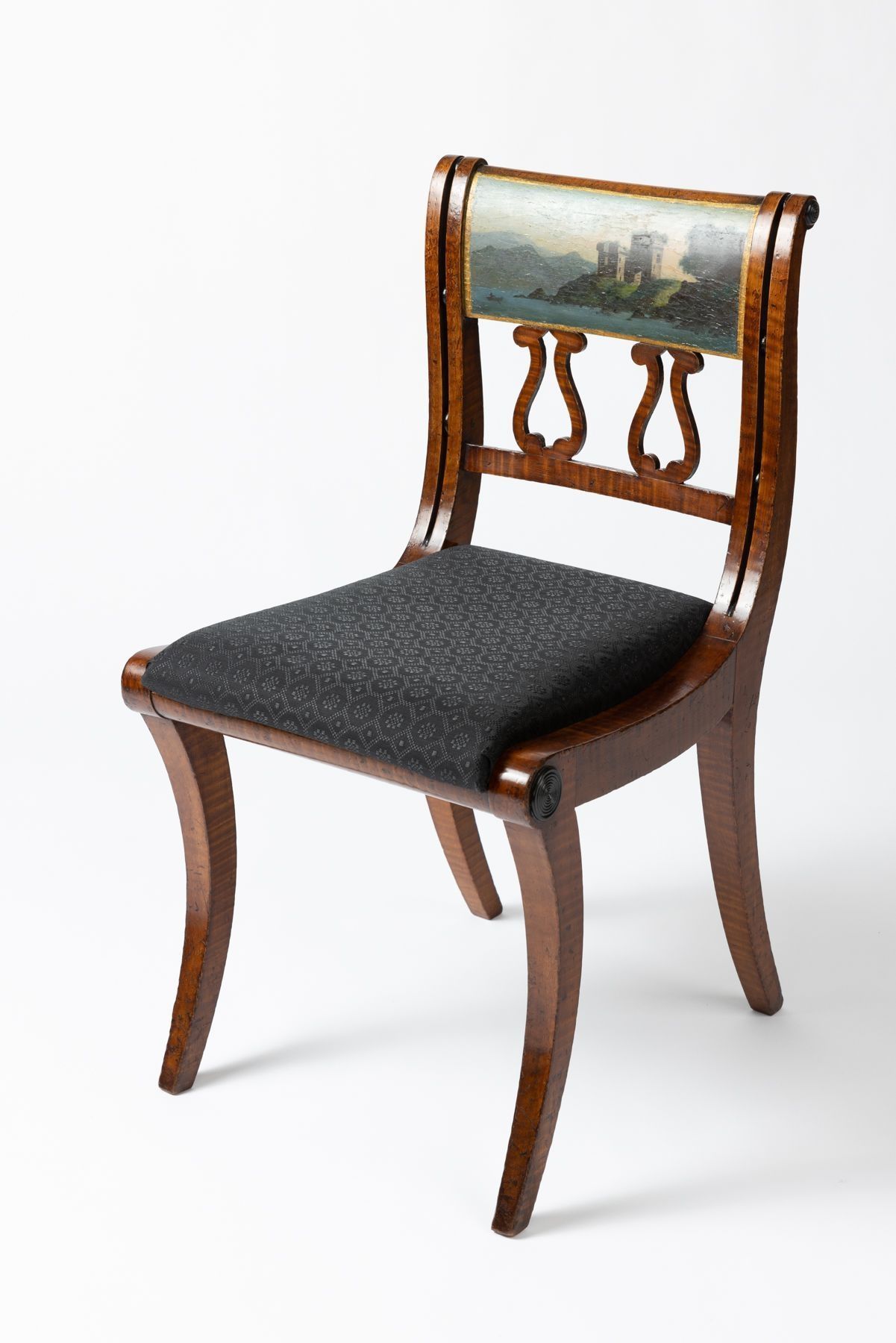
Scenic landscape chairsEntry/Object ID
2017.1–.6Description
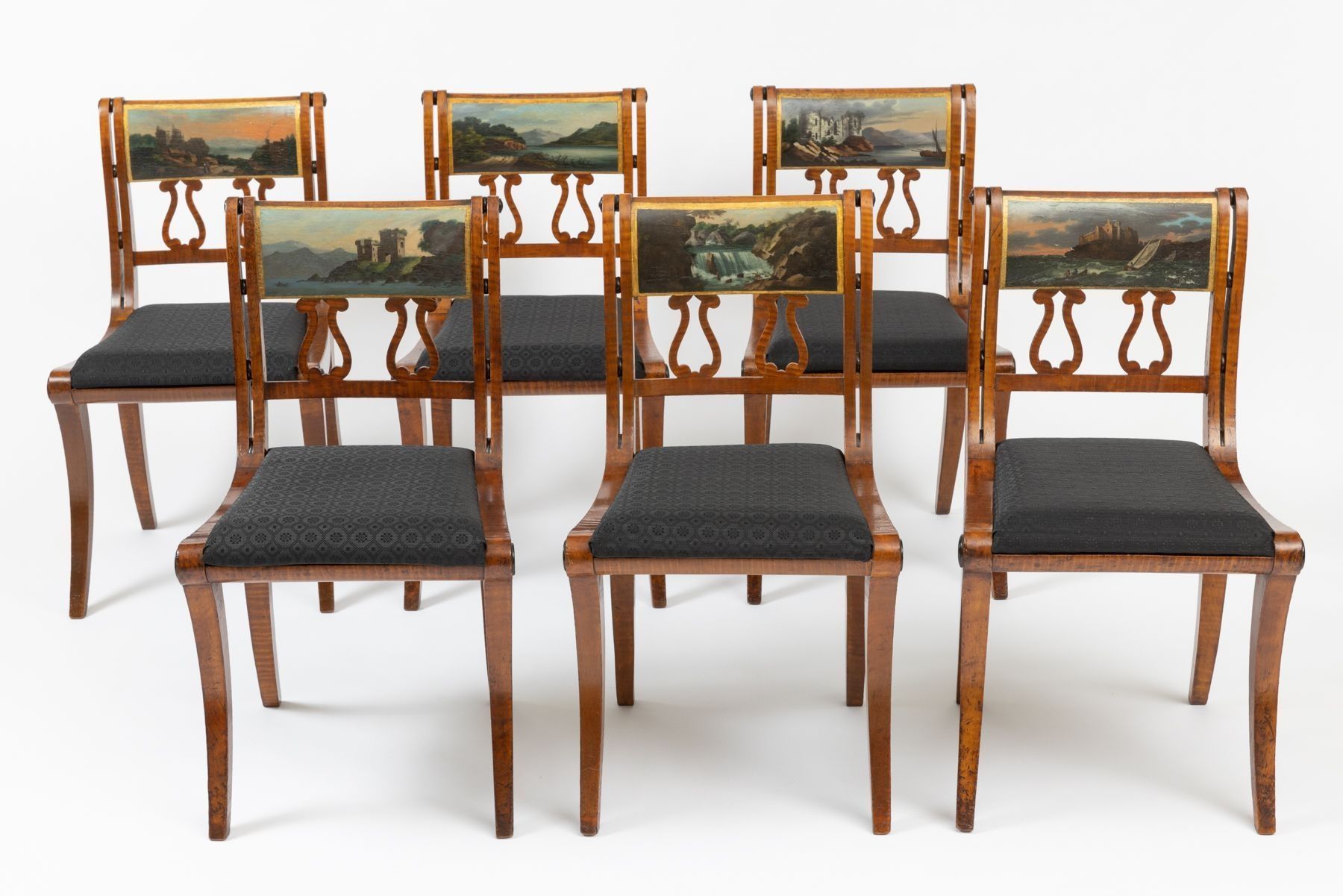
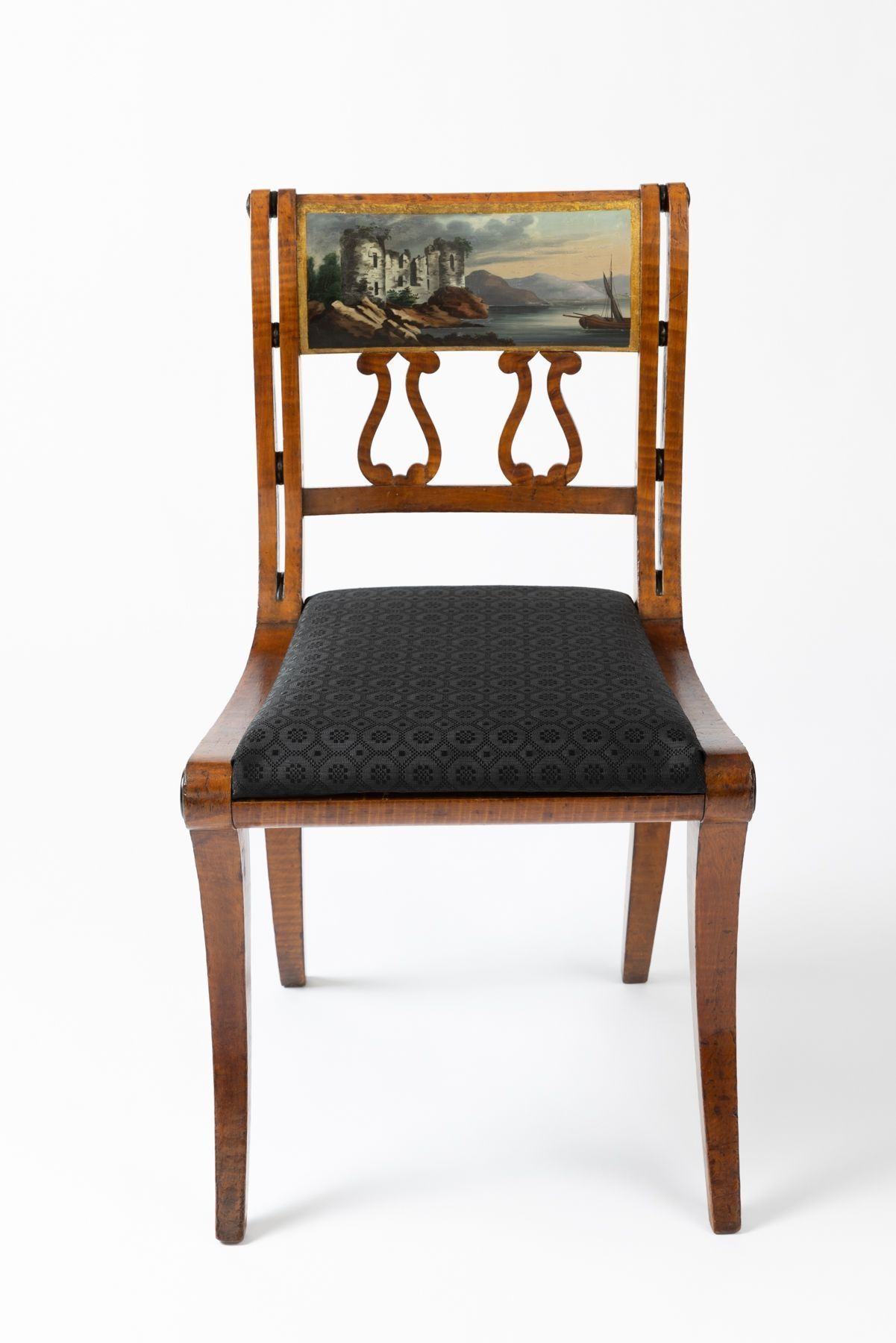
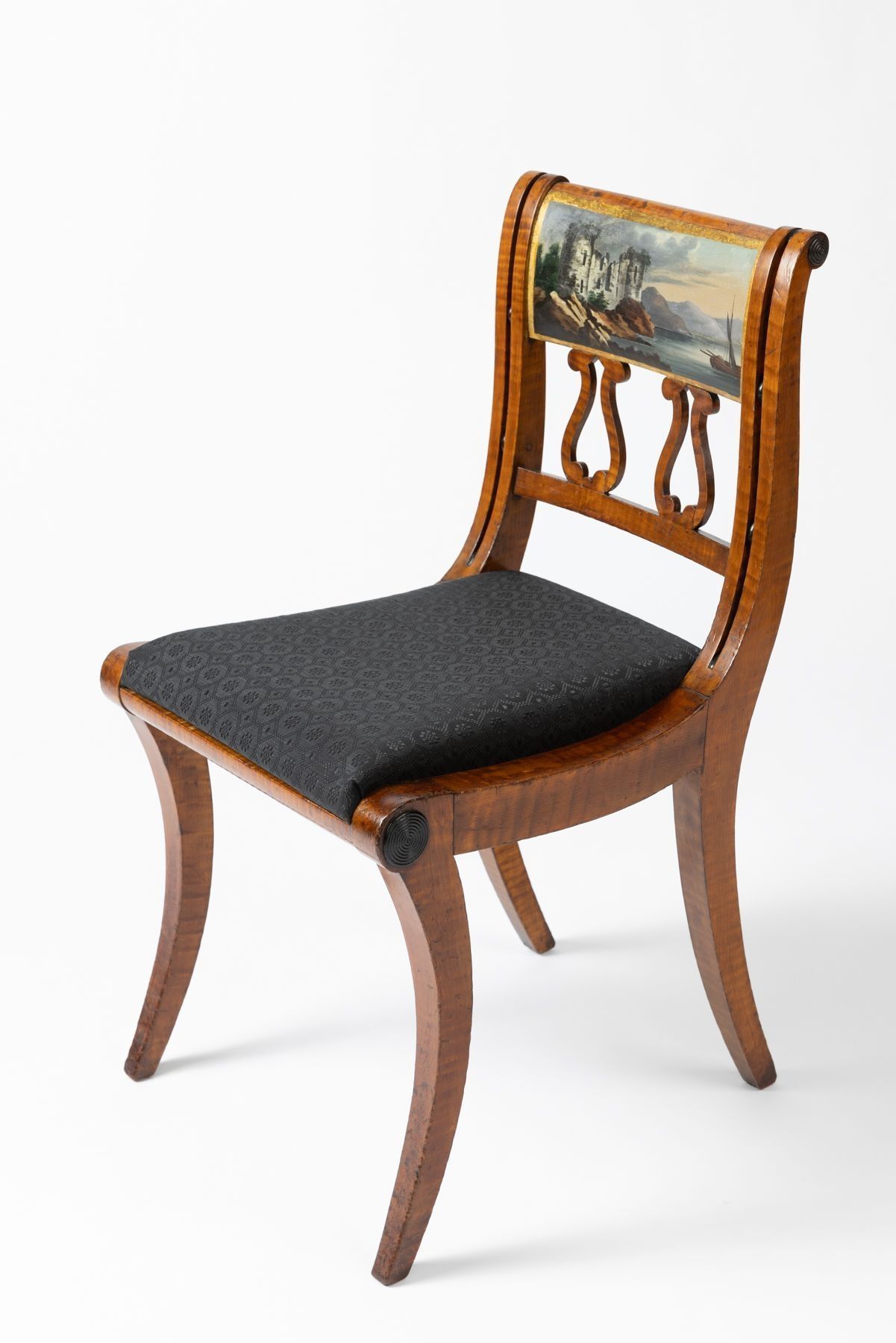
The chairs have curved crest rails (tablets) with painted landscape scenes, varnished tiger maple
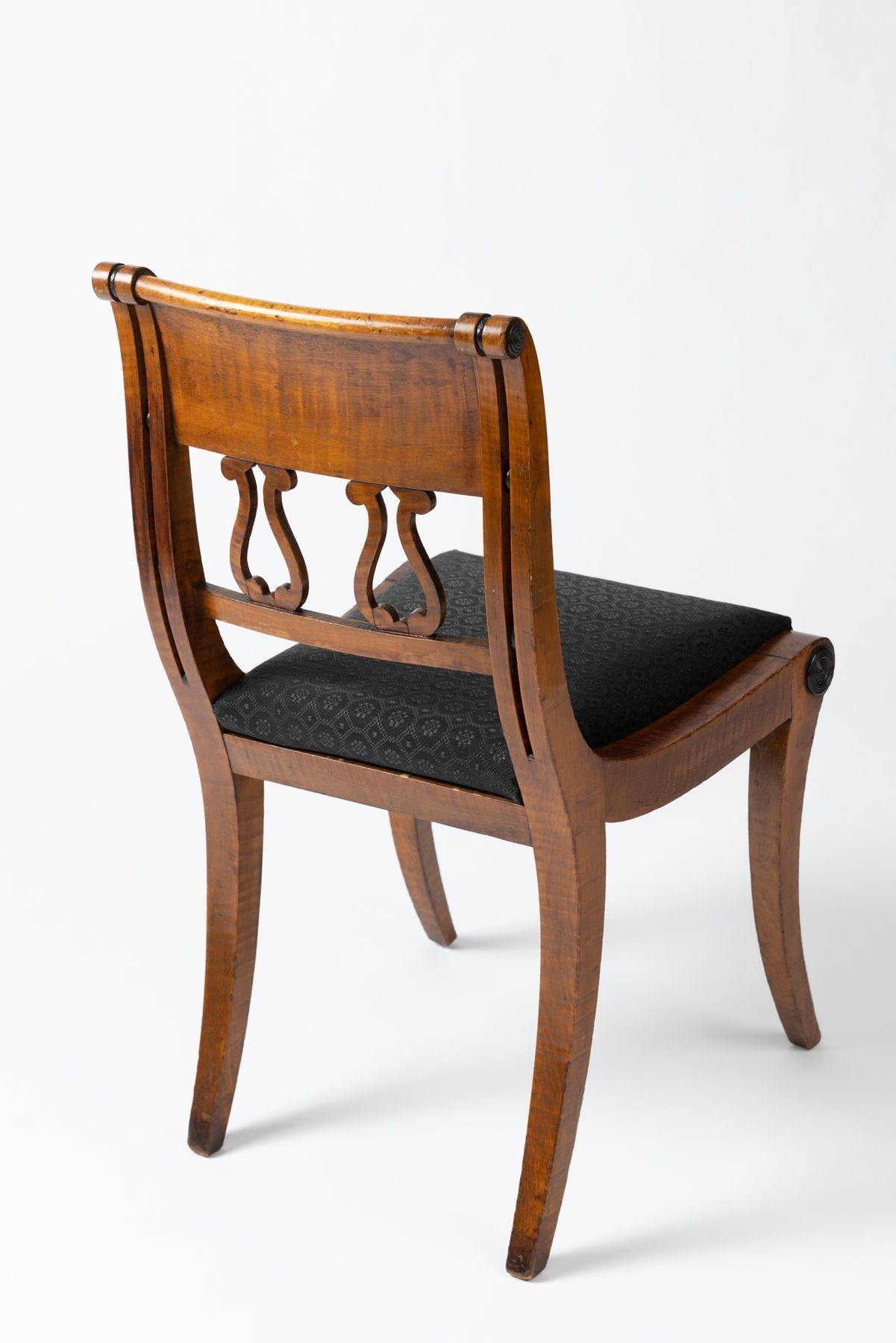
frames with mortise and tenon joinery, saber legs, divided rear posts, double lyre splats, turned ebonized wood detailing, and removable slip seats with upholstery. Chairs feature pierced stiles with ebonized discs between the stiles (the half-round disc at the seat is relief-carved, while the whole discs above were inserted and affixed with dowels). Carved ebony bosses at the knees and ears. The chairs feature a tablet back with painted landscapes, framed by a 1/2" band of gilding. Below the landscape paintings are flat double lyres without strings. Supporting back rails lack carving.
2017.1 painting features river, riverbank, mountains, trees, sky
2017.2 painting features waterfall, rocks, trees, sky
2017.3 painting features mountains, building, sky, people in foreground
2017.4 painting features water, mountains, sky, architectural ruin, trees, person in rowboat
2017.5 painting features water, clouds, building, and people on boats
2017.6 painting features water, mountains, clouds, castle, boat without peopleAcquisition
Accession
2017.1–.6Acquisition Method
PurchaseCredit Line
Gift of funds from Lila Acheson Wallace and others, by exchangeMade/Created
Date made
circa 1815 - circa 1820Place
State/Province
New YorkCountry
AmericaContinent
North AmericaNotes
with later alterationsInscription/Signature/Marks
Type
InscriptionNotes
period pencil inscriptions on chair rails of three chairsDimensions
Height
32-1/4 inWidth
18-1/2 inDepth
20-1/2 inMaterial
Maple, Paint, Gilding, Ebony, Modern horsehair upholstery, Unknown secondary woodCondition
Notes
Shortly after purchasing the chairs, Richard Kelly hired a conservator to lightly clean the wood surfaces, remove overpainting from the landscape scenes, and make replacement slip seat frames to replace two missing ones.
Pre 2020 conservation condition:
Structure
The overall structural condition is good. Parts of the more exposed turned /ebonized detailing have been replaced. Some joints and breaks appear to have been re-glued. The front rail joinery on chairs #4 and #5 is partly loose.
Crest Rails
The curved crest rails are painted with landscape scenes surrounded by 1⁄2” wide oil gilded borders. The tablets have varying conditions of active flaking, current losses, and previous restorations of old losses. The landscape scenes on chairs #1, #3, #4, and #5 have about 20% of their surfaces with old restorations of paint losses; the scenes on chairs #2 and #6 have about 10% of surfaces with restored paint. There are more recent paint losses and associated active flaking paint on all six rails, with more prominent looses and flaking on chairs #1, #3, #4, and #5, than on #2 and #6.
The gilded borders are largely overpainted with bronze paint that is now discolored with oxidation, and only small passages of the original gold gilding are apparent. Solvent test removal of the bronze over-paint indicates that most of the gilding below the paint is missing. There are small areas of flaking within the gilding and its over-paint. Borders of 1/8” wide pale masking tape have been applied around the painted scenes on all crest rails except chair #6, and this masking tape may have been removed.
Varnish
The show-wood frames are varnished and have attained a respected deep amber color; the varnish fluoresces pale green in UV light. There are multiple varnish coatings that have attained thickness. Old varnish losses are apparent in UV light, and these areas are now re-saturated and colored with later varnish. Some surfaces appear to have had older varnish removed, and newer varnish applied, e.g. tops of some side rails and backs of crest rails. There are small areas of more recent varnish loss. There is light dust and grime on varnish surfaces, and there is some older grime trapped between varnish layers.
Upholstery
The chairs have upholstered slip seats. The front and back chair rails have vertical holes for securing the slip seats with screws; the slip seats are not presently attached to the chairs. The slip seat frames for chairs #1 and #3 are new maple wood; the slip seats for chairs #2 and #4 are upholstered with pale green damask over padding and webbing; the slip seat for chair #5 is similarly upholstered and its show-cover has been removed, revealing a black cotton underlayment. The seat for chair #6 has had all upholstery removed; the wood frame has nailing evidence of several earlier upholstery campaigns, and glued repairs. It has not been determined whether the four old slip seat frames are original. Removal of the remaining upholstery on seat #’s 2, 4 & 5 may reveal evidence of earlier show-covers and materials. The curator has indicated black haircloth as a likely choice for new show-covers.
Inscriptions
Three chair rails have old pencil inscriptions that have not been deciphered.Provenance
Notes
The chairs were formerly owned by the Kelly family- the descendants of Richard Kelly, who acquired the six chairs from Sotheby's in 2000 (lot 599, sale 7420, January 20-21 2000).The chairs are part of a larger set of at least twelve that descended in the family of New York City tea merchant John Caswell (1792-1871). Four mates from the Caswell set are in the collection of Bayou Bend and two remain in unknown private hands.
The provenance, as published by Sotheby's, suggests that the Kelly set of six was reassembled and consigned by Mrs. Sumner (nee Virginia Caswell) Pingree of Beaufort, SC, who inherited them from her father, William Watson Caswell, Jr., who inherited them from William Watson Caswell, Sr., a descendent of John Caswell, tea merchant at 87 Front Street, house at 73 Murray Street, New York City. The Pingrees moved to Cuba in 1950. They returned with the chairs to the United States in 1959, when Castro came to power.