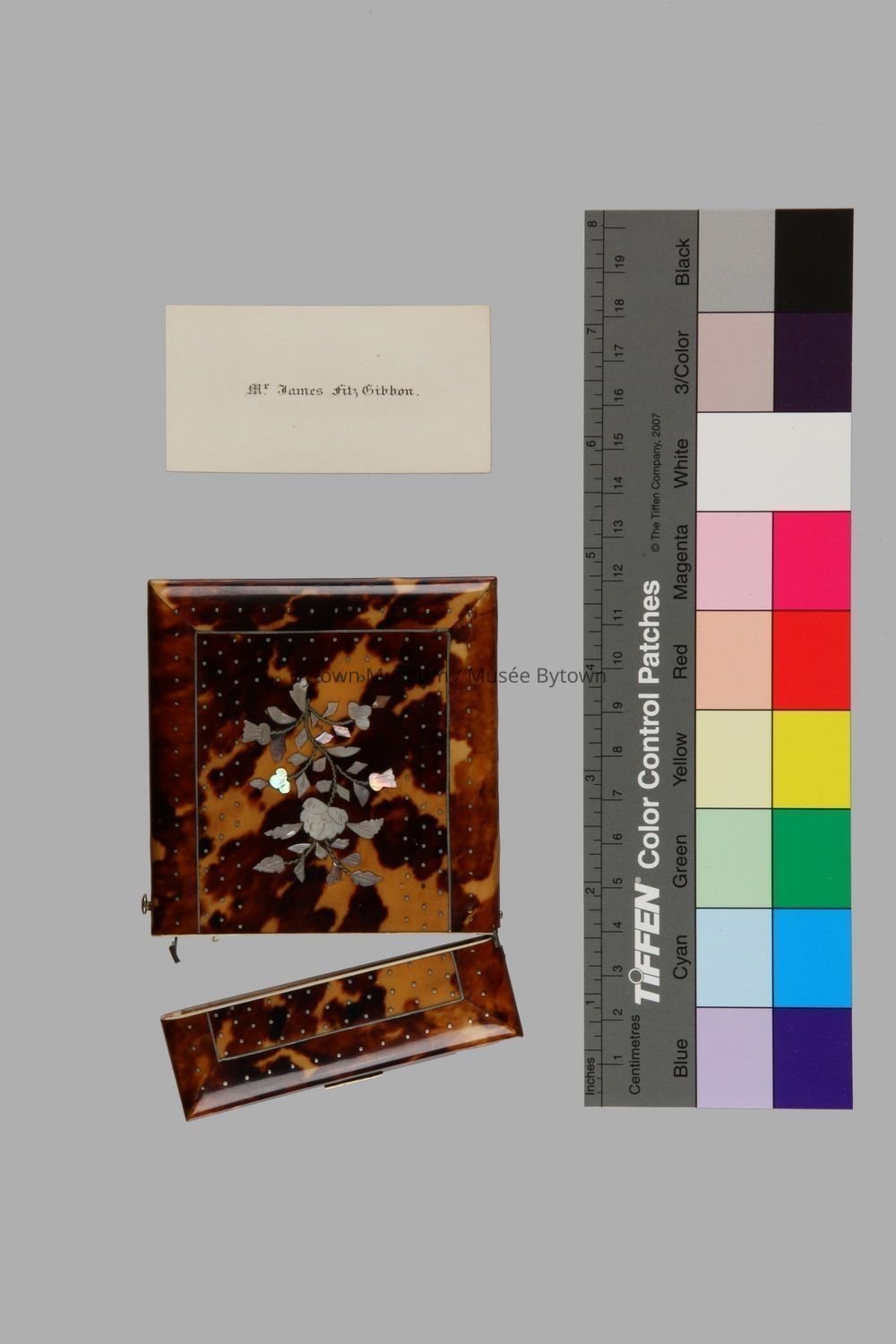
One small rectangular tortoise shell card case made of tortoiseshell with an inlaid flower design of thistle, rose and clover leaf in mother of pearl. The same design is on the front and the back. It opens from the top and is hinged on one side. It has what appears to be little silver nail heads making a design on the front and back. The interior of the case is lined with red velvet and there is a small metal plate on top of case. Inside of case are four of James Fitz Gibbon's calling cards.
Inscription/Signature/Marks
Transcription
"Mr. James Fitz Gibbon"
Notes
Printed in black ink in the center of a cream colored card.
Lexicon
Nomenclature 4.0
Nomenclature Secondary Object Term
Case, Card
Nomenclature Primary Object Term
Case, Personal
Nomenclature Sub-Class
Personal Carrying & Storage Gear
Nomenclature Class
Personal Gear
Nomenclature Category
Category 03: Personal Objects
Search Terms
Stationary Item, Stationary Item, Communication Artifacts
Legacy Lexicon
Object Name
Card case, Tortoiseshell, Case, Personal
Dimensions
Height
5 cm
Width
7.6 cm
Length
10.1 cm
Material
Mother of pearl, velvet, Brass, Tortoiseshell
Research Notes
Notes
This case and calling cards belonged to early Bytown resident James Fitzgibbon (1789-1868). The tortoise shell case is beautifully decorated with inlaid mother-of-pearl, which features a thistle, rose, and clover leaf design; all symbols of the British Isles.
In the 19th century, calling cards were part of an elaborate etiquette and were considered an essential social tool for upper and middle class citizens. Fitzgibbon was a middle class citizen in Bytown thanks to his role as a master carpenter and as the Overseer of Works on the Rideau Canal. In fact, he was personally hired to work on the canal by Colonel By, who had previously worked with him in Qu�bec City.
Fitzgibbon and his brother-in-law James Black also built Bytown’s first frame house in 1828. It was located on the corner of Rideau St. and Sussex Dr. and was built to house tenants.