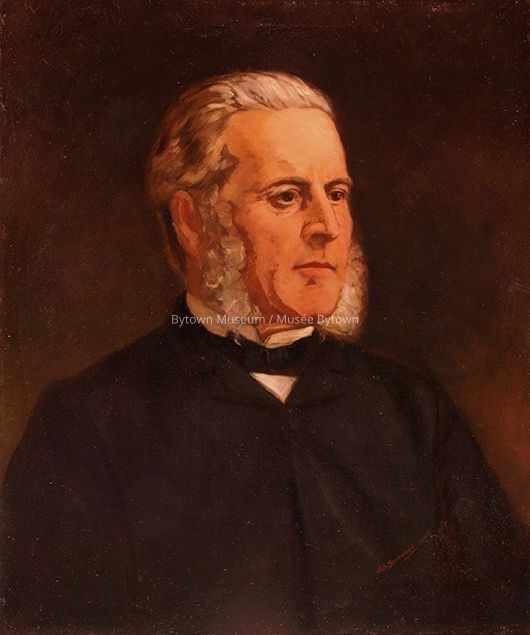
One oil painting depicting a front view of the head and shoulders of Sir Henry Newel Bate; he is looking to the right. The background is dark, the subject is wearing a black coat and tie and white shirt. His hair is brown but graying at temples and sideburns. The painting is displayed in a large gold painted wooden frame; the outer section of the frame has a gessoed design around outside. The middle section of frame is plain and the inner section forms oval border around painting; it is done in a gold stipple effect with a raised design in each corner.
Made/Created
Date made
1898
Inscription/Signature/Marks
Transcription
Back of painting reads: Sir Henry Newel Bate, Trennick House, Chapel Street, Ottawa" (on the actual canvas and on a label).
Lexicon
Nomenclature 4.0
Nomenclature Primary Object Term
Painting
Nomenclature Class
Art
Nomenclature Category
Category 08: Communication Objects
Search Terms
Photograph, Photograph, Furnishings
Legacy Lexicon
Object Name
Painting (visual work), Oil, Painting
Dimensions
Height
76 cm
Width
66 cm
Depth
6 cm
Research Notes
Notes
Henry Newell Bate (1828-1917) came to Canada from Cornwall, England with his family at the age of five. Though the Bate family originally settled in St. Catharines, Ontario, in 1854 Henry and his brother Charles moved to Ottawa (then called Bytown) to start a wholesale grocery and liquor business.
Henry Bate also invested in real estate, and famously owned many properties in the Sandy Hill neighbourhood of Ottawa. Bate’s house, located in Sandy Hill at 216 Chapel St., was named Trennick House in honour of his family’s home in Cornwall.
In 1899, Bate was appointed as the first Chairman of the Ottawa Improvement Commission by the Governor General of Canada. As its name suggests, the Commission was responsible for improving Ottawa’s infrastructure and appearance. The Commission eventually evolved into what we know today as the National Capital Commission.
For his many years of service to the city of Ottawa, Bate was knighted in London in 1910 by King George V. He passed away a few days before his birthday in April 1917.