Notes
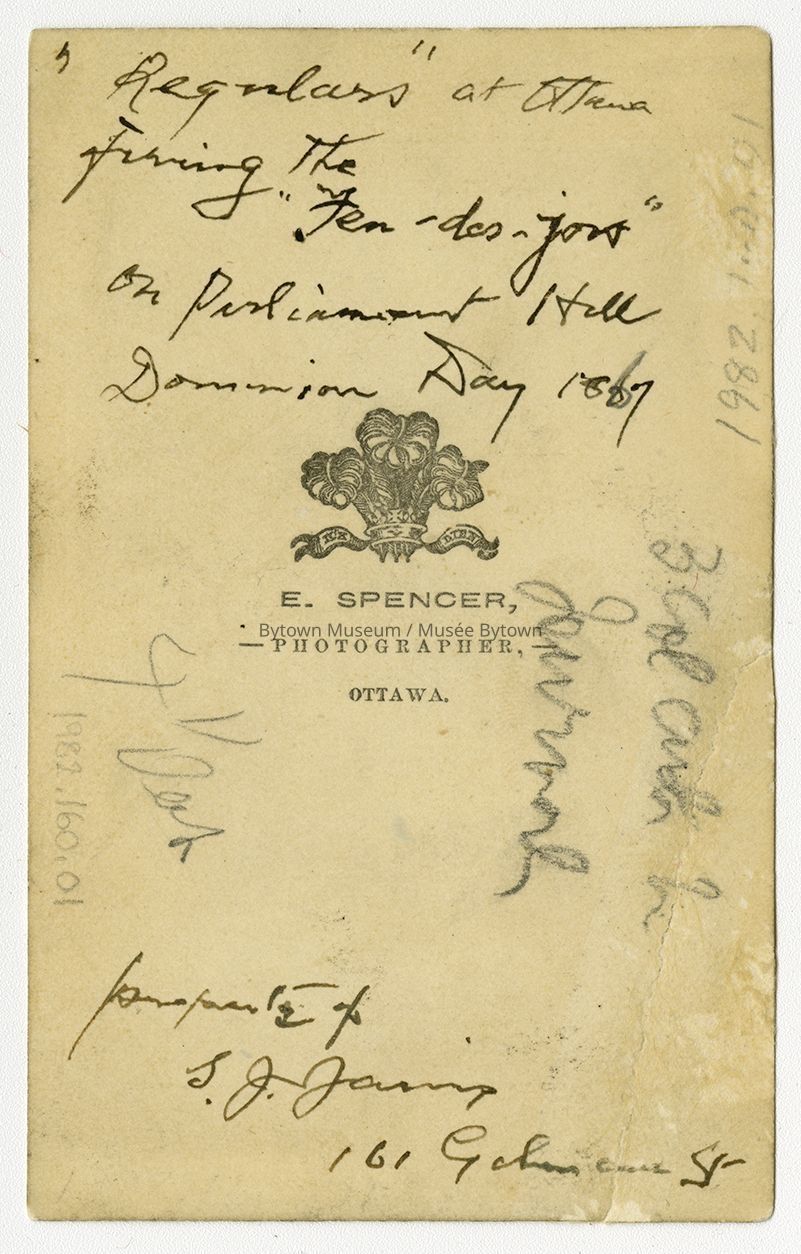
Elihu Spencer was born near Dundee, Ontario in April of 1818. On July 2, 1840, Spencer married Nancy Flynn at L'Orignal in Eastern Ontario. By the time of the 1851 Canada Census he was listed as a "Daguerreian Artist" living near Hawkesbury, Ontario. Spencer relocated to Ottawa around 1859 and opened up his "Daguerreian Saloon," first on Elgin Street, and shortly thereafter at 24 Sparks Street, where he remained until 1869. Spencer began with daguerreotype photographs (one of a kind images on a silvered copper plate), and later specialized in carte-de-visites, ambrotypes, albumen prints and stereographs.
Spencer took some of the first photographs of Ottawa - an Ottawa that no longer exists to be seen - and is credited as the city's first successful commercial photographer. He pioneered photography in this city, working with a staff of five, and along with men such as William James Topley, lead the way for print/paper based photography in the area. Spencer documented the construction of the new Parliament Buildings, capturing numerous views of all three blocks starting in 1859. Spencer's photographs of early Ottawa regularly won awards at Provincial exhibitions.
In the 1865 City of Ottawa Directory, Spencer is listed as a photographer working at Sparks and Elgin Streets, with his home on Slater near Metcalfe Street. He would later operate a studio on Queen Street.
On July 1st, 1867 the British North America Act came into effect, proclaiming the new nation of Canada. The day was marked by: military parades, lacrosse and cricket matches, a massive bonfire at Major's Hill Park, a salute by the Ottawa Garrison Artillery, and evening fireworks. Precious few images of that first Dominion Day exist. One photo, taken by Spencer on that historic first day of Confederation, shows an honour guard, which included members of the Ottawa and Victoria Cadet Corps, firing "un feu de joi" at Parliament Hill in celebration as the crowd looked to the future of their brand new nation.
Elihu Spencer, then listed as a resident of Lyon Street, died on July 28, 1898 after suffering from paralysis. He is buried in Ottawa's Beechwood Cemetery.
*See file for bibliographic information