Notes
Result: Identified
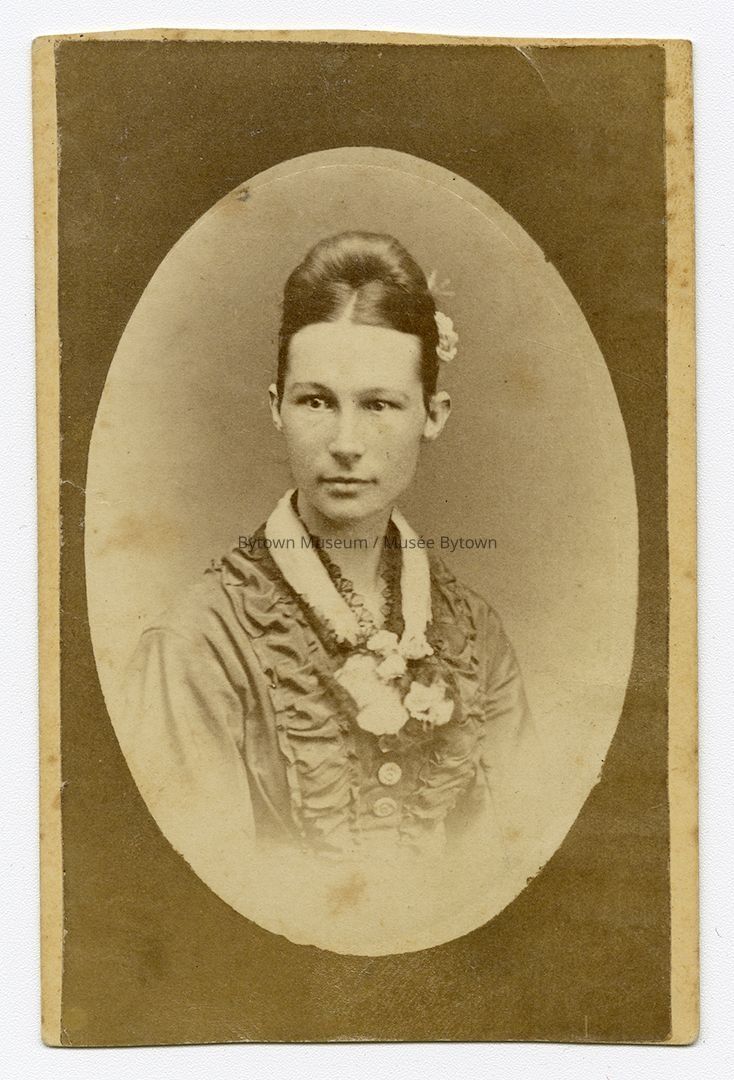
Alvira Lockwood, born in Kemptville, Ontario on October 6, 1842, was one of Ottawa's earliest photographers, as well as the city's first female photographer, and, in all likelihood, its youngest. She began her informal education by assisting her father, Joseph Almeron Lockwood (b. June 9, 1817 “ d. July 1, 1859), an itinerant daguerreotype artist originally from Madrid, New York. Joseph operated via a horse-drawn “portable photography saloon” in Carleton and Lanark Counties, as well as in upper New York State and western Quebec with partner George Martin of Montreal throughout the 1840s. Lockwood's travelling studio was described as, “[a] house-on-wheels [�& �] built expressly for the Daguerrean art�& � Joseph married Elizabeth “Melinda” Pierce (b.1819 “ d. Nov. 4, 1899), a native of Williamsburg (Dundas County), on November 10, 1841. The couple would go on to have eight children.
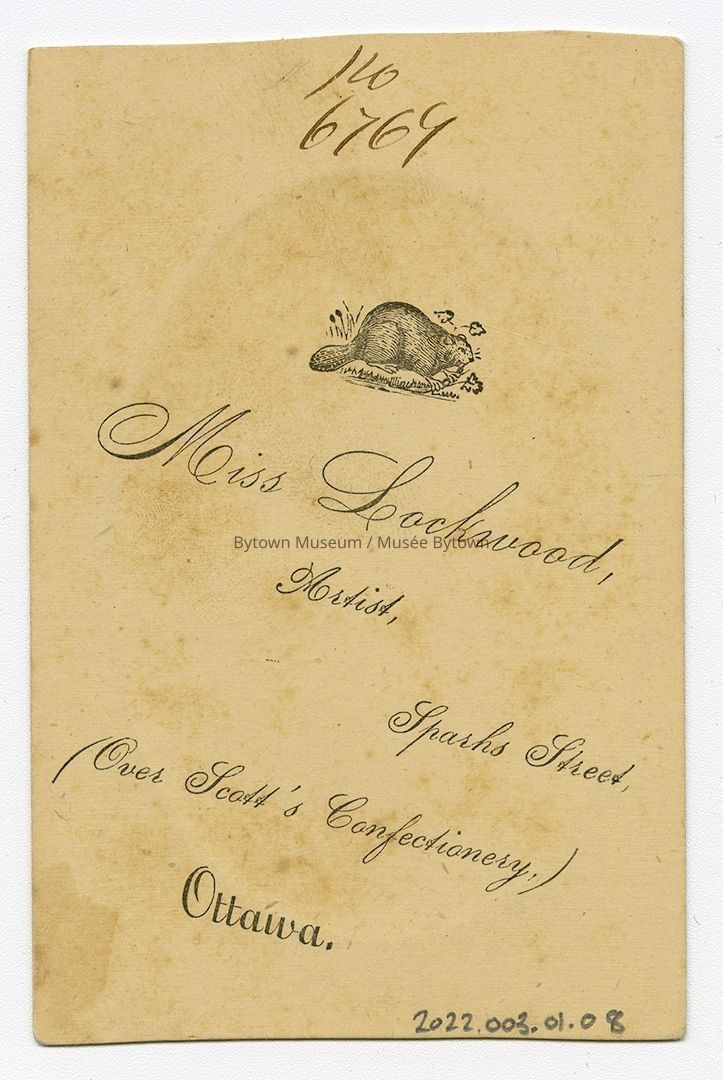
The Lockwood Family settled in Ottawa (then Bytown), after Joseph sold his interest in the portable studio and dissolved his partnership with George Martin in December of 1851. The family built a home and studio on rented land at the eastern end of Sparks Street, establishing Lockwood's Daguerrean Gallery. The studio advertised daguerreotypes, melainotypes, and ambrotypes, and also dealt in photographic supplies. The home was “quite conspicuous,” a low frame structure but having been built on a high knoll at the extreme eastern end of Sparks Street; “the first building at the west end of [Sappers] bridge,” where the old city Post Office once stood. Alvira, her younger sister Maria (1848 - 1931), and their mother Melinda, all worked alongside Joseph in the studio. Alvira later stated that, “from the time I was seven years old I had always been around the studio.” In the 1850s, Lockwood Studio was the first in Ottawa to employ the ambrotype process “ a positive photograph on glass, and a faster and cheaper alternative to the daguerreotype. Unfortunately, by early 1859 the land owner, Sir Henry Egan, notified Joseph of his intention to reclaim the land; the home was pulled down, and the Lockwood Studio moved into a space over Alex Scott's Bakery and Confectionary, “one of the best known spots in Ottawa,” on the southwest corner of Sparks and Elgin Streets.
Joseph Lockwood died of consumption in July of 1859, and the studio was taken over by Melinda and her daughters; Alvira, the oldest of the children, was just 12 at the time of her father's death. On the 1861 Canada Census Melinda, Alvira, and her children were listed as “Ambrotype Artists.” Around this time, the Lockwood's also began employing the tin-type process, and shortly thereafter, the albumen print, which would eventually replace the older, more expensive, and more delicate daguerreotype and ambrotype cased photographs. However, the studio did continue to advertise ambrotypes, and daguerreotypes through 1862. Having been ever-present in the studio with her father, Alvira knew the business and the photographic process well, and by 1863 began operating the studio under her own name, making her Ottawa's youngest professional photographer, and its first female professional photographer. She later stated, “Father had early taught me to take the cap over the machine and I helped him in that way when he was taking pictures. In time I got to understand how to make pictures. Of course at first after father died I did not take the pictures myself. But it was not long before I did, young as I was. At fifteen I was a full-fledged photographer.” Alvira's Studio was listed in the 1870 and 1871 City of Ottawa Directories on Sparks Street above Scott's Confectionary. The street frontage was adorned with a simple sign that read “A. Lockwood” which straddled the two buildings at 15 & 17 Sparks Street. A larger sign featuring an image of a daguerreotype camera and reading “Photographic Rooms” was installed above the painted lettering for Scott's Confectionary at the building's gable. The building was also shared by Mosgrove's Law Chambers.
On March 19, 1872, the Lockwood home on Rideau Street between Nelson and Friel Streets (as noted in the 1872/73 City of Ottawa Directory) was destroyed by fire. In 1870 Alvira had built a double tenement house on Rideau Street, where she lived with her Mother Melinda, and where she also maintained an office and her amateur painting studio. Her furniture was all but destroyed, however Edward McGillivray and Mr. Latimer (later Deputy Chief) of the Central Hook and Ladder Company entered the home via an upper window and “rescued a number of valuable papers and articles, succeeding even in carrying off the bureau in which they were secured.” After the fire, Ottawans “joined in making up a purse�& � as a tribute of their regard�& � to a most deserving lady on the occasion of [Alvira's] recent trouble.” At this time, Alvira's sister Maria, who was also living in the home on Rideau Street, moved to Almonte, Ontario, where she opened and operated her own studio until 1881 when it was sold to photographer James Townend. After that time Maria took up as an itinerant photographer, operating in Illinois and North Dakota until about 1919 when she was admitted to the State Asylum at Ogdensburg, New York, passing away in 1931. Not wanting her mother troubled by the process of rebuilding after the fire, Alvira moved Melinda back to the old family homestead, known as “Maple Lane” in Madrid, New York in 1872. Melinda would pass away at the family home in 1899 at the age of eighty. Alvira continued her work in Ottawa, operating on Sparks Street while living in the up-and-coming Sandy Hill neighbourhood.
In 1883 Alvira closed her studio in order to pursue an education in painting, a long-enduring passion. She first relocated to New York, where she studied “under one of the best of the New York art instructors” before moving to Paris, where she spent a further five years “under the great teachers of the eighties.” While in Paris, Alvira attended the funeral of Victor Hugo, later painting a life-sized portrait of the writer and politician, which later hung on the wall of her Rideau Street home. Alvira returned to Ottawa in 1891 and opened a new studio in her new home at 386 Rideau Street (in nearly the same location as her home that had burnt down in 1872) where she devoted considerable time to painting. In the City of Ottawa Business Directories of 1892 through 1896 she continued to be listed as an artist working and living at 386 Rideau Street. Around 1915, Alvira's youngest sibling, Joseph, who had lived in California for some 30 years, returned to Ottawa and moved into her Rideau Street home. He found gainful employment at the Ottawa Car Manufacturing Company and died in 1928.
For many years Alvira “taught oil painting, painting on china, charcoal work, burnt wood work, water colors, etc.” out of her home studio, which was judiciously hung with her own works including a great number of landscapes. She entered, and often won, competitions at local fairs, submitting works of embroidery, painting, charcoal, and more. Later in life, Alvira continued her artistic endeavours, taking woodworking night classes and remaining active within the community. She was a member of the Ottawa Horticultural Society and the Canadian Red Cross. Well into her 80th year, Alvira was described as “not a bit” old fashioned, an article in the Ottawa Citizen stating that, “She lives vigerously [sic] in the present and is right up to date.”
Alvira Lockwood died at the Perley Home for Incurables on April 5, 1925 at the age of 82. She had been suffering from hemiplegia (paralysis) for several months, eventually dying of heart failure. Her funeral was conducted by Reverend Channell G. Hepburn, the rector of All Saints' Church, at the chapel of George H. Rogers undertaking parlour on Laurier Avenue West, and thence onto Beechwood Cemetery where she is buried. In attendance were her brother Joseph, as well as her sister Eliza Lockwood, Mrs. B. Billings, and Mrs. Jennie Russell Simpson, then-member of the Women's Canadian Historical Society of Ottawa, among others. Alvira Lockwood's massive catalogue of some 12,000 negatives has sadly been lost, some having been destroyed by the fire of 1872, while others, in her own words, “were thrown out by the next tenant [of the studio], who was not a photographer.” A handful of her portraits remain in museums and private collections, while a portrait of the artist herself, although not wholly substantiated, exists within the holdings of Library and Archives Canada. The Bytown Museum in Ottawa currently has a collection of fifteen of Alvira Lockwood's portraits, and one of her sister Maria's.