Notes
Reference: [object Object]
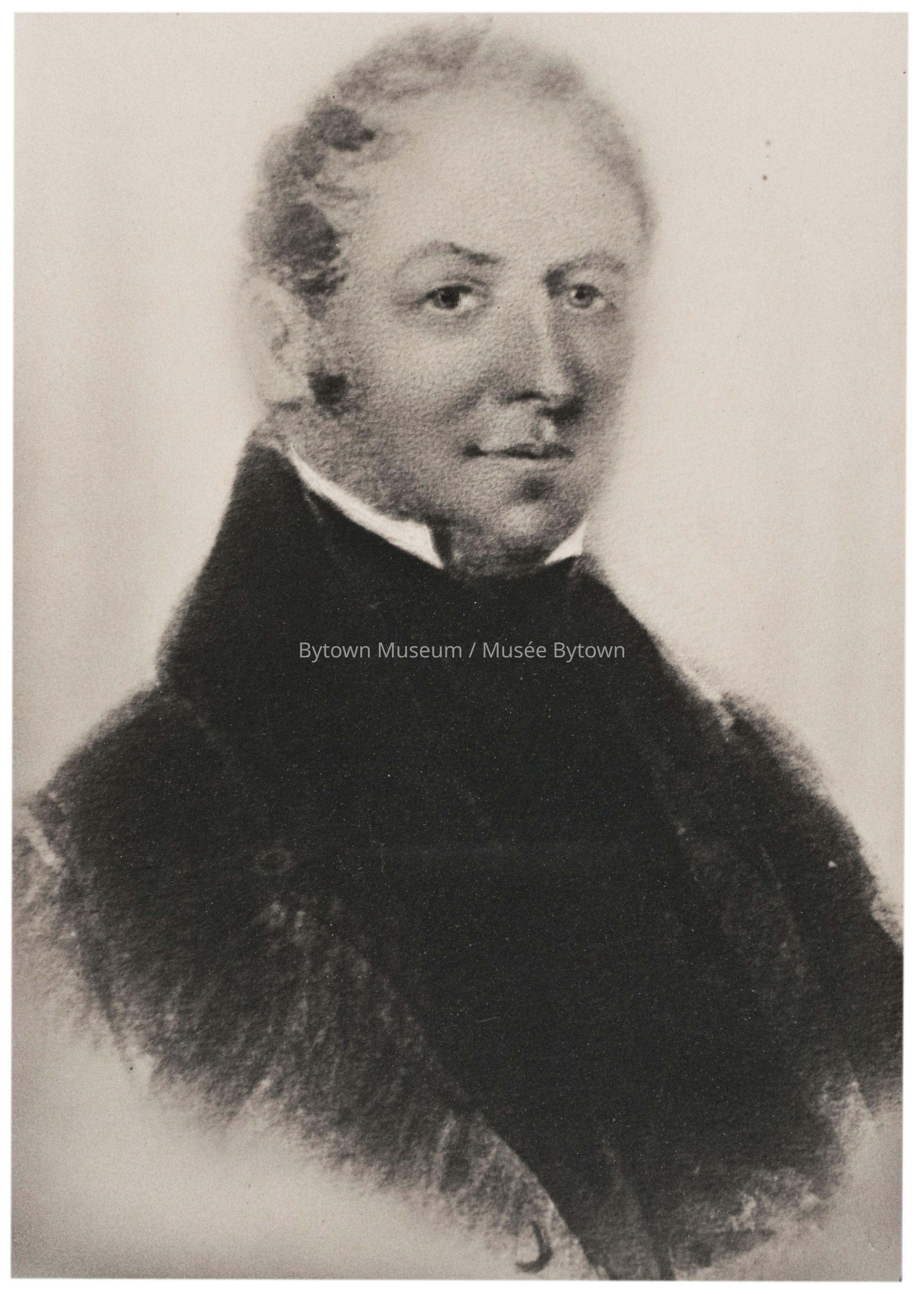
John Burrows Honey was born near Plymouth, Devonshire, on 1 May 1789. The son of Christopher Honey and Elizabeth Burrows, he married Ann Boden on 7 June 1809, and became a civil engineer. He, his wife and his brother Henry came to Canada in 1817, arriving in Quebec City in September and registering their names in Perth, Upper Canada, in December of the same year [Douglas 1954, Laberge 1987]. In January 1818, John arrived in Nepean township, bought some property, and built a log cabin on it in 1819. Two
years later, he sold the land and the cabin to Nicholas Sparks. He also began to sign his name simply as John Burrows. Beginning in 1826, he worked for Colonel By on the canal works, preparing sketches, plans and surveys for the Ordnance department [Elliott 1991, Mika 1982]. His wife, Ann Boden, died on 14 August 1831, and in 1833 he took a second wife, marrying Maria E. Hoskins, a widow whose maiden name had been Blake [Douglas 1954]. Burrows built the first place of worship in Bytown. Located on Chapel
street near its intersection with Rideau street, this small Methodist chapel held regular services beginning in 1827. In 1832, shortly before returning to England, Colonel By named Burrows as his agent in Canada. In 1841, John Burrows was serving as clerk of works [Legget 1972]. He died on 27 July 1848, and was buried in Wrightstown, but his remains were transferred to Ottawa's Beechwood Cemetery in 1882 [Gard 1904, Laberge 1987].