Notes
The PPCLI was the last privately raised regiment in Canada. It was founded by Andrew Hamilton Gault, a prominent Montreal businessman and a Captain in the Milita, who saw the need for a Canadian army unit that would be able to respond quickly to the crisis in Europe. He used his own fortune (a contribution of $100,000 for initial recruitment, financing, and equipment) as well as his relationship with the Governor General's staff to convince the Government to authorized the formation of the regiment. His
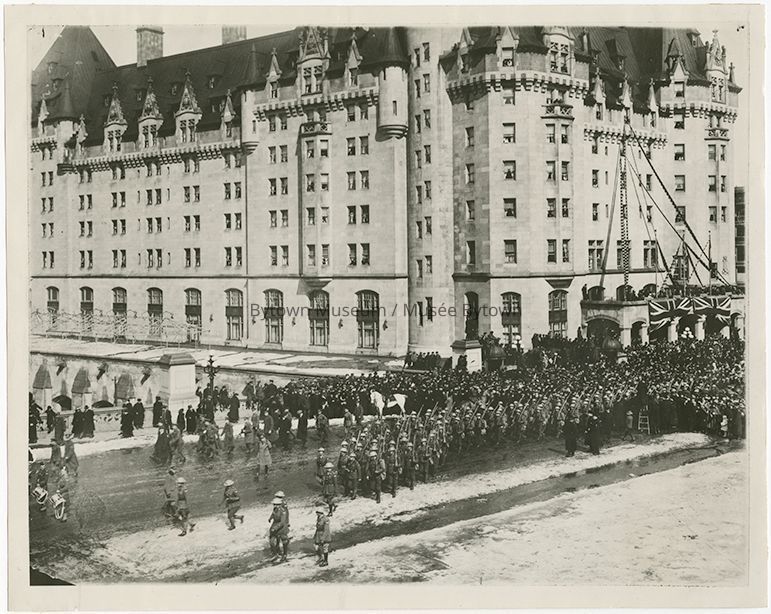
proposal was successful and the PPCLI was officially founded on August 10, 1914. To speed up the recruitment process, volunteers were required to have previously served in the military with the British Empire. Merely eight days after the call for volunteers, the Battalion was up to full strength, with all but 49 out of 1,098 officers and men who had limited to no military background. They paraded for the first time at Lansdowne Park on August 23rd and sailed for England shortly thereafter, the first
Canadian unit to serve overseas in WWI. They were in France with a British brigade by December of that year.
In May 1915, the PPCLI participated in the Battle of Frezenburg, part of the greater German offensive of April 1915. The soldiers had no masks to protect them from German chlorine gas attacks and only 154 officers and soldiers came away from the battle unscathed. The remainder of 1915 was spent rebuilding the Regiment from recovered soldiers or replacements from Canada. By the end of that year, the Battalion was attached to the Canadian Corps. It fought in all major Canadian campaigns including Ypres,
Sorrel, Somme, Vimy Ridge, and Passchendaele, accumulating 22 Battle Honours and three Victoria Crosses. Today, it is one of Canada's most prestigious regiments.