Notes
Reference: [object Object]
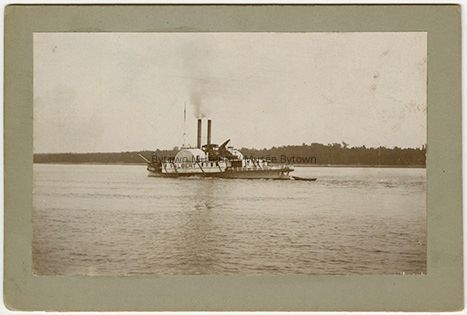
Steamboats, also known as steamers, were used by forwarders to ship goods and commodities up and down the Rideau canal, the Ottawa river and the St. Lawrence. In addition to freight, steamers also carried passengers. Two of the steamboat captains who did business on the canal were Robert Drummond and Thomas J. Jones. Drummond built the steamer Pumper, and owned the Rideau and the Margaret. A small boat called the Endeavour was put in service on the Grenville-Bytown route, but the venture was not a success
[Hill 1922a]. On 4 November 1848, the Phoenix was built and launched in Wrightstown, and under Captain Andrew Patterson it replaced the Speed as the royal mail steamer, making daily daylight trips, except on Sundays, between Bytown and Grenville [Lamirande 1982]. In 1850, the Prince Albert was described as the best steamboat on the Rideau. Owned by Hooker and Henderson of Kingston, it was sold at auction in Bytown during that same year [Bush 1981]. Before construction of the Rideau canal had even started,
the history of steamboats on the Ottawa river was already underway. In the summer of 1823, the Union of the Ottawa was put into service between the head of the Long Sault and Wright's settlement at the Chaudire Falls [Bond 1966]. It was the first steamer on the Ottawa, and early in November 1822, Captain William Grant had arrived in Hawkesbury from Montreal with four men to start building the Union. Grant was employed as Captain of the Union, which was taken over by Captain Johnson in 1828 [Lamirande 1982]. The owners of the Union were William Shepherd and Charles Campbell of Quebec City, Philemon Wright and Sons of Wrightstown, and Thomas Mears and William Grant of Hawkesbury. The engineer was John Cochrane [Girouard 1892]. The Union's run from Grenville to Wrightstown took about 34 hours. This service aided the settlement and commerce of the entire region [Greening 1961].