Notes
Citizens of Bytown first called for a library in 1837. The Bytown Mechanics Institute created one of the first libraries in town, but only for its members. By 1856 they had a library of about 1000, mostly academic books. There was also the Library of Parliament that opened in 1876, but this was limited to Ottawa’s elite and not the working-class people.
Eventually, in 1882 the Ontario Government passed the Free Libraries Act which allowed municipalities to establish public libraries. But Ottawa was still years behind opening one.
The Ottawa Council of Women began to advocate for the establishment a free library in Ottawa during the early 1890s. They quickly submitted a petition to the city, which had 280 signatures (plenty more than was needed). The Council even launched an advertising campaign that included a “Women’s Edition” of “The Evening Journal” newspaper where everything was written and edited by women and all profits went to a fund for the library.
The City drafted a by-law to establish a free library that was voted on. Those who could vote included men, single women, and widows over the age of 21 who owned property more than $400. Unfortunately, the vote was held in January 1896 but was not successful with 1958 votes for, and 3429 against. The main factor that dissuade voters was the cost, at $10,000 per year.
Otto J.L. Klotz was a past president of the Ottawa Literary and Scientific Society and husband to Marie Klotz, who was a member of the Ottawa Council of Women and was a leading figure if their fight for Ottawa to establish a public library. In 1901, Otto Klotz wrote to Andrew Carnegie a "prominent Scottish-born American philanthropist" asking for funds to help build a free, public library in Ottawa. The Mayor of Ottawa at the time, W.D. Morris, followed suit and petitioned Carnegie for funds, who had funded hundreds of libraries throughout the United States, Canada, and Britain. After weeks of receiving letters, Carnegie pledged $100,000 to pay for an Ottawa public library so long as the city found a site for it and agreed to not spend less than $7500 a year in upkeep for it.
The City of Ottawa took their time upon receiving these funds to purchase a site for the new building at the corner of Laurier Avenue and Metcalfe Street and select the architect for the project, E.L. Horwood. In 1905, city council approved a $15,000 budget to purchase books, where $3500 was spent on French books.
The first Librarian was Lawrence Burpee who quickly hired an assistant librarian, cataloguer, three circulation desk staff, and a building caretaker.
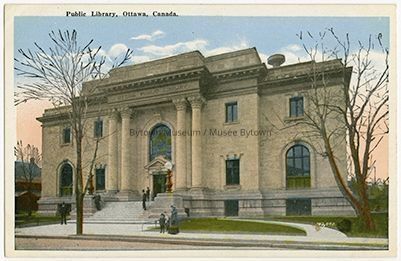
The new Ottawa Public Library opened on Monday, April 30, 1906. The building, pictured here, was classical in style, four stories tall, and had four Corinthian columns on the outside. Above the entrance was a large stained-glass window that featured famous authors such as William Shakespear, Charles Dickens, and Archibald Lampman.
Inside, the building had Italian marble walls and red oak wood flooring, with a portrait of Carnegie in the entrance hall. The basement of the building included classrooms, a newspaper room, a furnace room, and the caretaker’s quarters. The ground floor had reading rooms, librarian offices, a stack room, and circulation desks. There was also a grand marble and bronze staircase that led upstairs to boardrooms, a reference department, a lecture room, staff offices, and a cloakroom.
Although it was the Ottawa Public Library, it was called the Carnegie Library until the 1950s as a legacy to its major donor.
By 1907, the library gave out almost 20,000 library cards and circulated 129,000 books a year. And in 1916, the need for branches in other areas of the city grew and through another donation from Carnegie a new branch on Rosemount Avenue opened in 1919.
However, by the 1960s the building was getting old and had serious cracks in its walls and ceilings. It was eventually demolished in 1971, and today’s main branch of the Ottawa Public Library stands where it stood. The original stained-glass window and Corinthian columns were saved and repurposed in the current main branch building and the Rockcliffe Rockeries.