Notes
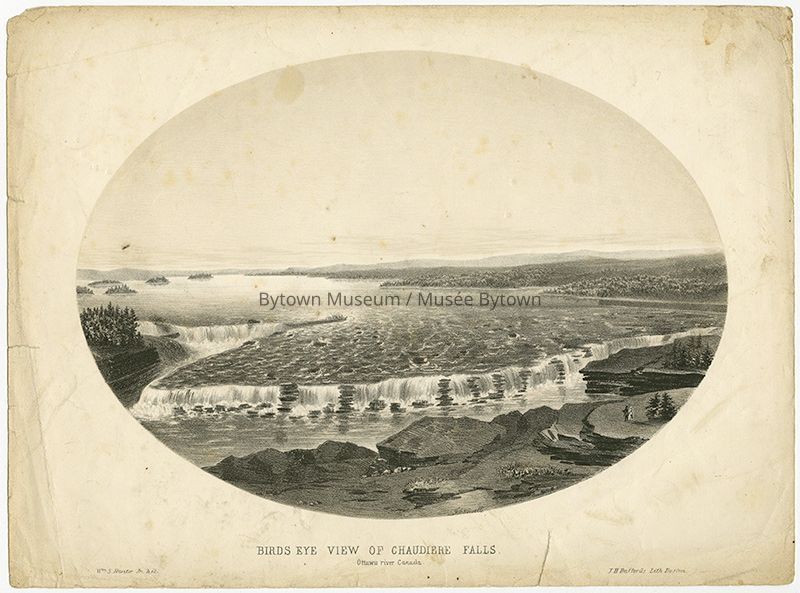
In 1855, William Stewart Hunter Jr. (1823-1894) wrote and illustrated Hunter's Ottawa Scenery, in the Vicinity of Ottawa City, Canada, an ambitious book comprised of fifteen scenic views, a preface, a map of eastern North America, and four informative chapters about Ottawa.
Hunter had his drawings replicated at one of America's leading lithography shops, J. H. Bufford & Co. of Boston. Two artist / lithographers redrew Hunter's subject on the stone -Bufford's young apprentice, Winslow Homer (1836-1910), who became one of America's greatest painters and printmakers, and John Perry Newell (active 1855-1878), a young freelance artist. Homer's first known works are included in Ottawa Scenery, specifically Rideau Falls, Falling into the Ottawa River, Ottawa City, Canada, which makes this publication very significant for American art.
Ottawa Scenery was published on the occasion of the newly renamed city of Ottawa, a lumber town of 10,000, formerly known as Bytown. In 1855, Ottawa was also among the cities proposed as the future capital of Upper and Lower Canada (present day southern Ontario and Quebec). In 1856, the Legislative Assembly ordered a second edition of 140 copies, one for each member, presumably to enlighten them about Ottawa's suitability as its capital.