Notes
In 1827, two companies of Royal Sappers and Miners arrived from England to build the Rideau canal. The 15th company arrived on 1 June 1827, and the 7th company on 17 September of the same year. The 15th remained in Bytown, and was discharged in 1831 [Billings 1909, Haig, 1975, Lett 1993]. The Royal Sappers and Miners were military artificers or skilled labourers, who worked under the direction of the Royal Engineers [Elliott 2008]. A number of Sappers and Miners were appointed to work on the first eight
locks in Bytown. Among them were lockmaster William Addison, mason George Sims, miner Robert Clements, wheeler John Porteous, miner Michael Rowe, carpenter John Smith, carpenter Thomas Hunter and miner Daniel Boyle [Hirsch 1982].Notes
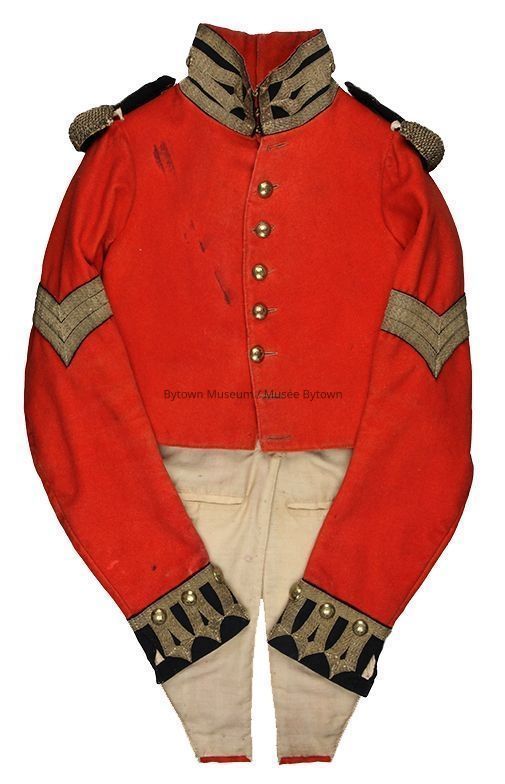
Joseph Coombs was born in Rossminoge, Wexford, Ireland in 1789 and enlisted with the Corps of Royal Sappers and Miners in 1812 at the age of 23. Corporal Joseph Coombs arrived in Bytown with the 15th Company in June of 1827. He was promoted to Sergeant in December of 1830.
A wheeler by trade, Coombs became a prominent community builder in Bytown. Described by his commanding officer as, "both intelligent and active," Coombs built one of the first frame houses in Bytown, constructed of trees felled on his lot on Rideau Street; it was still standing in the early 20th century. He was also the growing town's first lay Methodist preacher. Together with his wife Anne, they raised fourteen children, most of whom were born in England after he took his discharge in December of 1831. Coombs and his family returned to Bytown in 1832 where he became a druggist, a gaoler, and was later instrumental in organizing Bytown's first fire company. He was described as: solemn, a keen businessman, and a "disciple of the meek and lowly."
Joseph Coombs died on May 17, 1856 and was buried in the old Sandy Hill Cemetery until his remains were relocated to Beechwood Cemetery in 1877.