Label
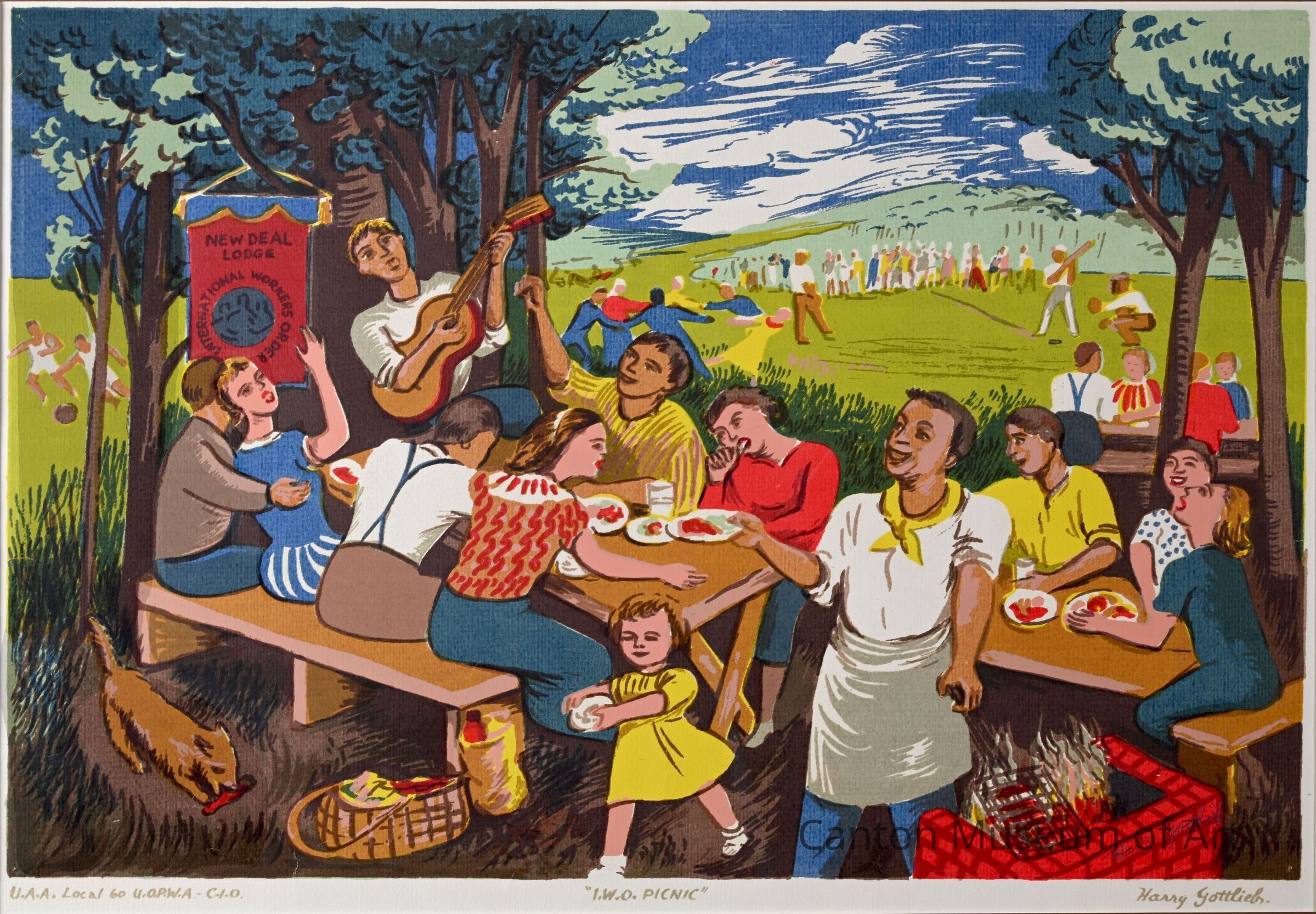
Gottlieb was one of America's first Social Realist artists. Politically committed, he was influenced by the ideas of Karl Marx and joined the Communist Party in the 1930s, remaining a lifelong member. While working for the WPA's Federal Art Project, he participated in an experimental initiative to establish silkscreen printing within fine art practice, unheard of at the time. As a result, he emerged as a key figure in the development of silkscreen as a fine art.
Gottlieb sought painterly effects in silkscreen, using many screens, colors, and complex printings in order to imitate watercolors and oils. He believed that fine art should be widely available to the public, stating: “The American people cannot afford oil paintings, or even watercolors, yet they want pictures in their homes. The sharecropper tacks up pictures from the Sunday paper; screen prints can provide an art that people can afford to buy."
The I.W.O. (International Workers Order), founded in 1930, was an immigrant fraternal organization that provided affordable health and life insurance, medical and dental clinics, cultural and social programs, and sponsored schools. At its peak after World War II, it served nearly 200,000 members through clinics, publications, and community activities. Led by Rockwell Kent from 1944 to 1953, the organization was ultimately disbanded during the Cold War Red Scare due to its political affiliations. I.W.O. also held dances, picnics, basketball and softball tournaments, concerts, and picnics, like the one seen here. The term "U.A.A. local 60 uopwa cio" at the bottom left of this print refers to the United American Artists (U.A.A.), Local 60, which was affiliated with the United Office and Professional Workers of America (UOPWA), a union part of the Congress of Industrial Organizations (CIO).