Label
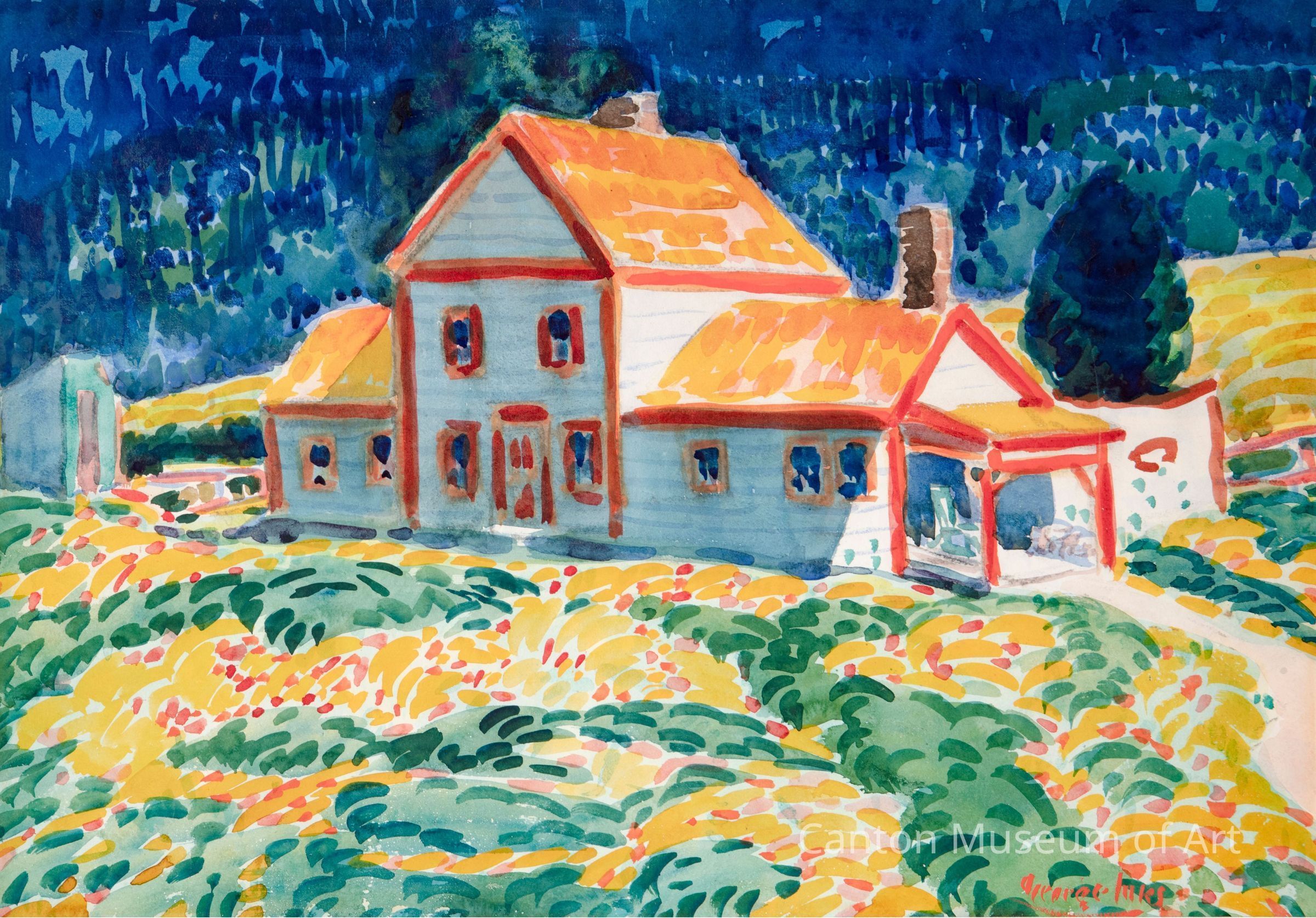
"My House, Berk(shire) Hills" is a depiction by George Luks of his residence. Luks was a very successful painter, enabling him to create a private haven where he could relax and pursue his passion for watercolor. In 1925 he purchased a farm house near Old Chatham, New York in the Berkshire Hills. He had moved to the countryside many times before in order to recover from his alcoholism, which he battled throughout his life, and which he was committed to a sanatorium for. He found comfort and freedom in the countryside in which the city could not provide. He had a great passion for this farm which was beautifully picturesque in its isolated setting against the blue tinted mountains.
While in Berkshire Hills, Luks came to know and paint the residents while he searched for antiques with which to furnish his home and subjects with which to inspire his brush. The watercolors of this period are among the best he ever produced. His mastery of color is fully evoked, employing brilliant, bold colors. Luks was adventurous with his use of color, with the farm house alternating in orange. red, and white, set amongst the rich green and yellow of the grass. In his work, he strove for originality and opposed traditional painting.
"My House, Berkshire Hills," expressively rendered in orange and yellow amid a field of green and blue mountains leaves little doubt Luks relished being there and loved the freedom and opportunity it presented. His cheerful outlook on this property and the positive effects it had on his health is confi�rmed in several letters written during summers he spent there. He used this property as a haven from his inner turmoil, and his work captures that spirit through his use of color.
Luks had a very unique way of mixing paint and using color. A few critics remarked upon his use of color in 1916, noting:
"He buys pigment and mixes his own colors and burns his cobalt to see if it is a true blue cobalt, and turns his back on the ready made paint tubes with a scorn worthy of the ancients. He seeks and �finds his own ways of putting paint on canvas, too. He puts colors that ‘bleed’ on the blank surface, and when they are dry he puts colors over them, and in two or three or ten years the undercolors will have bled a little through the overcolors, and you get something very beautiful and wholly different from anything that can be made from mixing two wet colors."