Label
Gene Kloss is one of the major American printmakers of the twentieth century, celebrated for her depictions of the New Mexico landscape and of Pueblo life and religious traditions, including those of the Penitente Brotherhood. Kloss spent extended time in Taos, New Mexico beginning in the mid-1920s, eventually making it her permanent home. She worked closely from observation, drawing inspiration from the land and the cultural life of its communities.
Kloss was best known for her skill in etching and aquatint. She developed a distinctive approach in which acid was applied directly to the plate in a manner she described as “painting” the image, allowing her to achieve subtle tonal gradations, luminous atmospheric effects, and strong contrasts of light and shadow. The aquatint process in particular enabled her to render night scenes, deep shadows, and glowing highlights with a quality often compared to watercolor.
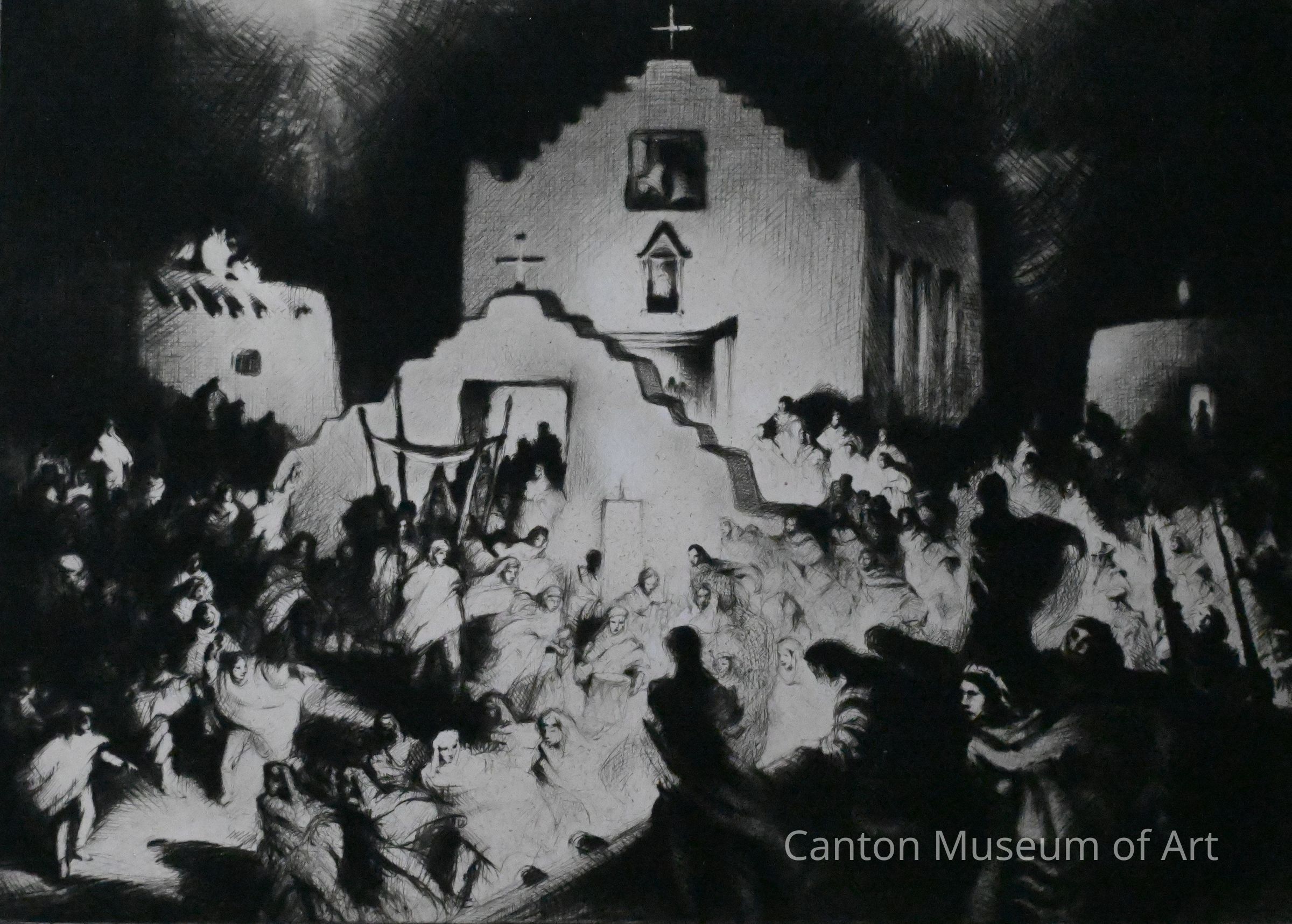
Processional – Taos depicts one of the most important rituals of New Mexico, a religious procession on Christmas Eve in front of San Geronimo Church. Located at Taos Pueblo, the procession blends Catholicism with Indigenous cultural practice. Kloss often spoke about the central role of Catholic faith in the Pueblo communities she depicted, noting that churches served as the heart of village life and were built and maintained by local residents. In interviews, Kloss described witnessing processions and religious observances at a respectful distance, depicting only what she was permitted to by the Taos people, who she became close with.
The Taos processional begins at sunset, after mass, when a group of men shoot rifles with blanks, signaling the birth of Christ. Following them is a covered palanquin in which a statue of the Virgin Mary stands dressed in white, pictured here in Kloss’s work in front of the doorway. The palanquin of the Virgin Mary is carried from San Geronimo Church into the plaza accompanied by the glow of large bonfires, dancing, and the sound of chanting and singing in English and Tiwa. The bonfires — specifically the towering pitchwood (ocote) pyres — typically stand around 15 feet high. These large, stacked firewood towers create a glowing ring around the plaza for the annual procession. As darkness deepens, the procession culminates in the return of Mary to the church. Kloss captured this moment of Mary emerging from the church, the crowd parting before her in urgent motion for her procession in the plaza. The figures are shown in long, robe-like garments that obscure individual identity and emphasize collective rhythm and movement. Kloss expertly depicted the glowing light of the pyres and the anticipation of the crowd amongst the night sky as only she could. Rendered in her characteristic tonal range of deep blacks, grays, and luminous light, Processional emphasizes atmosphere, ritual, and shared experience.