Label
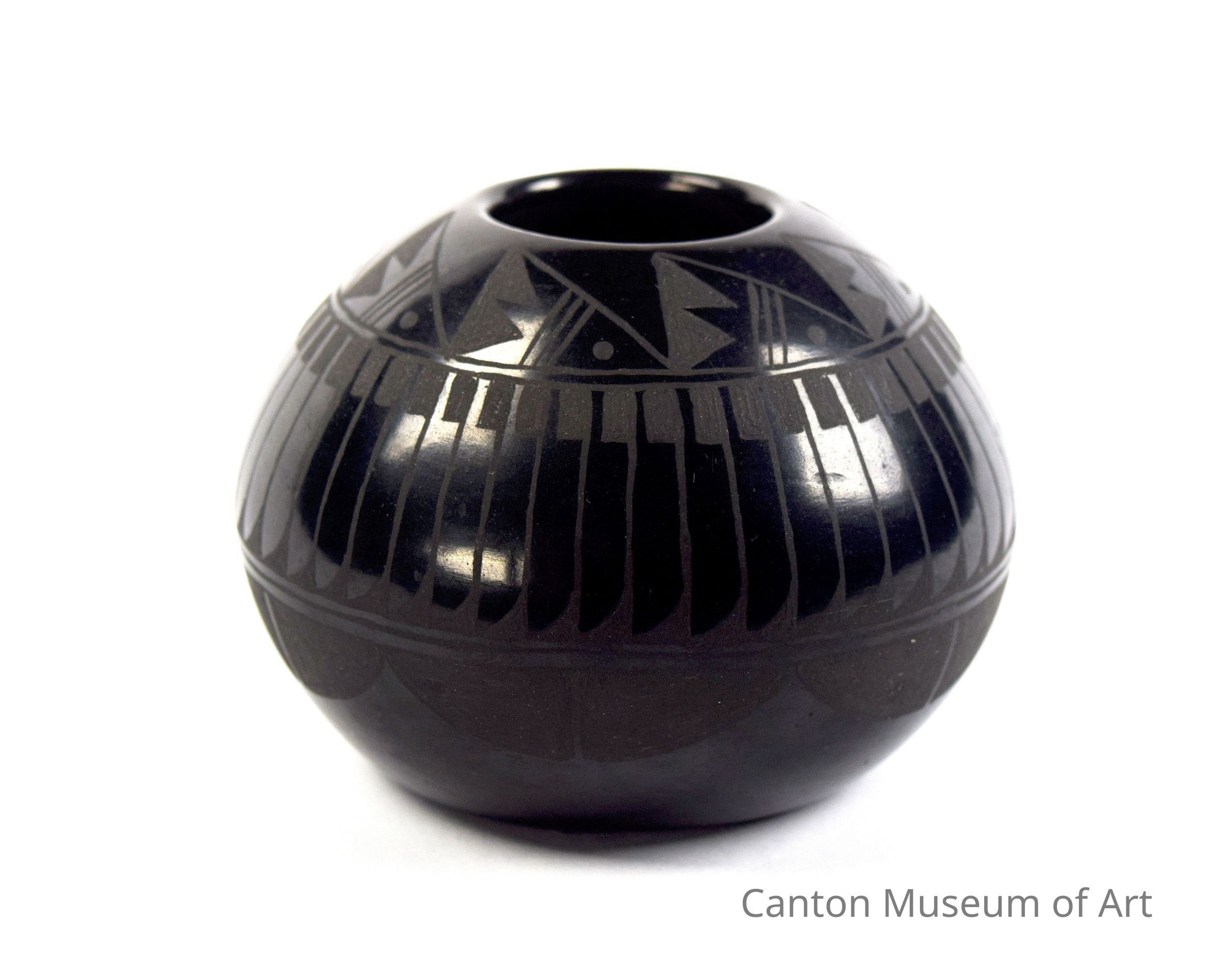
Naranjo’s “Seed Pot” has symbols of eagle feathers, points of star, fire birds, and rain clouds. Historically, seed pots were designed to protect the seeds for next year’s planting from rodents and insects. A wide-mouthed vessel like a traditional bowl, jar, or olla could not keep vermin out. To combat this, seed pots were created with a small opening that would allow one seed to be dropped in at a time. When the time for spring planting came, the seed pots would be smashed so all the seeds collected during the winter months could be used. Today's seed pots are purely decorative, as seen with this particular piece by Naranjo.
This particular seed pot was painted with a black-on-black decoration – a matte-black paint was applied to a highly polished background in order to produce negative images. This requires a lot of skill and precision with fine details.
Santa Clara Pottery is famous for producing hand-crafted pottery, specifically blackware and redware with deep engravings. Potters in Santa Clara are known for their creativity, excellence of design, high quality, and large quantity of production, and are credited with the development of black pottery. There were several ritualistic aspects of ceramics that were rooted in Santa Clara pottery. Clay was frequently referred to as "mother clay", and was believed to have a soul or deity. This allowed the pottery made from it to be more special, and more symbolic to the culture and heritage of the people. Like many other versions of New Mexican pottery, the pots are assembled, slipped, fired and polished to create something unique. They go through an extensive soaking, screening, mixing and shaping process, which displays the detail and precision these potters go through to reach their end goal. At Santa Clara, there were four methods of decorating pottery: painting, impressing, carving, and a resist-firing technique with incised designs.